
TA Repeats Expose a Structural Weakness in Cancer’s Extrachromosomal DNA
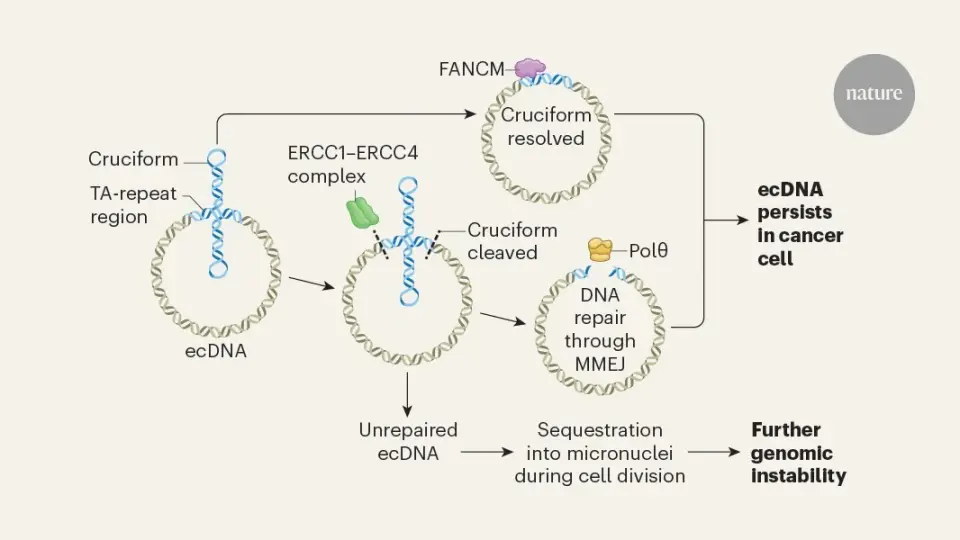
Researchers at Memorial Sloan Kettering Cancer Center (MSK) have identified a built-in structural vulnerability in extrachromosomal DNA (ecDNA), a circular genetic material found in roughly one in six human cancers. The study, published in Nature, reveals that repetitive TA sequences in ecDNA are prone to breaking, forcing cancer cells to rely on specific repair proteins to maintain stability. Disrupting these repair mechanisms destabilizes the DNA circles, offering a potential new therapeutic avenue to combat treatment-resistant tumors.
Key points
- ecDNA, which exists outside standard chromosomes, is present in approximately 16% of human cancers and is linked to rapid tumor growth and treatment resistance.
- TA repeats within ecDNA fold into fragile cross-shaped structures, creating weak points that are susceptible to breaks.
- Cancer cells depend on two proteins, FANCM and polymerase theta (Polθ), to prevent and repair these breaks, respectively.
- Blocking Polθ with experimental inhibitors causes ecDNA to destabilize and be lost by cancer cells, while cells without ecDNA remain unaffected.
- Combining Polθ inhibition with FANCM depletion amplifies this instability, suggesting a potential dual-target therapy strategy.
- The findings were validated across prostate, gastric, and colorectal cancer cell lines, as well as in human tumor sequencing data.
Background
This discovery builds on prior understanding of genomic instability in cancer, where genetic alterations drive tumor evolution. Recent archive coverage has highlighted the complexity of cancer treatment, such as the repurposing of the pancreatic cancer drug daraxonrasib for lung cancer, illustrating the search for new molecular targets. While alcohol-linked cancers have seen a rise in mortality, the focus on ecDNA offers a distinct, structural approach to addressing tumor resilience that is independent of lifestyle factors.
How outlets are covering it
Nature and UA.NEWS emphasize the dual nature of ecDNA: its repetitive sequences create a vulnerability that could be exploited for therapy, but the same breaks might also promote tumor evolution. SciTechDaily and The Debrief focus on the therapeutic potential, highlighting the specific proteins (FANCM and Polθ) and the success of Polθ inhibitors in clinical development. All sources agree on the core finding that ecDNA has a built-in fragility, but SciTechDaily and The Debrief provide more detail on the mechanism of the cross-shaped structures and the specific cancer types tested, whereas Nature and UA.NEWS frame the discovery within the broader context of genomic instability and cancer adaptation.
Why it matters
Identifying a structural weakness in ecDNA provides a new target for cancer therapies, particularly for tumors that are resistant to current treatments. Since ecDNA is associated with aggressive cancer growth and poor survival, destabilizing these DNA circles could lead to more effective treatments that prevent tumors from adapting and evolving. The availability of Polθ inhibitors in clinical trials accelerates the potential translation of this research into practice.
What to watch
Researchers will likely explore combination therapies that target both FANCM and Polθ to maximize ecDNA instability. Clinical trials for Polθ inhibitors may be expanded to test their efficacy in cancers that rely on ecDNA. Further studies will be needed to understand the long-term effects of destabilizing ecDNA and to determine if this approach can be applied across a wider range of cancer types.
- Circular DNA exposes a weakness in cancer cells Nature
- Repetitive sequences make tumor ecDNA vulnerable to breaks — Nature UA.NEWS
- Cancer’s Rogue DNA Has an Achilles’ Heel – and Scientists Just Found It SciTechDaily
- This Unusual "Rogue DNA" Allows Some Cancers to Thrive—and Scientists Just Found Its Achilles’ Heel The Debrief
Want the full story? Read the original reporting
Read on Nature