
Ancient Giant Eagles: Apex Predators That May Have Shaped Human Evolution
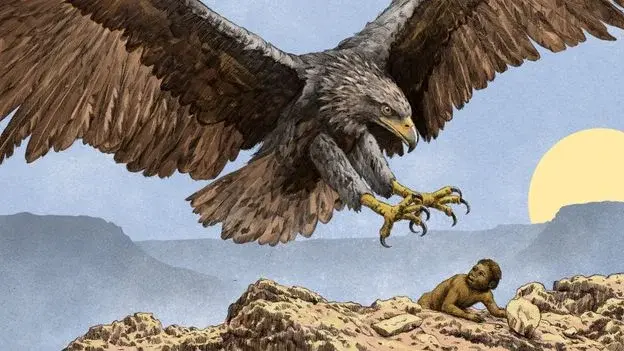
For nearly 50 million years following the dinosaur extinction, giant birds of prey dominated the skies and hunted early humans. Evidence suggests these massive raptors, including teratorns and Haast’s eagle, were significant predators of our ancestors, potentially driving the evolution of bipedalism, social cooperation, and language as humans developed strategies to evade aerial ambushes.
Key points
- The Taung child, an Australopithecus africanus infant from 2.8 million years ago, shows talon marks consistent with eagle predation, suggesting early humans were prey for giant birds.
- After the Cretaceous-Paleogene extinction event, small birds evolved into massive apex predators, filling the ecological void left by non-avian dinosaurs.
- Notable species include the South Carolina Pelagornis sandersi (7m wingspan), teratorns in the Americas (up to 6m wingspan), and New Zealand’s Haast’s eagle.
- Research by primatologist Scott McGraw indicates that raptor predation was a major selective force, influencing primate behavior and anatomy.
- The need to evade stealthy aerial predators may have driven the evolution of larger social groups, bipedalism for better visibility, and complex language for coordination beyond line of sight.
Background
This story expands on the broader narrative of megafauna extinction during the Pleistocene epoch. While previous coverage has focused on the formation of the Moon via giant impact or modern sports injuries, this article highlights how the extinction of dinosaurs created an ecological vacuum that allowed birds to evolve into massive predators, directly interacting with early hominins for millions of years before the Great Ice Age.
Why it matters
Understanding the role of giant birds in human evolution offers a new perspective on why humans developed specific social and cognitive traits. It challenges the view that only large terrestrial mammals shaped our ancestors, highlighting the overlooked threat of aerial predators that may have accelerated the development of language and group cooperation.
What to watch
Researchers like Scott McGraw suggest that re-examining existing fossil assemblages with this new understanding could reveal more evidence of raptor predation on early humans. Continued study of modern primate predation patterns in places like Ivory Coast may provide further insights into the evolutionary pressures faced by our ancestors.
Want the full story? Read the original reporting
Read on BBC