
SpaceX Completes Final Static Fire Tests for Historic Starship Flight 15
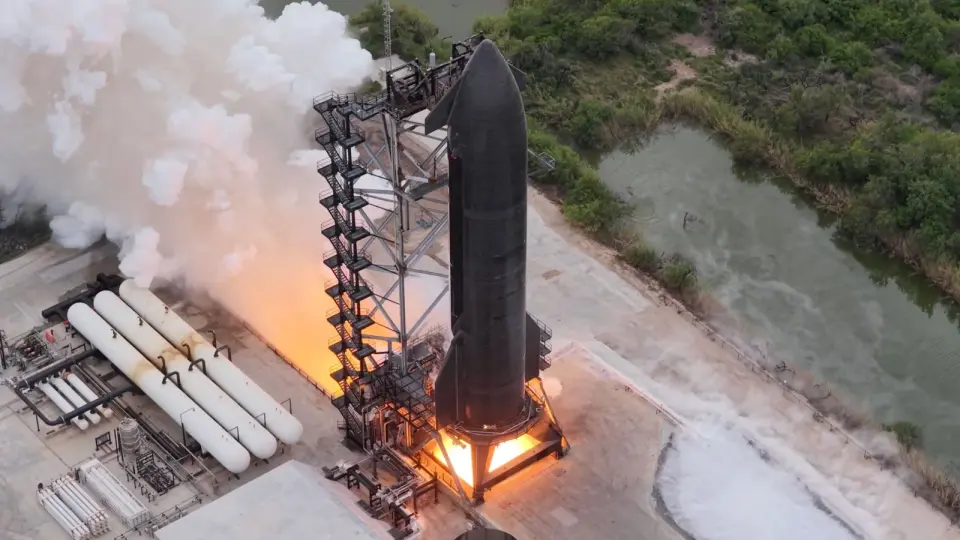
SpaceX has completed static fire tests for both stages of its Starship rocket, clearing the way for Flight 15, which is targeted for November. The upcoming test aims to achieve the first-ever simultaneous recovery of both the upper stage and the booster using the launch tower's mechanical arms.
Key points
- SpaceX conducted static fire tests for the upper stage, designated Ship 42, on October 26 and 27, igniting all six Raptor engines and simulating a deorbit burn.
- The Super Heavy booster, Booster 22, successfully completed a 33-engine static fire test prior to the upper stage checks.
- Flight 15 is scheduled for November and will attempt to catch both the upper stage and the booster with the 'chopstick' arms at Starbase in Texas.
- This mission follows Flight 14, which achieved the first orbital insertion for Starship on September 28 and deployed 26 Starlink V3 satellites.
- Elon Musk has described the potential double recovery as a 'profound technological milestone' and stated success is 'more likely than not.'
Background
Starship reached orbit for the first time during Flight 14 on September 28, 2026, deploying 26 Starlink V3 satellites. Although the mission ended early due to an engine anomaly and a Pacific splashdown, it confirmed the vehicle's orbital capability. This success accelerated SpaceX's plans to retire older rockets like Falcon 9, raising concerns about a launch capacity crisis for commercial operators. The current preparations for Flight 15 represent the next step in developing a fully reusable launch system for NASA's Artemis program and future Mars missions.
How outlets are covering it
Space.com and The News International emphasize the historic nature of the upcoming double recovery, with Musk calling it a 'profound technological milestone' and referencing a 'prophecy foretold.' Interesting Engineering focuses on the technical mechanics, explaining that a single Raptor engine is sufficient to deorbit the ship by reducing its speed by less than one percent, allowing atmospheric drag to complete the braking. The Corpus Christi Caller-Times provides a broader regional and regulatory context, noting that while Musk targets November, no official launch date or FAA planning advisory has been issued as of October 28. All sources agree that catching the upper stage is significantly more difficult than catching the booster, which has been recovered three times previously.
Why it matters
A successful double recovery would mark the first time an orbital launch vehicle is fully recovered without landing legs or ocean splashdown. This capability is essential for achieving the high launch cadences required for SpaceX's Starlink V3 and Starmind constellations, as well as for reducing costs for NASA's Artemis lunar missions. It represents a critical step toward SpaceX's goal of fully reusable, frequent spaceflight.
What to watch
SpaceX is expected to launch Flight 15 in November, pending regulatory approval for the tower catch. The company aims to increase its launch frequency to twice a week by 2027. Future missions will likely focus on deploying Starlink V3 satellites and testing the Human Landing System for NASA's Artemis program.
- SpaceX fires up Starship upper stage ahead of landmark Flight 15 test launch (video) Space
- Watch: Ship 42 Fires All Six Engines Ahead of Starship Flight 15 Yahoo
- Elon Musk: Starship 42 Will Be the First Tower Catch BASENOR - Tesla Accessories
- SpaceX conducts Starship prelaunch test in Texas. When is flight 15? Corpus Christi Caller-Times
- SpaceX to attempt historic double rocket catch on Starship Flight 15: ‘Prophecy foretold’ The News International
Want the full story? Read the original reporting
Read on Space