
Nanotyrannus 'Jodi' fetches $47.3M, igniting debate over fossil access
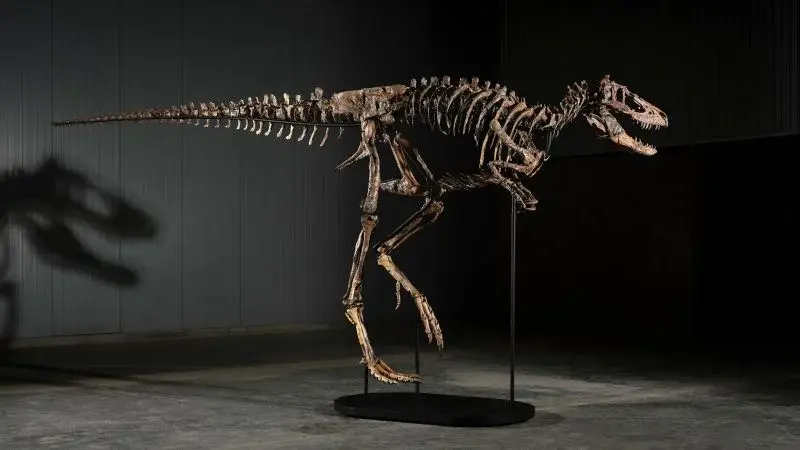
A rare Nanotyrannus skeleton named 'Jodi' sold for $47.3 million at Sotheby's, far exceeding estimates and becoming the second-most expensive dinosaur fossil ever sold. The sale has sparked criticism from scientists who argue such specimens should remain in public museums for research and education.
Key points
- The skeleton, discovered in 2019 by Montana rancher Jodi Pierson, sold for $47.3 million after a 12-minute bidding war among six contenders.
- The sale price far exceeded the pre-auction estimate of $6 to $9 million, making 'Jodi' the second-most expensive dinosaur fossil ever sold, behind 'Gus' (a T. rex skeleton sold for $50.1 million in July 2026).
- 'Jodi' is one of only three relatively complete Nanotyrannus skeletons known to science, with the other two being 'Jane' (at the Burpee Museum in Illinois) and a specimen at the North Carolina Museum of Natural Sciences.
- The specimen is approximately 19.6 feet long and 9.6 feet tall, comprising 191 bone elements, including a 'virtually complete' skull. Missing bones were replaced with 3D-printed and sculpted elements.
- The sale has drawn criticism from paleontologists who argue that high-value private sales remove scientifically significant fossils from public access and research, potentially hindering scientific understanding.
Background
Nanotyrannus, a smaller relative of T. rex, was recently confirmed as a distinct genus rather than a juvenile T. rex, following a 2025 study. The Hell Creek Formation in Montana, Wyoming, and the Dakotas is a significant geological site for dinosaur fossils, including the first T. rex skeleton discovered in 1902. The sale of 'Jodi' follows a trend of high-value fossil auctions, such as the $50.1 million sale of 'Gus' in July 2026, which has intensified debates over the accessibility of rare fossils for scientific research and public education.
How outlets are covering it
CNN and AP News emphasize the record-breaking nature of the sale and the scientific significance of the specimen, noting that 'Jodi' is one of only three known Nanotyrannus skeletons. The Guardian highlights the criticism from scientists, such as Thomas R. Holtz Jr. and Linda Ivany, who argue that such fossils should remain in public museums for research and education. KTVQ provides a more neutral overview, focusing on the discovery and sale without delving into the debate. All sources agree on the sale price and the rarity of the specimen, but they differ in their emphasis on the controversy surrounding private fossil sales.
Why it matters
The sale of 'Jodi' for $47.3 million underscores the growing market for rare dinosaur fossils and the ongoing debate over the accessibility of scientifically significant specimens. The high price tag, far exceeding estimates, suggests a potential bubble in the fossil market, as noted by paleontologist David Hone. The sale also raises questions about the balance between private ownership and public access to important scientific resources, with some scientists arguing that such fossils should remain in museums for research and education.
What to watch
The identity of the new owner of 'Jodi' remains unknown, and it is unclear whether the specimen will be donated to a museum or remain in private hands. The sale may influence future fossil auctions and the policies governing the sale of significant paleontological finds. Scientists and institutions may continue to advocate for the preservation of rare fossils in public collections to ensure their availability for research and education.
- Rare Nanotyrannus sells at auction for $47.3 million, becoming second most valuable fossil ever CNN
- Second most valuable dinosaur fossil in the world is sold for over $47 million FOX Weather
- Rare Nanotyrannus skeleton sells for $47.3m at New York auction The Guardian
- Rare dinosaur skeleton discovered in Montana sells for $47 million at auction KTVQ
- A dinosaur fossil that looks like a mini T. rex just sold for a giant $47 million AP News
Want the full story? Read the original reporting
Read on CNN