
ESA Mars Express captures steep, eroded profile of ancient volcano Tharsis Tholus
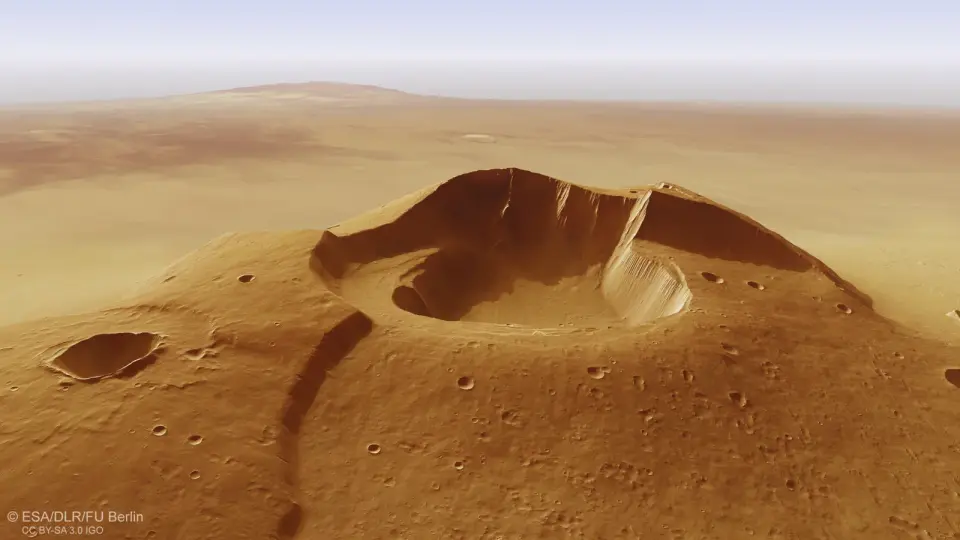
ESA’s Mars Express orbiter has released new high-resolution imagery of Tharsis Tholus, an ancient Martian volcano standing approximately 8 kilometers tall. Although smaller than the planet's giant shield volcanoes, Tharsis Tholus is notably steep, with slopes exceeding those of Earth's Mauna Kea. The images reveal a complex geological history, including multiple caldera collapses, impact craters, and erosion patterns, providing insights into Mars's volcanic past.
Key points
- The European Space Agency's Mars Express spacecraft, orbiting Mars since 2003, captured new images of Tharsis Tholus using its High Resolution Stereo Camera.
- Tharsis Tholus stands about 8 kilometers (4.97 miles) high, comparable to the highest peaks in the Himalayas, but is significantly smaller than Olympus Mons, which reaches 21.3 kilometers.
- The volcano features steep flanks, steeper than Earth's Mauna Kea, and exhibits signs of at least two caldera-forming collapses, with depressions nearly 3 kilometers deep.
- The imagery shows evidence of ancient lava flows, impact craters from asteroids, and geological deformations such as faults and grabens, all of which help reconstruct the planet's history.
- Researchers exaggerated the vertical scale in the 3D images to better visualize the volcano's topography and structural details.
Background
This observation follows recent findings suggesting Mars may still possess subsurface volcanic activity, such as hydrogen chloride gas detected near the Alba Mons volcano in November 2026. While Tharsis Tholus is considered geologically 'dead,' with its last lava flow estimated around 200 million years ago, it serves as a key archive for understanding the planet's more active past, which began approximately 3.8 billion years ago.
How outlets are covering it
Space.com and ESA emphasize the volcano's steepness and the utility of the new 3D imagery for understanding its structure. ESA specifically notes that the vertical scale was exaggerated by a factor of three to highlight topographical details. While Space.com focuses on the visual 'incredibility' of the peak, ESA provides a more technical breakdown of the caldera collapses and geological processes like faulting and landslides. Demokratis.co.id highlights the contrast between Tharsis Tholus and the much larger Olympus Mons, while Around Prague notes the steepness relative to Mauna Kea but does not provide additional unique data points beyond the primary reports.
Why it matters
Detailed imaging of ancient volcanoes like Tharsis Tholus allows scientists to piece together the environmental and geological conditions of early Mars. By analyzing features such as caldera collapses and erosion patterns, researchers can better understand how volcanic activity shaped the planet's surface billions of years ago and how it interacted with the surrounding landscape.
What to watch
ESA and DLR will continue to process data from Mars Express to further analyze the geological history of the Tharsis region. Researchers will use these high-resolution images to study the timing and nature of past eruptions and the subsequent erosion processes that have shaped the volcano's current appearance.
- The remains of a long-dead volcano on Mars photo of the day for Nov. 23, 2026 Space
- In the shadow of volcanic giants ESA
- Tharsis Tholus shield volcano seen by the German HRSC Mars camera Deutsches Zentrum für Luft- und Raumfahrt
- Orbiter Images Show Dead Martian Volcano Steeper Than Mauna Kea Around Prague
- Mars Express Reveals the Eroded Tharsis Tholus Volcano Demokratis.co.id
Want the full story? Read the original reporting
Read on Space