
Astronomers Await the Imminent but Unpredictable Nova Flare of T. Coronae Borealis
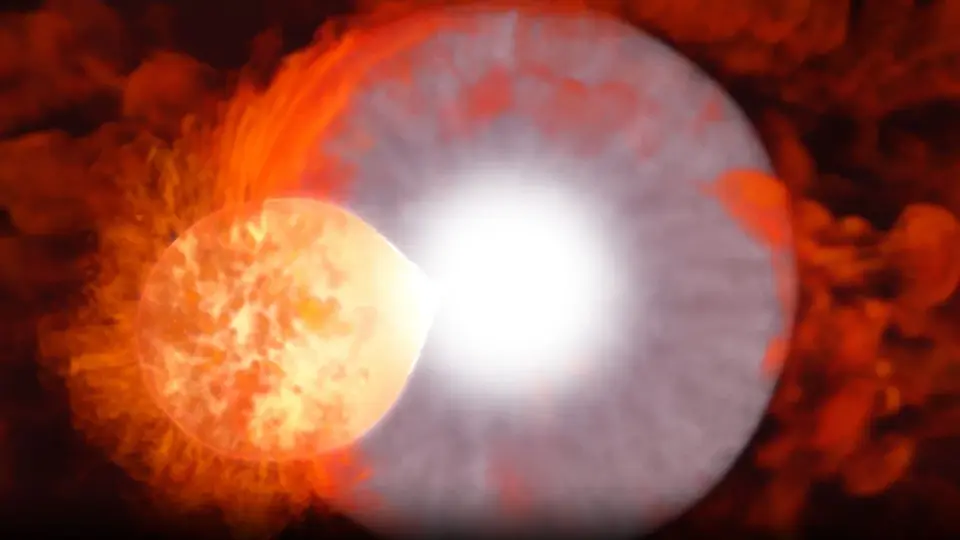
T. Coronae Borealis, a binary star system consisting of a white dwarf and a red giant, is expected to undergo a nova explosion within the next few years. The last eruption occurred in 1946, and the system is currently in a phase where material accumulation on the white dwarf is nearing a critical threshold. While the event is imminent, precise timing remains impossible due to the inability to accurately measure gas transfer rates and trigger mass. When the flare occurs, the star will brighten from magnitude +10 to +1.7, becoming visible to the naked eye for a few days before fading, though X-ray and radio emissions will persist for months.
Key points
- T. Coronae Borealis is a binary system where a white dwarf strips material from a red giant over an 80-year cycle, leading to a nova explosion.
- The last nova eruption was observed in 1946, placing the system well within the window for another event, but exact timing is uncertain.
- Bradley Schaefer of Louisiana State University notes that while the eruption is inevitable, the rate of gas accumulation and the specific trigger mass cannot be measured with high accuracy.
- Elizabeth Hays of NASA’s Goddard Space Flight Center suggests the event will likely occur before 2030, though she cannot provide a guaranteed prediction.
- The flare will cause the star to brighten to magnitude +1.7, visible to the naked eye for a few days, with broader spectral emissions lasting months.
- Amateur astronomers are currently monitoring the star every few minutes to detect the initial brightening, which will trigger global observatory responses.
Background
Recent astronomical research has highlighted the complex behaviors of white dwarfs in binary systems. In October 2026, scientists identified a rare double debris disk around the white dwarf J1328-1450, suggesting planetary remnants can survive stellar death. Additionally, in November 2026, researchers linked regular radio pulses to a white dwarf in a sun-like binary system, GPM J071507−114153, offering new insights into magnetic interactions. These discoveries underscore the dynamic and often unpredictable nature of white dwarf systems, providing background for the anticipated but elusive nova event of T. Coronae Borealis.
Why it matters
The potential nova of T. Coronae Borealis offers a rare opportunity for both professional and amateur astronomers to observe a cataclysmic stellar event in real-time. The event will serve as a critical test for models of binary star evolution and mass transfer, while also providing a visible spectacle that can be observed from Earth without specialized equipment. The unpredictability of the timing highlights the limitations of current astronomical models in forecasting such events, driving further research into the mechanics of nova triggers and gas accumulation.
What to watch
Astronomers will continue to monitor T. Coronae Borealis for any sudden brightening, which will signal the start of the nova. Upon detection, global observatories will activate pre-prepared observation programs to capture data across various spectra. The visible brightness is expected to peak within a day and fade below naked-eye visibility within a couple of days, while X-ray and radio emissions will continue for months or years.
Want the full story? Read the original reporting
Read on Space