
AI system RhoAgent designs functional RNA with 6x efficiency gains
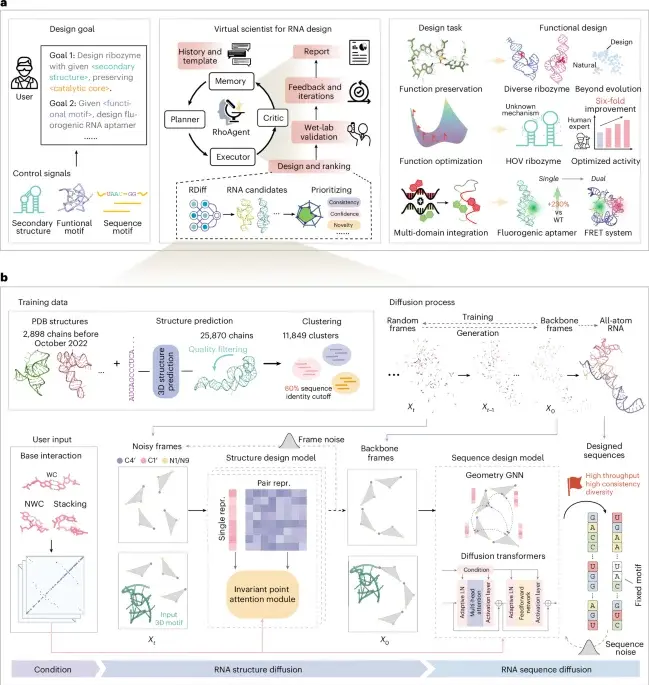
Researchers have introduced RhoAgent, an autonomous AI system capable of designing functional RNA molecules by iteratively refining candidates using experimental feedback. The system leverages a diffusion-based generative tool called RDiff to program three-dimensional structures, overcoming limitations in current computational methods. Validated through multiple benchmarks, RhoAgent generated active ribozymes with 40–70% sequence similarity to wild-type counterparts and improved the cleavage efficiency of the hovlinc ribozyme by up to sixfold. Additionally, it created a fluorogenic aptamer scaffold that increased fluorescence by 230% and designed 3D scaffolds for Förster resonance energy transfer systems, preserving the binding activities of distinct functional cores. This advancement represents a significant step in synthetic biology and therapeutic development, enabling the precise engineering of RNA for complex biological functions.
Key points
- RhoAgent is an agentic system that designs and iteratively refines RNA candidates using experimental feedback.
- The system utilizes RDiff, a diffusion-based generative tool conditioned on base interactions and functional motifs.
- RhoAgent generated diverse and active ribozymes with only 40–70% sequence similarity to their wild-type counterparts.
- The cleavage efficiency of the structurally uncharacterized hovlinc ribozyme was enhanced by up to sixfold compared to human-expert-truncated constructs.
- A fluorogenic aptamer scaffold designed by RhoAgent improved fluorescence by 230% relative to the wild-type aptamer.
- RhoAgent designed three-dimensional scaffolds that spatially position two distinct functional cores, creating aptamer-based Förster resonance energy transfer systems.
Background
The development of functional RNA is central to synthetic biology and therapeutics, yet traditional methods struggle to directly program the three-dimensional structures that govern function. Previous computational approaches, such as RaptGen and deep generative models, have shown promise but lack the iterative refinement capabilities of RhoAgent. This new system builds on advancements in AI-driven scientific discovery, including autonomous laboratories and generative models for protein and RNA design, to address the challenge of creating complex RNA structures with specific functions.
Why it matters
The ability to programmatically design functional RNA with high precision and efficiency could revolutionize synthetic biology and therapeutic development. By overcoming the limitations of human expertise and existing computational methods, RhoAgent enables the creation of novel RNA molecules for applications in gene regulation, drug delivery, and diagnostic tools. This advancement could accelerate the development of RNA-based therapies and enhance our understanding of RNA function in biological systems.
What to watch
The next steps involve further validation of RhoAgent's designs in diverse biological contexts and the integration of the system with autonomous laboratory platforms for high-throughput experimentation. Researchers will likely explore the application of RhoAgent in designing RNA for more complex therapeutic targets and in the development of RNA-based sensors and actuators for clinical use.
Want the full story? Read the original reporting
Read on Nature