
China's 1:5 Million Lunar Map and Chang'e-6 Data Redefine Moon's Geological History
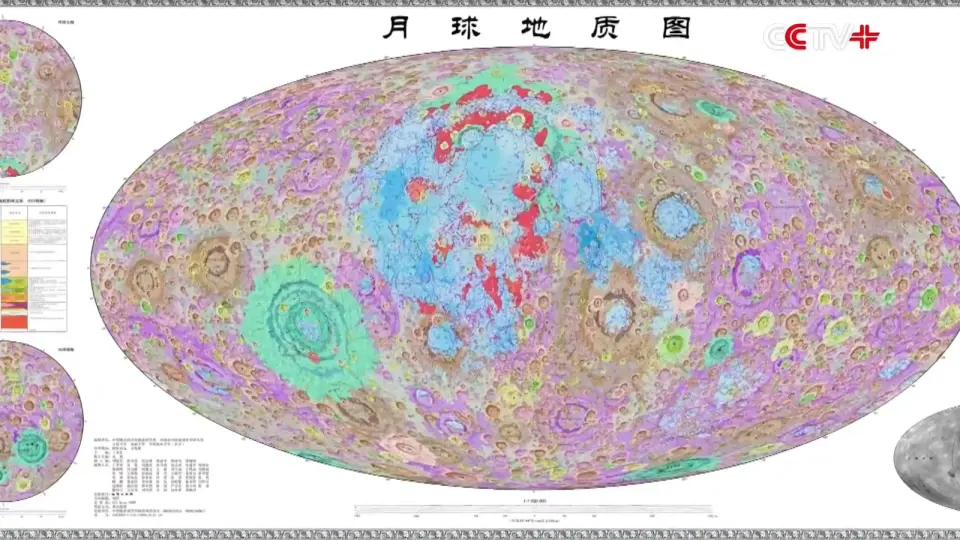
Chinese researchers unveiled a new 1:5 million scale geological map of the Moon on August 6, 2026, refining ancient period boundaries and expanding KREEP terrain areas. Concurrently, analysis of Chang'e-6 far-side samples using a new ion probe suggests the South Pole-Aitken impact, not just magma ocean cooling, explains the Moon's distinct near and far sides.
Key points
- The Institute of Geology, Chinese Academy of Geological Sciences (IGCAGS) released an updated lunar map on August 6, 2026, superseding the 2024 edition.
- The new map redefines the Aitkenian, Nectarian, and Imbrian geological periods and indicates KREEP terrane is more continuous and abundant than previously thought.
- IGCAGS aims to establish this map as an independent intellectual property standard for future planetary geologic mapping.
- Analysis of Chang'e-6 samples from the South Pole-Aitken basin using China's first homegrown ion probe suggests the massive impact reshaped the far side's crust and mantle.
- This finding challenges the traditional lunar magma ocean model, which previously struggled to explain the stark compositional differences between the Moon's near and far sides.
Background
This development follows the 2024 Chang'e-6 mission, which returned 1,935.3 grams of samples from the Moon's far side. It occurs amid a broader U.S.-China space race, with NASA targeting a 2028 lunar landing under Artemis and China aiming for a crewed lunar landing before 2030.
How outlets are covering it
Space.com and UA.NEWS emphasize the strategic significance of the new map, highlighting China's intent to create an independent intellectual property framework for deep-space exploration. Global Times and Bastille Post focus on the scientific breakthroughs from Chang'e-6 samples, specifically how the ion probe analysis provides evidence that the South Pole-Aitken impact, rather than uniform magma ocean differentiation, caused the Moon's 'two faces' dichotomy. While Space.com notes the map's role in soft power, the Chinese state media outlets stress the technical precision and new geological insights derived from the far-side samples.
Why it matters
The new map and sample analyses provide critical data for understanding lunar evolution, potentially influencing future international standards for planetary mapping. The findings from Chang'e-6 resolve a long-standing scientific debate about the Moon's hemispheric differences, demonstrating China's growing capability in independent deep-space scientific research and challenging previous models based solely on near-side Apollo and Soviet samples.
What to watch
China plans to apply the cartographic standards from this lunar map to other celestial bodies. Further analysis of the Chang'e-6 samples is expected to continue refining models of the Moon's crust and mantle, while the U.S. and China continue to compete for lunar milestones in the late 2020s.
- 'This goes beyond showcasing technological soft power': China's new moon map signals bold space ambitions (video) Space
- New advances in lunar soil research offer scientific evidence to unravel mystery of moon’s 'two faces' Global Times
- China has unveiled an updated geological map of the Moon UA.NEWS
- Chinese scientists uncover new clue to Moon's two-face mystery in Chang'e-6 samples bastillepost.com
- China releases new geological map of Moon TV BRICS
Want the full story? Read the original reporting
Read on Space