
New WHOLISTIC Method Maps Body-Wide Cellular Circuits in Transparent Vertebrates
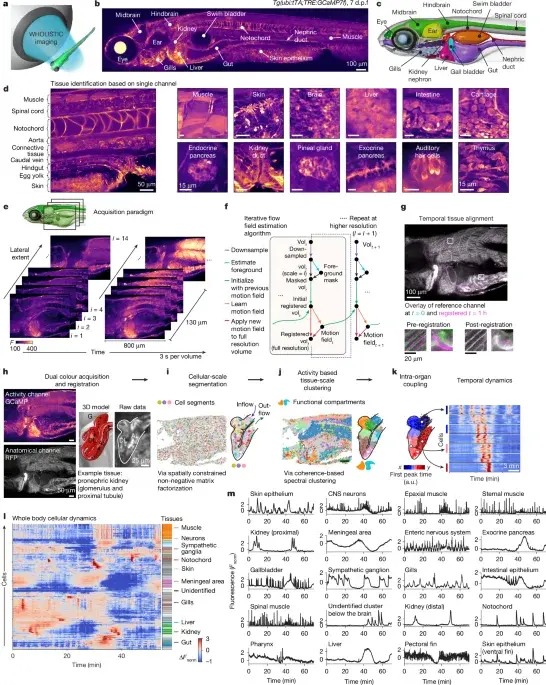
Researchers at HHMI’s Janelia Research Campus have developed WHOLISTIC, a new imaging platform that records real-time calcium activity across nearly all cells in a living larval zebrafish. By combining pancellular transgenic expression of calcium sensors with spinning-disk confocal microscopy and advanced computational analysis, the method captures simultaneous cellular dynamics across multiple organ systems. This approach reveals previously unknown physiological interactions, including muscle synergies, brain-body circuits, and responses to stress, bridging the gap between cellular and organismal physiology.
Key points
- WHOLISTIC uses a transgenic zebrafish line expressing the calcium indicator GCaMP7f in almost all cells to monitor intracellular calcium dynamics at second-timescale resolution.
- The technique employs spinning-disk confocal microscopy, which proved more robust than light-sheet microscopy for imaging opaque, heterogeneous tissues in the anterior body region.
- Advanced registration algorithms and spectral clustering allow researchers to align moving tissues and identify functional tissue ensembles based on activity patterns rather than just anatomy.
- Whole-body expansion microscopy (WB-ExM) was developed to provide high-resolution anatomical context, revealing that ependymal cells in the hindbrain have long ventral projections that facilitate slow oscillatory activity during rest.
- Optogenetic integration allowed for causal testing of brain-body circuits, such as the vagus nerve’s control over the gastropharyngeal sphincter, confirming a conserved neural-gut connection.
Background
This development follows recent advances in multi-scale imaging, such as the 2026 University of Glasgow system linking whole-body PET scans with cellular microscopy for cancer research. While previous studies like the 2026 Nature Aging analysis focused on static tissue changes across aging, WHOLISTIC addresses the dynamic, moment-to-moment coordination of cells across organs, a gap identified in physiological research due to the inability to record time-varying activity simultaneously throughout the entire body.
How outlets are covering it
The primary source, Nature, emphasizes the technical innovations of WHOLISTIC, detailing the specific engineering of the GCaMP7f transgenic line, the superiority of spinning-disk confocal microscopy over light-sheet methods for tissue scattering, and the computational workflows for registration and clustering. It highlights specific discoveries, such as chondrocyte responses to cold and meningeal responses to ketamine. The secondary source, HHMI, frames the achievement as a breakthrough in understanding the 'conversation' between body parts, focusing on the broader implications for connecting physiology, neuroscience, and behavior. HHMI highlights the collaboration with University College London, Virginia Tech, and Tsinghua University, and emphasizes the accessibility of the method through open-source tools and common microscopes. While both sources agree on the core capability, Nature provides granular methodological details, whereas HHMI focuses on the conceptual shift from organ-specific to whole-body systems biology.
Why it matters
WHOLISTIC establishes a new paradigm for systems biology by enabling the simultaneous observation of cellular activity across the entire body. This capability allows researchers to identify unknown interactions between organs, such as muscle-organ coupling and brainstem-controlled blood flow redistribution, which are critical for understanding homeostasis and disease. By bridging the observability gap between cellular and organismal scales, the method offers a pathway to discovering therapeutic targets and understanding how complex behaviors are generated by distributed biological networks, moving beyond the limitations of studying single organs or isolated cell types.
What to watch
The research team is currently adapting the WHOLISTIC method to adult Danionella cerebrum, a fish that remains transparent throughout its life, to study more complex behaviors than those possible in larval zebrafish. They plan to share the transgenic fish lines and computational methods with the scientific community to enable global adoption. Future work will likely focus on applying this platform to understand how diseases and medicines affect body-wide circuits, potentially leading to new insights into conditions like stroke, heart failure, and high-altitude adaptation.
Want the full story? Read the original reporting
Read on Nature