
New Microscope Platform Unifies High-Resolution Imaging Across Diverse Biological Scales
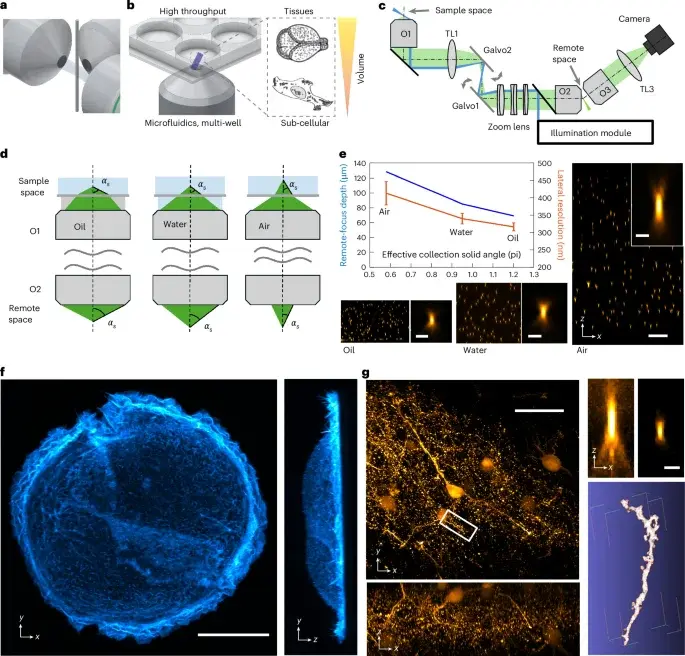
Researchers have introduced the multi-immersion oblique plane microscope (miOPM), a versatile light-sheet fluorescence microscopy platform designed to overcome the fragmentation of current imaging systems. By utilizing a novel 'any immersion remote focusing' framework and a tunable zoom lens, miOPM allows users to interchange oil, water, and air objectives while maintaining diffraction-limited performance across a wide range of refractive indices. This adaptability enables high-resolution imaging of subcellular dynamics, whole organisms, and cleared tissues within a single instrument, potentially democratizing advanced 3D imaging capabilities.
Key points
- The miOPM system addresses the lack of versatility in traditional light-sheet fluorescence microscopy, which often requires specialized instruments for specific applications like subcellular dynamics or cleared tissue imaging.
- The platform uses a single primary objective for both illumination and detection, eliminating the need for complex orthogonal objective matching required in conventional designs.
- A key innovation is the integration of a zoom lens that adjusts magnification to match the sample's refractive index, preventing axial distortions and maintaining diffraction-limited imaging across refractive indices from 1.33 to 1.51.
- The system supports seamless interchangeability of oil, water, and air objectives, allowing users to tailor resolution, sensitivity, and volumetric coverage to specific experimental needs without rebuilding the optical train.
- Demonstrated applications include high-resolution imaging of T-cell microvilli, expansion microscopy of liver tissue, contact-less multi-well plate imaging, and correlative light and electron microscopy (CLEM) for studying alpha-synuclein aggregates.
Background
This development follows a trend in microscopy toward more flexible and high-throughput imaging platforms. While previous innovations like Bruker’s GAIA microscope focused on ultra-cold quantum imaging, the miOPM addresses challenges in biological imaging by consolidating multiple specialized light-sheet variants into one adaptable system. This aligns with broader efforts to improve the efficiency and accessibility of advanced imaging techniques in biological research.
Why it matters
The miOPM has the potential to significantly reduce the cost and complexity of advanced biological imaging by replacing multiple specialized instruments with a single, adaptable platform. This could accelerate research in areas such as cancer biology, neurodegenerative diseases, and developmental biology by enabling high-resolution, high-throughput imaging of diverse samples without the need for extensive technical expertise or custom hardware configurations.
What to watch
The researchers plan to further explore the capabilities of miOPM, including its application in cryogenic imaging and high-throughput screening. They also aim to expand the range of compatible objectives and sample types, potentially integrating additional modalities to enhance its versatility for various biological and material science applications.
Want the full story? Read the original reporting
Read on Nature