
Lunar Cooling: 10,000 New Cracks Reveal Moon Has Shrunk 148 Feet
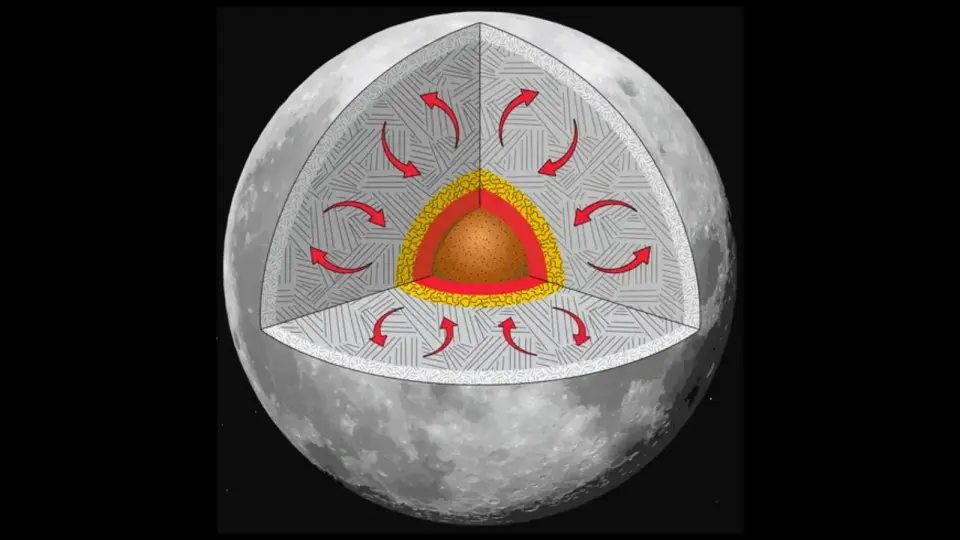
A new study confirms the Moon is shrinking as it cools, with its radius decreasing by approximately 148 feet over the last 400 to 800 million years. Researchers identified over 10,000 young surface faults using NASA imagery, indicating ongoing contraction that could influence future human settlement planning.
Key points
- The Moon’s radius has decreased by about 148 feet (45 meters) over the past 400 to 800 million years due to internal cooling.
- Researchers identified over 10,000 young faults, or cracks, on the lunar surface using data from the Lunar Reconnaissance Orbiter Camera.
- The contraction rate is estimated at 2.4 to 4.3 inches per million years, or roughly 0.1 micrometers annually.
- Unlike Earth, the Moon has a single tectonic plate, meaning seismic activity can occur anywhere on the surface rather than just at plate boundaries.
- Areas with thicker crust show fewer faults, suggesting greater stability, while thinner regions are more prone to cracking.
Background
This finding adds to recent lunar discoveries, including the identification of a new crater from a 2024 impact and data from the Artemis II flyby. It also relates to earlier studies on lunar water scarcity, which suggest that limited resources may cap future settlements at 100,000 people, making geological stability a critical factor for site selection.
How outlets are covering it
Space.com and Popular Science both cite the same study led by Thomas Watters of the Smithsonian, agreeing on the 148-foot radius reduction and the 10,000 fault count. Popular Science emphasizes the practical implications for NASA’s long-term human presence, noting that the single-plate structure allows moonquakes to occur anywhere. MARCA’s coverage is minimal, focusing only on the confirmation of the Moon’s shrinking status without detailed analysis.
Why it matters
Understanding the Moon’s ongoing contraction helps scientists predict seismic activity and select stable landing sites for future Artemis missions. The distribution of faults indicates that thicker crust areas are safer, while thinner regions pose higher risks for infrastructure and human habitation.
What to watch
Researchers expect existing faults to continue growing and new ones to form as the Moon’s interior cools. NASA will likely use this data to refine safety assessments for future lunar landings and permanent settlements.
- The moon is shrinking. 10,000 cracks on the lunar surface reveal by how much Space
- The moon is shrinking. Astronomers finally know how fast. Popular Science
- Lunar fault maps reveal how much the moon is shrinking Phys.org
- The Moon Is Shrinking, Causing More Faults Than Expected And Threatening Future Bases IFLScience
- NASA confirms it: the Moon is now smaller MARCA
Want the full story? Read the original reporting
Read on Space