
ProDiT Unifies Sequence and Structure Diffusion to Generate Functional Proteins
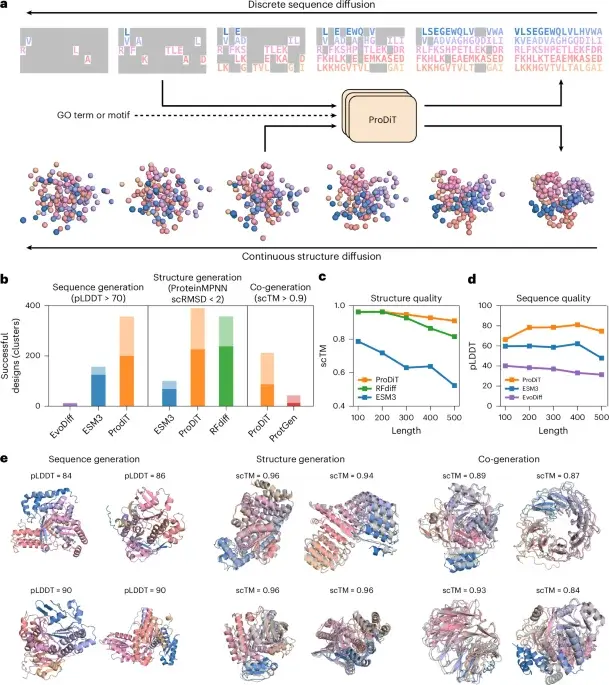
Researchers have introduced ProDiT, a multimodal diffusion model that generates protein sequences and three-dimensional structures with computationally predicted functions. Trained on 128 million proteins, the system produces designs across 463 Gene Ontology terms and demonstrates the ability to create multistate proteins with allosteric regulation, outperforming previous single-modality approaches in both quality and speed.
Key points
- ProDiT is a transformer-based model that unifies continuous structure diffusion and discrete sequence diffusion, eliminating the need for separate pipeline stages.
- The model was trained on 128 million non-redundant protein chains from AlphaFoldDB and UniProtKB, utilizing a 321-million-parameter architecture for unconditional generation and a 576-million-parameter version for function-conditioned tasks.
- In silico evaluations confirmed successful functional designs for 463 distinct Gene Ontology terms, with the model achieving approximately 10x higher throughput than RFdiffusion on a single GPU.
- The system successfully scaffolded multistate enzymes, such as carbonic anhydrase and lysozyme, where calcium binding was predicted to deactivate catalytic activity through conformational changes.
- Active-site geometry was recovered with high precision in 45 Gene Ontology categories, with all-atom root-mean-square deviations below 1.0 Angstroms, confirming the preservation of catalytic motifs.
Background
Previous de novo protein design methods, such as RFdiffusion and ESM3, typically operated in isolation, focusing either on structural backbones or amino acid sequences without fully capturing the relationship between the two. RFdiffusion, published in 2023, relied on the limited structural data in the Protein Data Bank, whereas ProDiT expands its training scope to the 214 million structures in AlphaFoldDB. This shift addresses a key limitation in the field: the inability of single-modality models to reason about sequence-structure-function relationships or target protein dynamics, which are essential for natural proteins that adopt multiple states to modulate function.
How outlets are covering it
Nature highlights the architectural efficiency of ProDiT, noting that its streamlined design allows for faster training and generation compared to specialized structure models like RFdiffusion. Bioengineer.org emphasizes the practical implications of the model's ability to generate multistate proteins, detailing specific case studies where calcium binding was predicted to disrupt catalytic activity in lysozyme and carbonic anhydrase. Both sources agree that while the model represents a significant advance in computational design, the authors caution that in silico predictions do not guarantee biochemical catalysis, as factors like electrostatic environments and distal dynamics are not fully captured by current motif conditioning.
Why it matters
ProDiT expands the toolkit for protein engineering by enabling the design of proteins with specific functions and multiple conformational states, which is critical for developing allosterically regulated enzymes and therapeutic proteins. By unifying sequence and structure modeling, the model addresses the 'last mile' challenge of ensuring designed proteins are stable and functional, potentially accelerating the development of novel biocatalysts and reducing the reliance on trial-and-error experimental methods.
What to watch
Future research will focus on experimental validation of ProDiT-generated proteins, including wet-lab expression, biophysical characterization, and enzymatic assays to confirm physical activity and regulatory responsiveness. The authors also plan to explore additional techniques from the image diffusion literature, such as classifier-free guidance, to improve the success rate of generating proteins for less prevalent functional terms.
Want the full story? Read the original reporting
Read on Nature