
Purdue and LMU Munich advance scalable quantum computing via photonics and atomic networks
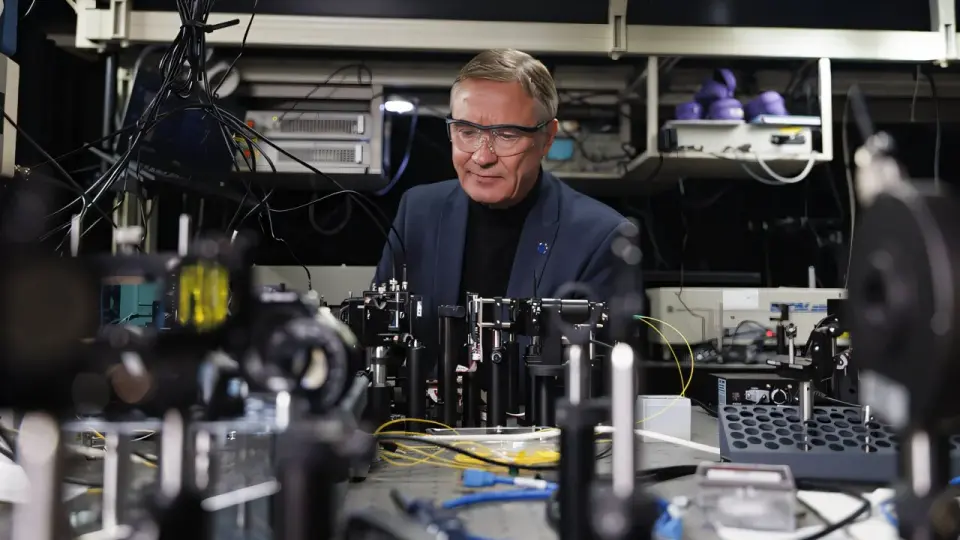
Researchers at Purdue University and LMU Munich have achieved key breakthroughs in scaling quantum computing. Purdue engineers demonstrated methods for generating single photons and controlling them on chips, while LMU Munich created a platform linking atoms via light. These advances aim to solve issues with qubit stability, error correction, and large-scale integration.
Key points
- Purdue University researchers Vladimir Shalaev and Alexandra Boltasseva developed a method to generate single photons at room temperature using silicon nitride platforms with engineered atomic defects.
- The team created a single-photon switch using optical nonlinearity, allowing one photon to trigger an electron avalanche that alters the refractive index of silicon, enabling control of light beams.
- A new framework using machine learning predicts quantum decoherence patterns, specifically spectral diffusion, potentially reducing errors by a factor of 20 and minimizing the number of qubits needed for error correction.
- LMU Munich and Max Planck Institute researchers built a platform combining optical cavities and Rydberg atoms, allowing individual rubidium atoms to exchange information with light and interact with neighbors, a step toward networked quantum computers.
- German researchers at NVision Quantum Technologies and Ulm University identified a single molecule capable of acting as an individually addressable qubit, offering a manufacturable route for large-scale quantum circuits via existing foundry processes.
Background
Recent developments in quantum computing have focused on scaling qubit counts and improving stability. IBM recently announced its Nighthawk r3 processor targeting 520 qubits, while PsiQuantum continues its Australian project. Earlier this year, teams observed room-temperature supersolid states and measured W-state entanglement, highlighting the ongoing push for more efficient and stable quantum systems.
How outlets are covering it
Purdue University emphasizes the advantages of photonic qubits, which operate at room temperature and move at the speed of light, reducing energy consumption compared to superconducting qubits. LMU Munich focuses on neutral-atom networks, highlighting the challenge of combining optical cavities with Rydberg atoms to enable communication between processing nodes. NVision Quantum Technologies argues that molecular qubits offer a manufacturable path to hundreds of thousands of qubits, contrasting with current technologies that struggle with error correction beyond eight qubits. While all sources agree on the need for scalability, they differ in their preferred physical platforms: photons, neutral atoms, and single molecules.
Why it matters
These advancements address critical barriers to practical quantum computing: reliable single-photon generation, error correction through decoherence prediction, and scalable manufacturing. Solving these issues could lead to quantum computers capable of performing complex calculations faster than supercomputers, with significant implications for cryptography, materials science, and drug discovery.
What to watch
Purdue researchers plan to integrate statistical physics insights into machine-learning models to further predict decoherence. LMU Munich aims to deterministically entangle atoms in specific configurations for quantum error correction. NVision is working on placing molecular qubits onto photonic chips with partner HyperLight. These steps are crucial for moving from proof-of-concept to large-scale, fault-tolerant quantum systems.
- Research advances quantum computing that harnesses speed of light Phys.org
- Purdue Engineers Advance Quantum Computing With Light Quantum Zeitgeist
- Quantum networks: A building block for light-linked quantum computers LMU München
- ‘A huge step for the field’: light-connected single molecule qubit hints at disruption to quantum computing tech Chemistry World
- Illinois Researchers Give Quantum Light a Place to Wait | Newswise Newswise
Want the full story? Read the original reporting
Read on Phys.org