
Rubin Observatory’s First Science Release Maps COSMOS Field with 3.2-Gigapixel Camera
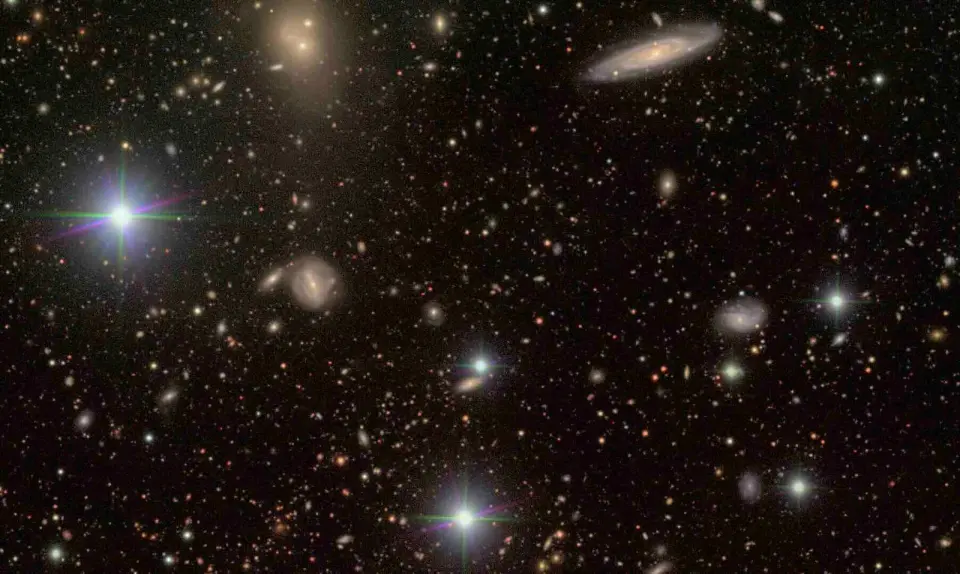
The NSF-DOE Vera C. Rubin Observatory has released its first scientific data, featuring a deep-field image of the COSMOS region in the Sextans constellation. Captured by the 3.2-gigapixel LSST Camera, the composite view reveals over 500,000 galaxies and 50,000 stars, marking the start of a decade-long survey to track cosmic changes.
Key points
- The image was produced by stacking hundreds of individual observations from the 8.4-meter Simonyi Survey Telescope.
- The COSMOS field is a prime target because it faces away from the Milky Way's crowded plane, allowing unobstructed views of distant galaxies.
- This release is part of the Early Data Preview 2 (EDP2), the first science data from the Legacy Survey of Space and Time (LSST).
- Future observations will focus on detecting transient phenomena like supernovae and variable stars through repeated imaging over ten years.
Background
The Vera C. Rubin Observatory began its decade-long Legacy Survey of Space and Time (LSST) in early 2026, following preliminary imagery released in June 2025. The COSMOS field has been a cornerstone of astronomical research since 2003, previously studied by Hubble, James Webb, Chandra, and Spitzer across various spectral ranges to understand galaxy formation and cosmic evolution.
How outlets are covering it
While The Debrief and PetaPixel report the image contains over 500,000 galaxies, Gizmodo cites a higher figure of 650,000 galaxies in the same view. PetaPixel emphasizes the physical scale of the 3.2-gigapixel camera, noting its 6,600-pound weight and 189 CCDs, whereas The Debrief focuses on the scientific value of the COSMOS field as a reference point. All sources agree that the image serves as a baseline for future time-domain astronomy, with Bob Blum of NOIRLab highlighting the potential for discovering transient objects through repeated observations.
Why it matters
This release validates the performance of the world's largest digital camera and establishes a new benchmark for wide-field, high-resolution astronomy. By repeatedly imaging the same regions, the Rubin Observatory will create a comprehensive cinematic record of the universe, enabling the detection of faint, changing objects and advancing research into dark matter, dark energy, and supernovae.
What to watch
A second phase of data release is expected later in 2026, featuring individual observations and specialized difference images that highlight changes between successive exposures. The full LSST survey will continue for ten years, generating billions of objects and trillions of measurements for public access.
- Rubin Observatory Reveals More Than Half a Million Galaxies in Landmark First Science Image The Debrief
- NSF–DOE Rubin Observatory Opens Deep Window on Famous Cosmic Field Rubin Observatory
- 3.2-Gigapixel LSST Camera Captures Over Half a Million Galaxies PetaPixel
- World’s largest digital camera captured over 500,000 galaxies and 50,000 stars in one deep view of universe The Times of India
- Rubin Gets a Closer Look at the COSMOS Field, Revealing More Than 650,000 Galaxies in One Image Gizmodo
Want the full story? Read the original reporting
Read on The Debrief