
Singapore Researchers Unveil Lutetium Clock with Record 10^-19 Accuracy
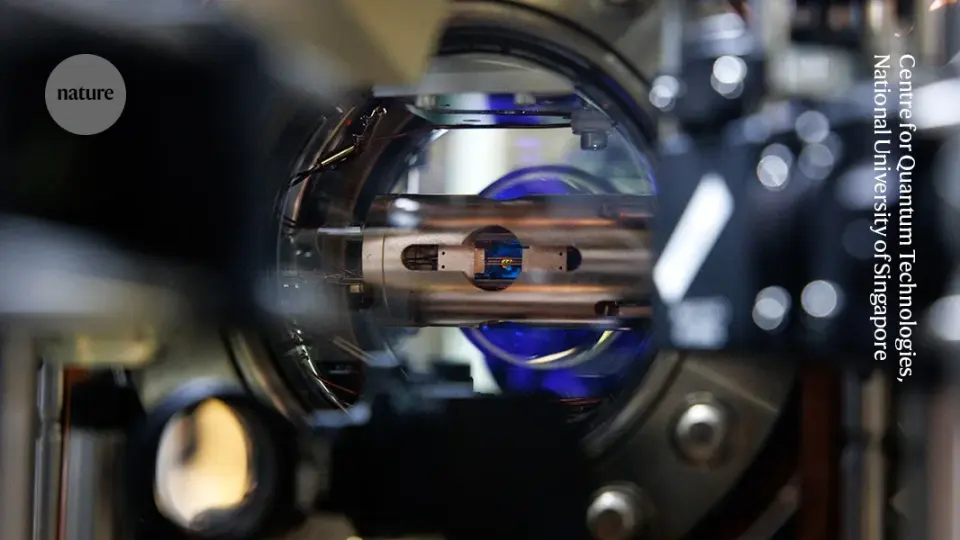
Researchers at the National University of Singapore (NUS) have developed the world’s most accurate atomic clock, utilizing the rare-earth element lutetium. Published in Nature on September 23, 2026, the device achieves an uncertainty of 1 x 10^-19, meaning it would take over 260 billion years to lose a second. This optical clock is four times more precise than the previous record-holder based on calcium ions. The team verified its accuracy by comparing two independent clocks, which agreed to the 19th decimal place. The breakthrough, resulting from over a decade of work, could lead to a redefinition of the second and enable ultra-precise gravity mapping.
Key points
- The new clock uses a single lutetium ion and a laser with a wavelength of 848 nanometers to mark time.
- It achieves an uncertainty of 1 x 10^-19, the lowest recorded for any optical atomic clock.
- Two independent clocks were compared over 200 hours, agreeing to the 19th digit, the most precise comparison ever performed.
- Lutetium is less sensitive to temperature and magnetic field fluctuations than other elements like ytterbium or strontium.
- The team aims to miniaturize the device for transportable use outside the laboratory.
Background
Global time standards have relied on caesium atomic clocks since the 1960s, but optical clocks using elements like strontium and ytterbium are increasingly accurate. The international body responsible for time standards is considering data from these new optical clocks for a potential redefinition of the second, expected in or after 2030. This development follows a decade of research by the NUS team, which included developing a method called 'hyperfine averaging' to define the clock transition.
How outlets are covering it
Nature and The Economic Times emphasize the clock’s record-breaking accuracy and its potential to redefine the second, noting that it is four times more accurate than the previous calcium-based record. Mirage News highlights the practical robustness of lutetium, noting its stability across extreme temperature ranges, from Death Valley to the Antarctic plateau. All sources agree on the technical specifications, including the 1 x 10^-19 uncertainty and the 19-digit agreement between two clocks. David Leibrandt of UCLA, cited by Nature, described the accuracy as 'impressive' and praised the verification method. Kyle Arnold of NUS, cited by Mirage News, noted that comparing two clocks is essential for verifying accuracy, as a single clock cannot confirm its own precision.
Why it matters
This breakthrough could lead to a redefinition of the second and enable ultra-precise measurements of Earth’s gravitational pull, with applications in geophysics and fundamental physics. The clock’s robustness against environmental factors suggests it could be miniaturized for use outside the laboratory, potentially improving satellite navigation and communication networks. The ability to resolve height differences of millimeters through gravity effects opens new avenues for precision measurement in scientific research.
What to watch
The NUS team plans to miniaturize the clock into a transportable system without compromising accuracy. They also aim to compare their lutetium clock with other world-leading atomic clocks, though current gravity differences between locations make this challenging. The international body responsible for time standards is expected to consider data from optical atomic clocks for a redefinition of the second in or after 2030.
- Best clock ever: timekeeper based on lutetium atoms wows researchers Nature
- Lu+ optical frequency references with accuracy verified at the 19th digit Nature
- NUS researchers develop new Lutetium Atomic Clock with record accuracy that could advance precision timeke The Economic Times
- Singapore Scientists Create Most Accurate Atomic Clock Mirage News
Want the full story? Read the original reporting
Read on Nature