
Tag

Lutetium

All articles tagged with #lutetium

Singapore Lutetium Clock Sets New Global Standard for Timekeeping Accuracy
science1 month ago

Singapore Lutetium Clock Sets New Global Standard for Timekeeping Accuracy

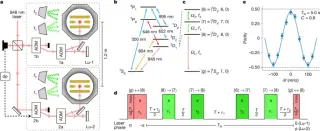
Researchers at the National University of Singapore have developed a new atomic clock based on the element lutetium, achieving an accuracy that surpasses all previous records. Published in Nature, the device measures time with an uncertainty of less than one part in 10^19, meaning it would lose less than a second over 300 billion years. This represents a four-fold improvement over prior optical clocks. The team verified the precision by comparing two independent units over 200 hours, finding no measurable difference. The clock’s stability against environmental disturbances like heat and magnetism makes it a potential candidate for redefining the second and enabling high-precision gravity mapping.
Singapore team achieves 19-digit accuracy in lutetium atomic clock comparison
science2 months ago

Singapore team achieves 19-digit accuracy in lutetium atomic clock comparison

Researchers at the National University of Singapore (NUS) have developed a pair of optical atomic clocks using lutetium ions that achieve a fractional frequency uncertainty of 1 × 10⁻¹⁹. By comparing two independent systems over 200 hours, the team verified agreement to the 19th decimal place, marking a fourfold improvement over previous records. This precision enables millimeter-scale gravity measurements and supports the potential redefinition of the SI second.

Singapore Researchers Unveil Lutetium Clock with Record 10^-19 Accuracy
science-and-technology2 months ago

Singapore Researchers Unveil Lutetium Clock with Record 10^-19 Accuracy

Researchers at the National University of Singapore (NUS) have developed the world’s most accurate atomic clock, utilizing the rare-earth element lutetium. Published in Nature on September 23, 2026, the device achieves an uncertainty of 1 x 10^-19, meaning it would take over 260 billion years to lose a second. This optical clock is four times more precise than the previous record-holder based on calcium ions. The team verified its accuracy by comparing two independent clocks, which agreed to the 19th decimal place. The breakthrough, resulting from over a decade of work, could lead to a redefinition of the second and enable ultra-precise gravity mapping.