
SpaceX CRS-35 Launch Creates 'Space Jellyfish' Phenomenon Over Florida and Virginia
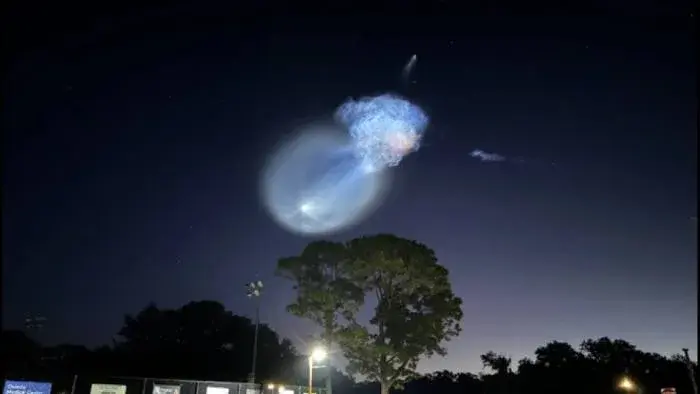
A pre-dawn SpaceX Falcon 9 launch on October 13, 2026, delivered the 35th commercial resupply mission to the International Space Station. The launch produced a visible 'space jellyfish' atmospheric effect across Central Florida and Virginia due to sunlight illuminating high-altitude rocket exhaust while the ground remained dark. The Dragon spacecraft, carrying over 6,300 pounds of supplies including final Roll-Out Solar Arrays, is scheduled to dock autonomously on October 15.
Key points
- SpaceX launched a Falcon 9 rocket at 6:33 a.m. EDT from Cape Canaveral Space Force Station on October 13, 2026, for the CRS-35 mission.
- The launch created a 'space jellyfish' visual effect, where expanding rocket exhaust was illuminated by sunlight at high altitudes while observers on the ground were still in darkness.
- The phenomenon was observed by residents in Central Florida, the Tampa Bay Area, and Roanoke, Virginia, though it was not specifically forecast by NASA or SpaceX due to variable atmospheric conditions.
- The Dragon spacecraft carries over 6,300 pounds of cargo, including the final set of ISS Roll-Out Solar Arrays, artificial retina manufacturing hardware, and 3D heart tissue models for drug testing.
- The spacecraft is expected to autonomously dock with the Harmony module of the ISS on October 15 at approximately 11 a.m. EDT, after a flight of roughly 52 hours.
Background
This event follows recent public interest in celestial phenomena, such as the rare pre-dawn occultation of Jupiter and its moons by the Moon on October 6, 2026. It also relates to previous discussions about jellyfish-shaped anomalies, such as the 2023 Mars NavCam image which was determined to be a cosmic-ray artifact rather than a biological entity. The current 'space jellyfish' is a distinct atmospheric optical effect caused by rocket exhaust, not a camera glitch or biological organism.
How outlets are covering it
WKMG and WYFF focused on the visual spectacle, describing the 'space jellyfish' effect seen by residents in Florida and Virginia, and explaining the science of sunlight illuminating high-altitude exhaust. FOX 13 Tampa Bay emphasized that while dozens of observers saw the display, neither NASA nor SpaceX specifically predicted it, noting that visibility depends on atmospheric conditions and launch timing. NASA provided the official mission details, confirming the launch time, the cargo manifest including solar arrays and medical research hardware, and the scheduled docking date, without highlighting the atmospheric phenomenon in their primary advisory.
Why it matters
The successful launch of CRS-35 ensures the continued delivery of critical supplies and scientific experiments to the International Space Station, including the final Roll-Out Solar Arrays. The widespread public observation of the 'space jellyfish' effect highlights the intersection of routine space operations with accessible astronomical phenomena, engaging the public in space exploration and atmospheric science.
What to watch
The Dragon spacecraft is scheduled to dock with the ISS on October 15 at 11 a.m. EDT. It will remain at the station until mid-November before returning to Earth with time-critical research and cargo, splashing down off the coast of California. The first-stage booster was set to attempt a landing at Landing Zone 40 at Cape Canaveral Space Force Station following stage separation.
- PIN IT: SpaceX launch makes ‘space jellyfish’ effect in sky. Here’s the science behind it WKMG
- Photos: SpaceX CRS-35 launch creates 'space jellyfish' over Bay Area FOX 13 Tampa Bay
- Glowing 'space jellyfish' effect lights up sky after rocket launch WYFF
- NASA Sets Coverage for SpaceX 35th Station Resupply Launch, Arrival NASA (.gov)
- What is that strange cloud in the sky? WFLA
Want the full story? Read the original reporting
Read on WKMG