
Ribose and Boron: A Mutual Survival Mechanism in Earth's Prebiotic Chemistry
A new study suggests that ribose, a fragile sugar delivered to Earth by meteorites, may have helped keep boron dissolved in ancient waters. This dissolved boron, in turn, protected ribose from breaking down, creating a mutual survival mechanism that could have facilitated the formation of RNA and the origin of life.
Key points
- Ribose, a key component of RNA, is chemically unstable and breaks down easily when heated.
- Boron, in the form of borate, binds to ribose and prevents it from degrading into brown goop.
- Researchers found that ribose helps borate minerals dissolve, keeping more boron in solution.
- This creates a two-way relationship: ribose keeps boron available, and boron protects ribose.
- Meteorites, like the Murchison meteorite, delivered carbon compounds, including ribose, to early Earth.
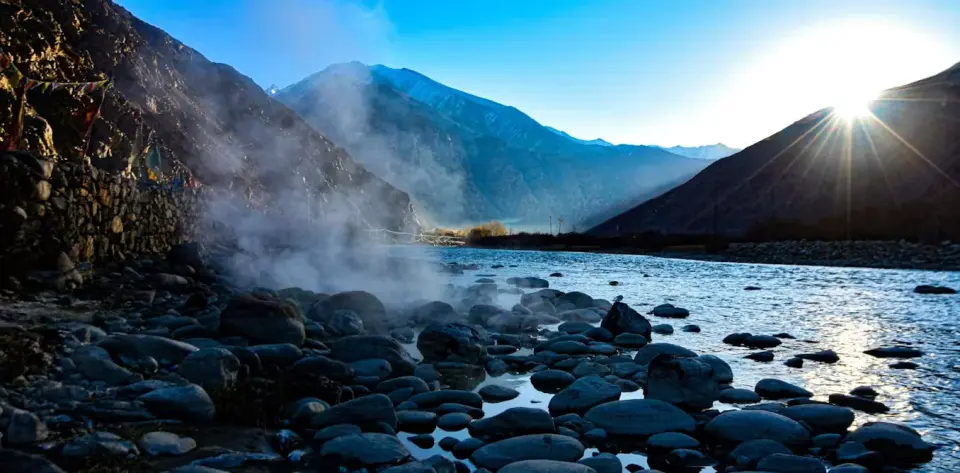
- The study used real minerals from the Puga hot springs in India to simulate prebiotic conditions.
Background
This research builds on the long-standing 'primordial soup' hypothesis, which posits that life arose from complex chemical mixtures in ancient oceans or hot springs. Previous laboratory experiments often used purified chemicals, which may have missed the 'messy' interactions of natural environments. The new study aims to make these experiments more realistic by using actual minerals and conditions from places like the Puga hot springs in the Himalayas, which are thought to resemble early Earth environments.
Why it matters
Understanding how fragile molecules like ribose could have survived long enough to form RNA is crucial for explaining the origin of life on Earth. This mutual protection mechanism between ribose and boron offers a plausible pathway for the accumulation of necessary building blocks in prebiotic environments. It also has implications for the search for life elsewhere, as similar chemical interactions could occur on other planets or moons with water and carbon compounds.
What to watch
Researchers plan to test the effects of other carbon-containing molecules, such as ethylene glycol and glycerol, on natural mineral deposits. They will also investigate how more abundant elements like silica and calcium interact with carbon molecules, to see if primordial soups could have influenced the formation of other minerals and rocks on early Earth.
Want the full story? Read the original reporting
Read on The Conversation