Tag

Origin Of Life

All articles tagged with #origin of life

Ancient Microbes May Have Emerged in Earth's Harsh Hadean Era
science11 days ago

Ancient Microbes May Have Emerged in Earth's Harsh Hadean Era

New geochemical data and molecular-clock analysis suggest life could have arisen during Earth's fiery Hadean period, about 4.4–4.2 billion years ago, with LUCA as the Last Universal Common Ancestor and LECA leading to modern eukaryotes; evidence points to liquid water despite extreme conditions, and ongoing genome recovery efforts may further refine when these ancestral stages appeared.

Ryugu Samples Show All Five Nucleobases, Hinting Life’s Ingredients Arrived from Space
space-and-spaceflight25 days ago

Ryugu Samples Show All Five Nucleobases, Hinting Life’s Ingredients Arrived from Space

A Nature Astronomy study analyzing Hayabusa2’s Ryugu samples found all five nucleobases—the DNA/RNA building blocks—supporting the idea that asteroids delivered the ingredients for life to early Earth. The researchers note Ryugu has roughly equal amounts of purine and pyrimidine bases, unlike some meteorites, and that ammonia concentration may influence nucleobase formation, suggesting such molecules could have been more widespread in the early solar system.

Sun’s outward drift in the Milky Way billions of years ago may have fostered Earth’s life
astronomy1 month ago

Sun’s outward drift in the Milky Way billions of years ago may have fostered Earth’s life

New Gaia-based research suggests the Sun and many Sun-like stars formed at similar times and distances from the Milky Way’s center and likely migrated outward from the galactic core about 4–6 billion years ago as the Milky Way’s central bar evolved. This outward journey could have placed our solar system in a calmer outer disk for much of its history, potentially aiding Earth’s habitability and the emergence of life. The findings stem from two astronomy studies analyzing ~6,600 solar twins within ~1,000 light-years and will be broadened with upcoming Gaia data.

Ancient Asgard archaea may have used oxygen long before Earth’s oxygenation reshaped life
planet-earth1 month ago

Ancient Asgard archaea may have used oxygen long before Earth’s oxygenation reshaped life

A Nature study analyzing deep-sea sediments found Heimdallarchaeia genomes with components of aerobic respiration, suggesting Asgard archaea could tolerate and potentially use oxygen long before Earth’s oxygenation, providing metabolic groundwork for the archaeal–eukaryotic merger that gave rise to complex life.

Tiny 45-base ribozyme copies itself, nudging origin-of-life theories
science1 month ago

Tiny 45-base ribozyme copies itself, nudging origin-of-life theories

Researchers identified QT-45, a 45-base RNA ribozyme that can act like a tiny polymerase to copy RNA strands and, crucially, can synthesize a copy of its own sequence by base-pairing with a template. In tests, QT-45 copied various RNAs with about 95% fidelity (roughly 2–3 errors per copy), though the process is slow. This demonstrates self-replicating RNA is plausible at very small sizes and could be refined by evolution under prebiotic conditions.

Lab-made cosmic dust sheds light on life's beginnings
science2 months ago

Lab-made cosmic dust sheds light on life's beginnings

A University of Sydney doctoral student creates tiny cosmic-dust analogues in the lab by exciting a mix of nitrogen, carbon dioxide and acetylene with 10,000 volts of electricity, reproducing conditions around stars to study how dust catalyzes organic molecules and potentially seeded life; the team aims to build a database of dust types to compare with meteorites and astronomical observations.

Ice-Formed Hydrogen Cyanide Could Jump-Start Life Across the Solar System
science2 months ago

Ice-Formed Hydrogen Cyanide Could Jump-Start Life Across the Solar System

Researchers modeling frozen hydrogen cyanide find it converts to hydrogen isocyanide, enabling two pathways to prebiotic molecules like amino acids and nucleobases, even in extreme cold. The work suggests cyanide-based chemistry could have seeded life on early Earth and may occur on icy worlds such as Titan or in other planetary atmospheres across the solar system.

Lost City Under the Sea: A 60-Meter Habitat That Could Rewrite Life's Origins
science2 months ago

Lost City Under the Sea: A 60-Meter Habitat That Could Rewrite Life's Origins

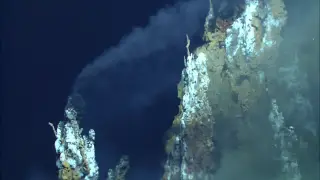
Scientists describe the Lost City hydrothermal field off the Mid-Atlantic Ridge, featuring calcite chimneys up to 60 meters tall and vents that emit hydrogen- and methane-rich fluids, supporting life without magma heat and potentially shedding light on how life began on Earth and perhaps on icy worlds; a 2024 1,268‑meter mantle rock core from the site could hold crucial clues, and the ecosystem’s uniqueness and mining threats have spurred calls to protect it, potentially as a World Heritage site.

Could Life on Earth Have Originated from Mars?
science3 months ago

Could Life on Earth Have Originated from Mars?

The article explores the hypothesis that life on Earth may have originated from microorganisms on Mars, which could have been transported via meteorites. It discusses the timing of planetary formation, early conditions on Mars and Earth, and the challenges of microbial survival during space travel, ultimately questioning whether Earth’s life could have come from Mars or if it originated independently on Earth.