
The Nile Crocodile's Jaw: A 100-Million-Year Evolutionary Trade-Off
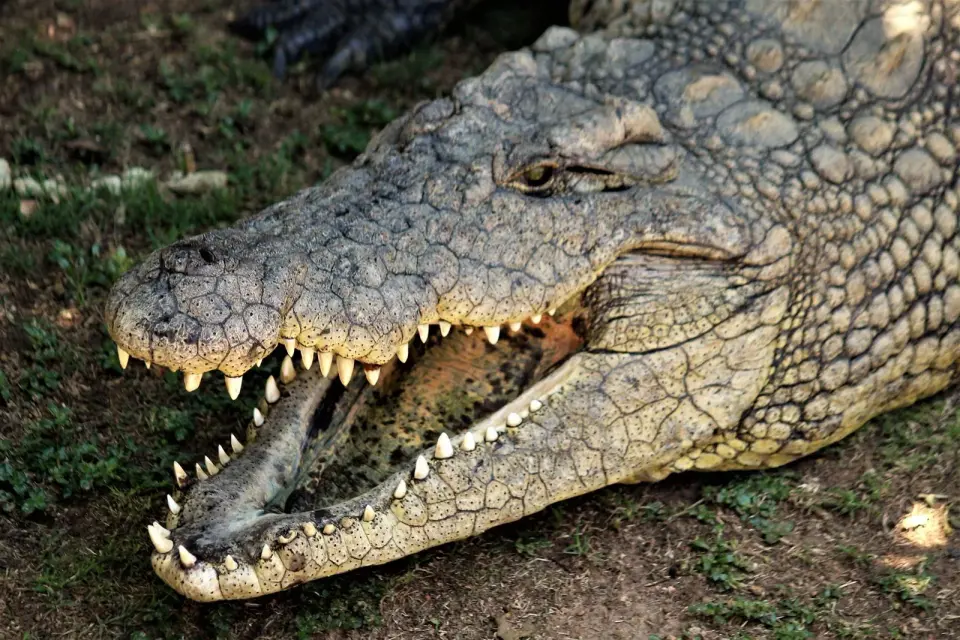
The Nile crocodile possesses the strongest measured bite force among living animals, yet its jaw-opening muscles are so weak that a human can hold its mouth shut. This extreme asymmetry is an evolutionary adaptation for ambush predation, prioritizing rapid, crushing closure over the ability to open the jaw against resistance.
Key points
- Nile crocodile bite force is measured at approximately 3,700 PSI, exceeding all other living animals, though some studies cite up to 5,000 PSI for the species.
- The jaw-opening muscles (depressor mandibulae) are significantly weaker than the closing muscles, allowing an adult human to pin the jaw shut with two hands and tape.
- This anatomical imbalance is a result of 100 million years of evolution, optimizing the animal for fast, explosive closure during ambush rather than sustained chewing or opening against resistance.
- The crocodile's skull features dense bone struts and a rear-set hinge, providing a long lever arm for the powerful closing muscles (pterygoideus and temporalis).
- The lineage is over 200 million years old, with the modern crushing design being the most successful adaptation for waterline ambush predation.
Background
This story builds on previous coverage of animal danger and evolutionary adaptations. In August 2026, a report mapped the deadliest animals by U.S. state, highlighting the significant threat posed by large predators like bears and alligators, which share similar ambush or crushing strategies. Additionally, earlier discussions on evolutionary logic, such as the goblin shark's 125-million-year lineage, provide background on how ancient lineages adapt to specific ecological niches over deep time.
Why it matters
Understanding the Nile crocodile's jaw mechanics illustrates how evolution optimizes for specific survival strategies, in this case, ambush predation. The extreme asymmetry between closing and opening forces demonstrates that biological design is not about balanced strength, but about maximizing efficiency for a specific ecological role. This has implications for understanding prehistoric predators like Tyrannosaurus rex, which shared similar jaw architectures, and for wildlife management, where handlers exploit this weakness to safely restrain large crocodilians.
What to watch
Researchers may continue to refine bite-force measurements across crocodilian species to determine if the Nile or saltwater crocodile holds the absolute record. Conservation efforts in Lake Nasser and other sub-Saharan habitats will focus on mitigating illegal hunting for skins and meat, which threatens the species despite its evolutionary resilience. Further paleontological studies may explore how extinct crocodilian relatives, like the 'cat crocodile,' experimented with different jaw architectures before the modern crushing design prevailed.
Want the full story? Read the original reporting
Read on Space Daily