
Alabama Fossil Reveals 316-Million-Year-Old Scorpion with Modern Features
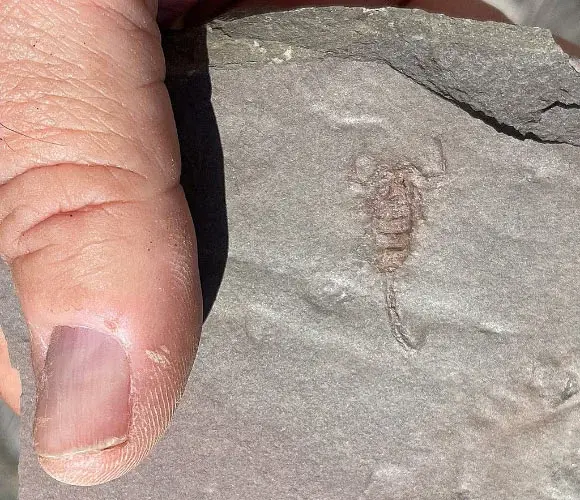
A tiny scorpion fossil found in an Alabama coal mine is the oldest known member of the modern scorpion lineage in North America, dating to 316–319 million years ago. The specimen, likely a juvenile molt, displays breathing structures and body proportions similar to living scorpions, suggesting modern traits evolved earlier than previously thought.
Key points
- The 22 mm fossil was discovered in the Union Chapel Mine in Walker County, Alabama, part of the Pottsville Formation.
- Ultraviolet imaging revealed breathing pores (spiracles) on belly plates, a feature characteristic of modern scorpions (Orthosterni).
- The specimen lacks leg-base plates and lateral eyes, preventing precise family classification, but its wide tail and narrow pincers suggest venom-based hunting.
- Researchers from Flinders University, the American Museum of Natural History, and the University of Alabama published the findings in The Science of Nature.
- The fossil is the first scorpion body found in the southeastern US, complementing existing trackway evidence at the site.
Background
Prior to this discovery, scorpions in the Pottsville Formation were known only through fossilized footprints. The only other comparably ancient, complete orthostern scorpion was previously found in Britain. This find helps narrow the timeline for the emergence of modern scorpion traits in North America.
How outlets are covering it
Sci.News emphasizes the fossil’s significance as the oldest North American representative of the modern scorpion lineage and highlights its potential to clarify evolutionary timelines. Earth.com focuses on the specific anatomical details, such as the elongated tail segment and book lung traces, linking them to faster stinging and venom reliance. Both agree on the fossil’s age and location but differ in emphasis: Sci.News stresses the broad evolutionary implication, while Earth.com details the morphological evidence and the uncertainty regarding species identification due to missing features.
Why it matters
This discovery pushes back the known timeline for modern scorpion characteristics in North America by over 300 million years, providing crucial data on arachnid evolution and ancient ecosystems in the Carboniferous period.
What to watch
Researchers hope to find additional specimens with intact undersides to determine the specific family of the Alabama scorpion. Continued excavation at the Union Chapel Mine may yield more fossils that further detail ancient ecosystems.
- Fossil Scorpion from Alabama Coal Mine is Oldest of Its Kind in North America Sci.News
- 310 million-year-old fossil reveals scorpion that looked much like modern relatives Phys.org
- Carboniferous Scorpion Fossil From Alabama Illuminates Modern Arachnid Evolution Bioengineer.org
- Scorpion fossil from an Alabama coal mine has strikingly modern features Earth.com
Want the full story? Read the original reporting
Read on Sci.News