
Butterfly Wing Patterns Create Motion Illusions to Confuse Predators
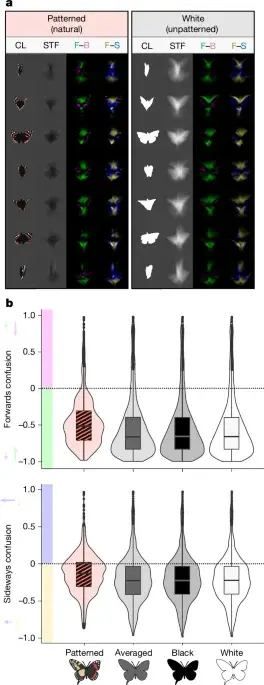
Research published in Nature demonstrates that butterfly wing patterns function as 'motion dazzle,' creating visual illusions that confuse predators. By combining high-contrast stripes with specific flight dynamics, butterflies disrupt a predator's ability to accurately gauge speed and direction, leading to missed attacks or strikes on non-vital areas. This mechanism explains why brightly colored butterflies survive despite lacking traditional camouflage.
Key points
- High-speed filming of butterfly take-offs revealed that natural wing patterns generate significantly more motion confusion than unpatterned controls, misleading predators about the insect's trajectory.
- Phylogenetic analyses indicate that this anti-predator strategy is evolutionarily widespread across butterfly species, rather than being limited to specific lineages.
- In silico evolution experiments using genetic algorithms independently converged on high-contrast, butterfly-like wing patterns when selected for motion confusion, validating the hypothesis.
- Behavioral experiments with human participants showed that wing patterns influenced where they clicked on a screen, mimicking how predators might misjudge the location of a moving target.
- The study suggests that motion dazzle is a key defense strategy, explaining why few predators have specialized in catching butterflies on the wing despite their conspicuous appearance.
Background
Previous studies on motion dazzle in animals like zebras and snakes had yielded equivocal results, often using rigid prey models that did not account for the complex limb movements of live animals. This research builds on earlier findings by incorporating biological motion, specifically the interaction between wing patterns and flight dynamics, to provide empirical support for the motion dazzle hypothesis in butterflies.
Why it matters
This research provides a new understanding of how visual patterns function in nature, moving beyond traditional concepts of camouflage and warning signals. It highlights the importance of dynamic interactions between an animal's appearance and its movement in evading predators, offering insights into the evolution of visual defenses in moving animals.
What to watch
Future research may explore the specific mechanisms by which predators process these illusory motion cues and how this strategy compares to other anti-predator defenses in different taxa. Additionally, the findings could inform the design of visual deterrents for human-made structures, such as wind turbines, to reduce wildlife collisions.
Want the full story? Read the original reporting
Read on nature.com