Tag

Butterflies

All articles tagged with #butterflies

Ancient Genetic Switch Shapes Wing Patterns Across Lepidoptera
science8 days ago

Ancient Genetic Switch Shapes Wing Patterns Across Lepidoptera

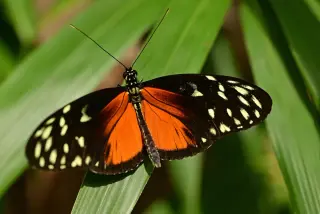
An international study finds that distantly related Lepidoptera rely on the same two genes, ivory and optix, controlled by regulatory switches, to produce identical wing color patterns across 120 million years of evolution, via Müllerian and Batesian mimicry; the work suggests evolution may be more predictable than previously thought, with mutation hotspots enabling rapid adaptation, including an inversion mechanism in some moths and genetic modification confirming the gene’s role in color.

Trump's Butterfly Metaphor Triggers Confusion Over Iran Drone War
politics16 days ago

Trump's Butterfly Metaphor Triggers Confusion Over Iran Drone War

Former President Donald Trump sparked confusion with a butterfly analogy about Iran's drones on Truth Social, pairing butterflies with drones and AI imagery as he bragged about strikes; the post drew ridicule and raised questions about his cognitive stability, while the piece also notes his administration's record on monarch butterfly protections.

Two Genes, 120 Million Years: Repeating Mimicry in Butterflies and Moths
science20 days ago

Two Genes, 120 Million Years: Repeating Mimicry in Butterflies and Moths

A study of neotropical butterflies and a day-flying moth shows that the same two genes, ivory (a long noncoding RNA) and optix (a transcription factor), underlie similar wing color patterns across species separated by over 120 million years, with regulatory changes near ivory driving the variation. In the moth Chetone histrio, a chromosomal inversion including ivory mirrors a butterfly inversion, suggesting recurrent use of a shared genomic toolkit that constrains evolutionary pathways and could help predict responses to environmental change.

A Shared Genetic Playbook Drives Butterfly and Moth Color for 120 Million Years
biology21 days ago

A Shared Genetic Playbook Drives Butterfly and Moth Color for 120 Million Years

Researchers found that distantly related butterflies and a day-flying moth repeatedly rely on the same two genes, ivory and optix, to produce warning coloration. Rather than changing the genes themselves, evolution tweaks regulatory switches that control when and where these genes are active, a pattern conserved across seven butterfly lineages and a moth for over 120 million years. This suggests evolution may be more predictable than previously thought and could help scientists anticipate future adaptations, with findings published in PLoS Biology.

Osaka Makes a Butterfly-Themed Entrance, Sparks Australian Open Victory
sports4 months ago

Osaka Makes a Butterfly-Themed Entrance, Sparks Australian Open Victory

Naomi Osaka opened the Australian Open with a bold butterfly-themed entrance—featuring a wide-brim hat, veil and a white parasol—before defeating Antonia Ruzic 6-3, 3-6, 6-4. The look nods to her 2021 Melbourne success and jellyfish-inspired dress, while the event’s water motif and a remodeled Rod Laver Arena tunnel provided a backdrop as she eyes a second-round match against Sorana Cirstea and builds confidence.

Butterfly-inspired cancer detection: Unveiling the unseen
science-and-technology2 years ago

Butterfly-inspired cancer detection: Unveiling the unseen

Researchers have developed an imaging sensor inspired by the visual system of butterflies, allowing it to "see" into the ultraviolet (UV) range. The sensor uses stacked photodiodes and perovskite nanocrystals to image different wavelengths in the UV spectrum. By leveraging the spectral signatures of biomedical markers, such as amino acids, the sensor can differentiate between cancer cells and normal cells with 99% confidence. This technology has potential applications in surgery to help surgeons determine clear margins when removing tumors and can also provide insights into the behavior of species that can see in the UV range.

Illegal Butterfly Trade: Man Arrested for Smuggling $200,000 Worth of Insects
crime2 years ago

Illegal Butterfly Trade: Man Arrested for Smuggling $200,000 Worth of Insects

A Long Island man, Charles Limmer, has been charged with smuggling $200,000 worth of deceased, protected butterflies, including birdwings, and other insects into and out of the United States. Limmer allegedly labeled the illegal shipments as "decorative wall coverings" and "origami paper craft" to conceal the smuggling scheme. He expressed contempt for the U.S. Fish and Wildlife Service and faces up to 20 years in prison if convicted. Limmer, who claims to be a lepidopterist and conservationist, had obtained a federal license to import and export wildlife commercially in 2016 but had it suspended last October. The indictment seeks the forfeiture of over 1,000 insects.

Ancient DNA Blocks Unite Butterflies and Moths, New Research Shows
science2 years ago

Ancient DNA Blocks Unite Butterflies and Moths, New Research Shows

New research reveals that butterflies, moths, and aquatic caddisflies share DNA "blocks" dating back over 200 million years, providing insights into their genetic history and the evolution of chromosomes. Scientists developed a method to analyze the chromosomes of these species and found shared blocks of homology, indicating a common ancestry. This study improves understanding of moth and butterfly gene evolution and may also aid in studying chromosome evolution in other organisms.

The Colorblindness of Male Butterflies: Exploring the Lack of Vivid Vision
biology2 years ago

The Colorblindness of Male Butterflies: Exploring the Lack of Vivid Vision

Female zebra longwing butterflies have the ability to see colors that males cannot, thanks to a gene on their sex chromosome called UVRh1. Researchers have discovered this through genomic sequencing and lab experiments. The presence of this gene on the sex chromosome raises questions about how it got there and sheds light on the evolution of differences between sexes. Further research on other longwing species may provide more insights into the origins of this gene and other differences between male and female butterflies.

"Fluttering Minds: How Butterflies Master Spatial Learning"
science2 years ago

"Fluttering Minds: How Butterflies Master Spatial Learning"

Researchers have discovered that Heliconius butterflies exhibit spatial learning, providing the first experimental evidence of such abilities in any butterfly or moth species. These butterflies can learn and memorize spatial information on large scales, which is important for their foraging behavior known as traplining. The study suggests that complex learning skills, including the use of spatial information, may be more common in insects than previously recognized. The findings highlight the possibility of widespread cognitive abilities in insects and open up avenues for further research on the mechanisms of navigation in butterflies.

Butterflies' Remarkable Spatial Memory Unveiled
science2 years ago

Butterflies' Remarkable Spatial Memory Unveiled

A new study has found that Heliconius butterflies are capable of spatial learning, providing the first experimental evidence of this ability in any butterfly or moth species. The research suggests that complex learning skills, such as the use of spatial information, may be more common in insects than previously thought. The study conducted spatial learning experiments at different scales and plans to further investigate the cognitive abilities and navigation mechanisms of Heliconius butterflies.

The Evolutionary Origins of Butterflies Unveiled in New Study.
science3 years ago

The Evolutionary Origins of Butterflies Unveiled in New Study.

A new study suggests that butterflies likely originated in western North America or Central America around 100 million years ago, after splitting from moths. Butterflies first evolved from moths when they began feeding on the nectar of new species of flowering plants usually available during the day. The findings shed light on the origins of this remarkable group of insects that now populate the globe with 19,000 different species. The research team worked with close to 90 colleagues from six continents to collect DNA from all kinds of butterflies to piece together the butterfly family tree.