
Distant Galaxy Collision Yields Brightest Gigamaser Yet
TL;DR
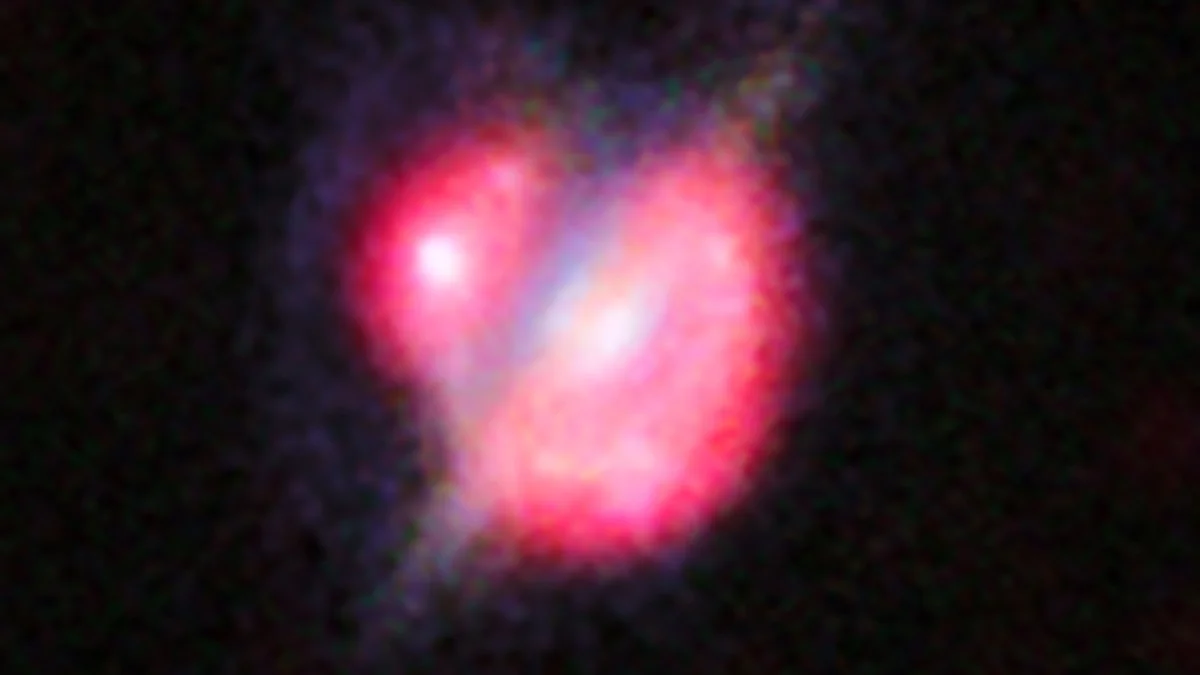
Astronomers using the MeerKAT radio telescope have detected the brightest and most distant hydroxyl gigamaser, produced when gas in colliding galaxies stimulates hydroxyl molecules to emit intense microwaves. The signal, traveling about 7.8–8 billion light-years, is magnified by a foreground galaxy acting as a gravitational lens, making it appear exceptionally bright. The discovery advances study of high-redshift OH megamasers and galaxy mergers and is published (preprint available) in Monthly Notices of the Royal Astronomical Society Letters.
- Astronomers Spot a Record-Breaking 'Space Laser' 8 Billion Light-Years Away ScienceAlert
- 'Truly extraordinary': Mega-laser shooting at us from halfway across the universe is the brightest 'cosmic beacon' we've ever seen Live Science
- MeerKAT discovers record-breaking cosmic laser halfway across the universe Phys.org
- Astronomers Spot Huge Microwave Laser Blasting Into Space Futurism
- MeerKAT discovers largest-ever cosmic laser 8 billion light-years away The Brighter Side of News
Want the full story? Read the original reporting
Read on ScienceAlert