
Engineers achieve time crystallization in active metamaterials via wave coarsening
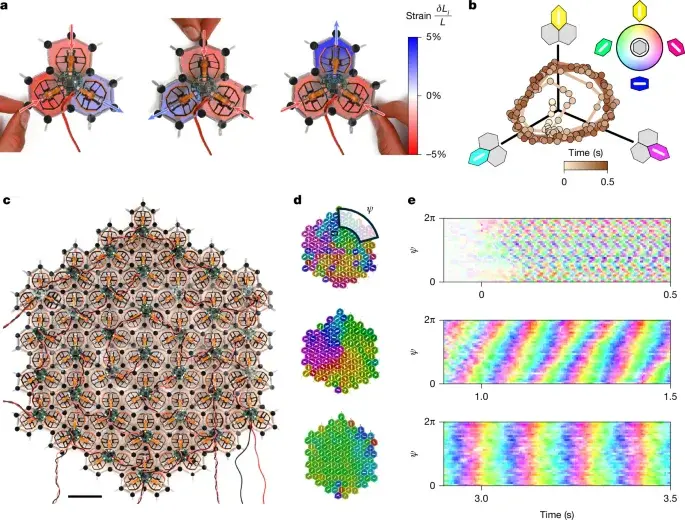
Researchers have demonstrated a new form of time crystallization in mechatronic metamaterials, where vibrations spontaneously coarsen into a globally synchronized state. Published in Nature, the study shows that breaking momentum conservation through non-reciprocal interactions allows short-wavelength vibrations to grow into a single, stable rhythm without external control.
Key points
- A team led by Corentin Coulais and co-leads Jonas Veenstra and Jack Binysh observed 'wave coarsening' in 1D and 2D active elastic media.
- The process involves vibrations growing in wavelength, period, and amplitude until the system reaches a globally synchronized time crystal state.
- Experiments used a 2D honeycomb structure with 37 active units and a 1D elastic ring with 24 motorized units, both oscillating initially at approximately 30 hertz.
- The phenomenon relies on non-reciprocal interactions, where the response of one component to another is not mirrored, breaking momentum conservation.
- The resulting synchronized state is robust against random disturbances and maintains stability as the size of the material increases.
- The team plans to extend this research to 3D active materials to enable shape changes and directed motion without central controllers.
Background
This research builds on prior work in active matter and non-reciprocal physics, including studies on odd elasticity and topological edge modes in active liquids. It follows a trend of using engineered materials to explore non-equilibrium states, distinct from recent coverage of natural wave phenomena like El Niño-driven Kelvin waves or geopolitical shifts.
How outlets are covering it
Nature emphasizes the fundamental physics of wave coarsening as a universal organizing principle for nonlinear waves, drawing parallels to diffusive relaxation in magnetized metals. Bioengineer.org frames the discovery primarily through the lens of robotics, highlighting the potential for self-organizing machines that do not require central controllers. Interesting Engineering focuses on the engineering achievement, noting that while the material synchronizes, it has not yet demonstrated controlled switching between multiple practical robotic tasks. All sources agree on the role of non-reciprocal interactions but differ in emphasis: Nature on theoretical implications, Bioengineer.org on biological inspiration, and Interesting Engineering on current limitations.
Why it matters
This discovery provides a new mechanism for controlling complex motion in active materials, potentially leading to multifunctional robots that derive their behavior from material properties rather than programmed instructions. It also offers insights into the transient physics of systems with non-potential interactions, which could influence fields ranging from acoustics to optomechanics.
What to watch
The researchers aim to develop 3D active materials to investigate how wave coarsening behaves in three dimensions and how it can be harnessed for shape changes. They also plan to explore switching between distinct stable motion patterns within a single material to achieve different robotic functions.
- Wave coarsening drives time crystallization in mechatronic metamaterials Nature
- Robotic 'time crystal' organizes itself into a single rhythm despite random disturbances Phys.org
- A new material that spontaneously moves back-and-forth, forming crystal-like patterns Universiteit Leiden
- Vibrating metamaterial syncs itself into a single rhythm, like musicians finding the same beat Bioengineer.org
- 37-unit robotic material synchronizes movement without a clock or central control Interesting Engineering
Want the full story? Read the original reporting
Read on Nature