Tag

Non Reciprocal Interactions

All articles tagged with #non reciprocal interactions

Self-Organizing Vibrations Create New Time Crystal in 3D-Printed Metamaterials
science-and-technology1 month ago

Self-Organizing Vibrations Create New Time Crystal in 3D-Printed Metamaterials

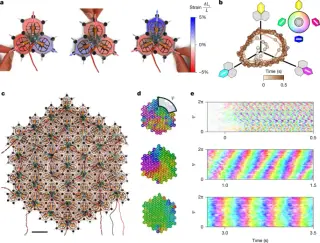
Physicists have discovered a new mechanism for time crystallization called 'wave coarsening,' where vibrations in engineered materials spontaneously synchronize without external timing. Using 3D-printed honeycomb and ring structures, researchers demonstrated that non-reciprocal interactions allow small, rapid oscillations to merge into a single, stable rhythm. This self-organizing process offers a potential route to robust temporal order in active matter, distinct from traditional time crystals that require external driving forces.
Engineers achieve time crystallization in active metamaterials via wave coarsening
science1 month ago

Engineers achieve time crystallization in active metamaterials via wave coarsening

Researchers have demonstrated a new form of time crystallization in mechatronic metamaterials, where vibrations spontaneously coarsen into a globally synchronized state. Published in Nature, the study shows that breaking momentum conservation through non-reciprocal interactions allows short-wavelength vibrations to grow into a single, stable rhythm without external control.

Light-Induced Non-Reciprocal Magnetism Challenges Traditional Physics
science1 year ago

Light-Induced Non-Reciprocal Magnetism Challenges Traditional Physics

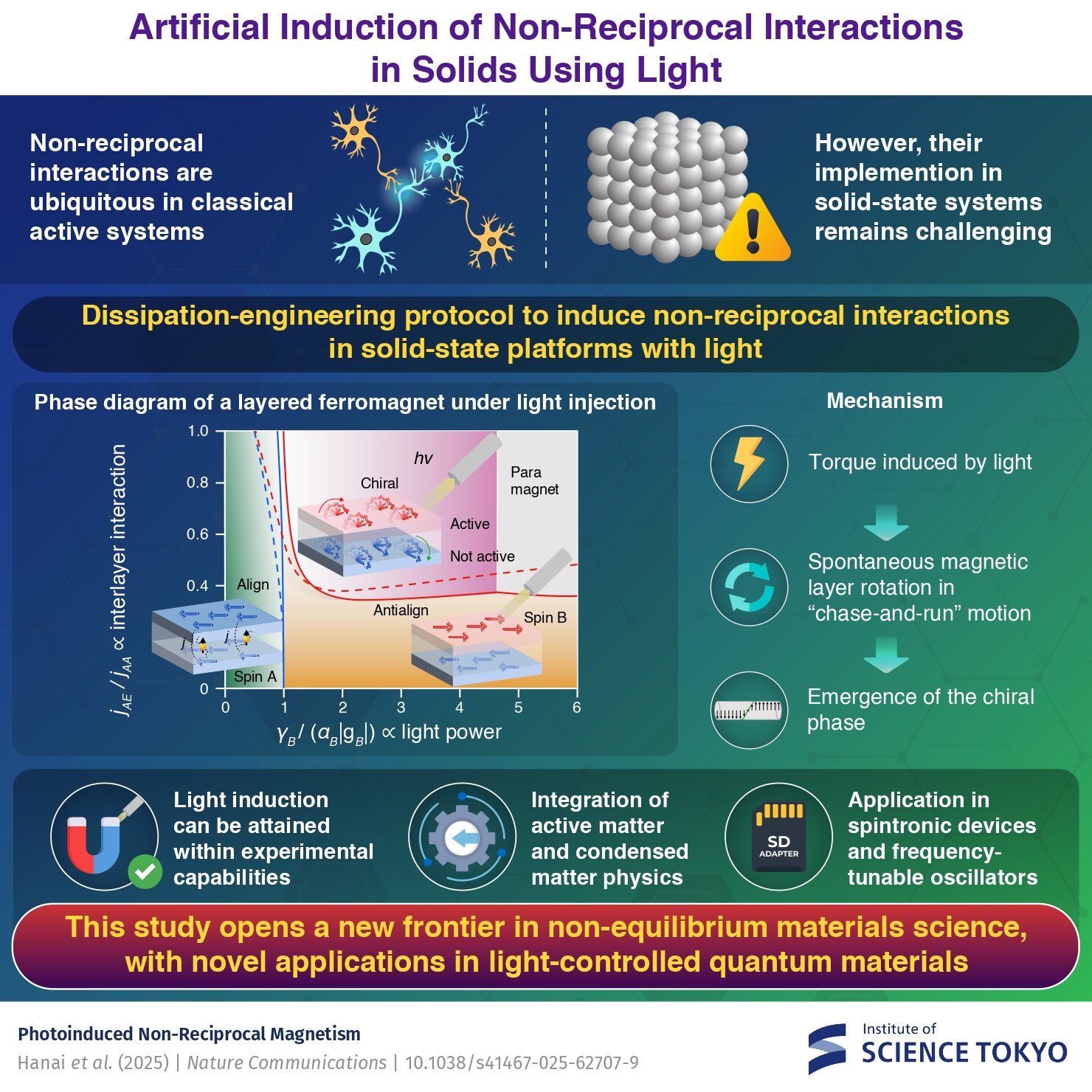
Researchers from Japan have theoretically demonstrated that shining specific light on magnetic metals can induce non-reciprocal magnetic interactions that effectively violate Newton's third law, leading to a novel chiral phase with persistent rotation, opening new avenues in non-equilibrium materials science and potential technological applications.

"Solitons: Time, Space, and Rule Bending"
science-and-technology2 years ago

"Solitons: Time, Space, and Rule Bending"

Researchers from the University of Amsterdam have demonstrated the unique behavior of topological solitons in a robotic metamaterial, showing that they can be harnessed through non-reciprocal interactions to control the movement of robots, sense their surroundings, and communicate. The solitons, which behave like particles but retain their shape and cannot disappear, are being studied for their potential applications in materials science, robotics, and engineering, offering new possibilities for self-propelled motion and advanced functionality.

"Study Unveils Revolutionary Kinetic Asymmetry in Molecular Interactions"
science-and-technology2 years ago

"Study Unveils Revolutionary Kinetic Asymmetry in Molecular Interactions"

Researchers have discovered a new type of non-reciprocal molecular interaction, termed kinetic asymmetry, which does not require external forces such as hydrodynamics. This phenomenon could redefine our understanding of molecular interactions and has implications for the evolution of life and the design of molecular machines. The study, conducted by scientists from the University of Maine and Penn State, suggests that local gradients of reactants and products around catalysts, like enzymes, can lead to one molecule being repelled by yet attracting another molecule. This insight into kinetic asymmetry could also inform the development of synthetic molecular motors and pumps, offering a deeper understanding of the origins of life and the complex behavior of matter.

"Sperm's Surprising Physics-Defying Feat Stuns Scientists"
science3 years ago

"Sperm's Surprising Physics-Defying Feat Stuns Scientists"

Scientists have discovered that sperm and single-celled algae defy Newton's third law of motion due to their non-reciprocal interactions with their surroundings. These microscopic organisms move through viscous fluids using whip-like tails or flagella, which possess an "odd elasticity" that allows them to propel forward without losing much energy to the surrounding fluid. The researchers also introduced a new term, "odd elastic modulus," to describe the internal mechanics of flagella. The findings could have implications for designing self-assembling robots and understanding collective behavior.