
ISS Crew Captures Rare Lunar Rock Formation in Madagascar
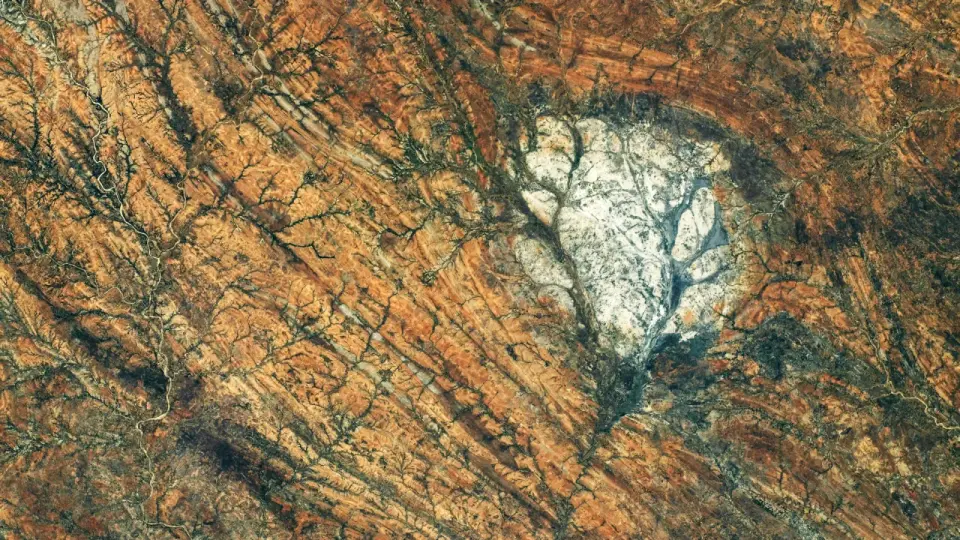
An astronaut on the International Space Station photographed the Saririaky anorthosite massif in southern Madagascar, a 100-square-kilometer formation of rock similar to lunar highlands. The image, taken on August 28, 2026, highlights a geological feature formed over 600 million years ago. This terrestrial deposit offers scientists a valuable comparison for studying the Moon's ancient crust, as limited lunar samples restrict direct analysis. The surrounding landscape also preserves evidence of massive tectonic forces from the assembly of the supercontinent Gondwana.
Key points
- Astronauts aboard the ISS captured a high-resolution image of the Saririaky anorthosite massif in southern Madagascar on August 28, 2026.
- The formation covers approximately 100 square kilometers and consists of bright, reflective igneous rock known as anorthosite.
- Anorthosite is the primary component of the Moon's bright highlands, which are visible to the naked eye from Earth.
- Geological research indicates the Saririaky formation originated during the late Precambrian era, at least 600 million years ago.
- The area lies within a ductile shear zone, where ancient continental collisions during the formation of Gondwana caused intense rock deformation.
- Some researchers suggest a second anorthosite massif 60 kilometers north was once connected to Saririaky but was separated by tectonic stretching, a process called boudinage.
Background
NASA has frequently used orbital imagery to highlight geological and cultural features on Earth, as seen in recent coverage of NASA's Landsat 9 mapping of Vasquez Rocks and the use of decorrelation stretch techniques to reveal hidden rock art. While previous focus has been on Mars-related discoveries, such as organic molecules found by Curiosity, this story shifts attention to terrestrial geology that mirrors lunar history.
Why it matters
The Saririaky formation provides a critical terrestrial analog for understanding the Moon's early formation. Because lunar samples are scarce, studying Earth's anorthosite deposits helps scientists interpret the processes that created the Moon's highlands over 4 billion years ago. Additionally, the deformation patterns in Madagascar offer insights into the immense forces involved in assembling ancient supercontinents, enhancing our understanding of Earth's tectonic history.
What to watch
Researchers will continue to analyze the geological similarities between the Saririaky massif and lunar samples to refine models of planetary crust formation. Further study of the boudinage structures in the region may clarify the tectonic history of the Gondwana supercontinent. NASA may release additional high-resolution imagery from the ISS to support ongoing geological surveys of similar formations worldwide.
Want the full story? Read the original reporting
Read on Science Daily