
JWST Red Dots Linked to Rapid Black Hole Growth in Early Universe
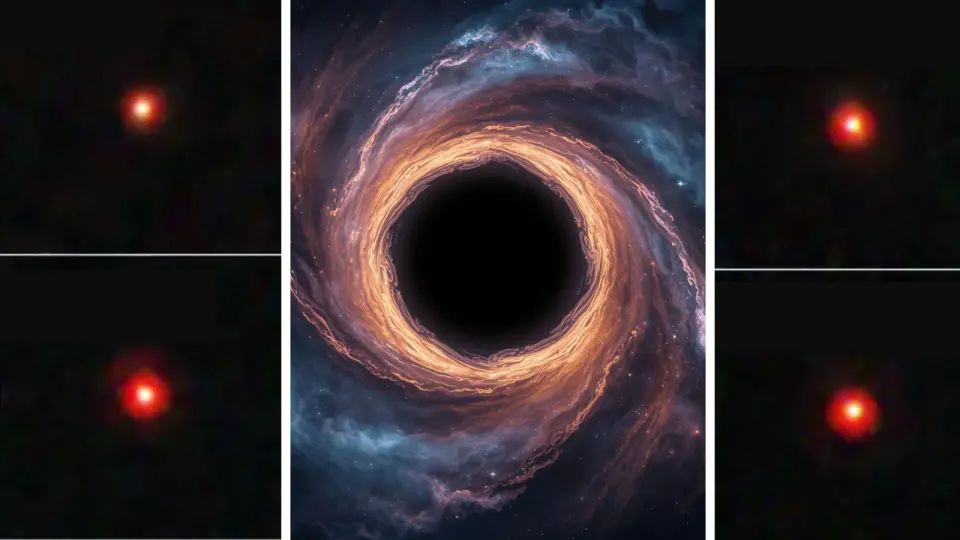
New simulations and spectral analyses suggest that 'little red dots' seen by the James Webb Space Telescope are not galaxies, but supermassive black holes rapidly accreting gas in the early universe. This finding helps explain how massive black holes formed within a billion years of the Big Bang.
Key points
- JWST discovered 'little red dots' appearing 600 million to 1 billion years after the Big Bang, which vanish by 1.5 billion years.
- Researchers propose these objects are 'black hole stars,' where a massive black hole is enveloped in a dense, optically thick gas cocoon.
- Spectral analysis of GLIMPSE-17775 revealed over 40 lines, including hydrogen, oxygen, and iron, supporting the black hole star hypothesis.
- Simulations from the Max Planck Institute show these objects emerge naturally as black holes grow rapidly via super-Eddington accretion.
- The debate continues over whether these are distinct objects or simply early phases of galaxy and black hole evolution.
Background
Since 2026, JWST has identified numerous 'little red dots' in the early universe, sparking debate over their nature. Previous coverage highlighted MoM-BH*-1 as a potential 'black hole star' and noted conflicting theories regarding their composition and origin.
How outlets are covering it
Space.com and bgr.com emphasize the 'black hole star' model, where a black hole is wrapped in a gas cocoon, explaining the red color and high luminosity. Gizmodo highlights the collaborative effort to solve this puzzle, noting that while the term 'black hole star' is debated, the consensus is that these objects involve rapid black hole growth. Starlust.org focuses on the spectral evidence, such as the Balmer break, which indicates dense hydrogen rather than dust. All sources agree that these findings challenge existing models of black hole formation in the early universe.
Why it matters
Understanding the nature of little red dots could resolve the mystery of how supermassive black holes formed so early in the universe, potentially rewriting astrophysical models of galaxy and black hole evolution.
What to watch
Astronomers plan to observe more red dots in detail to confirm the black hole star model and understand the population of these objects, aiming for a concrete answer within the next couple of years.
- The James Webb Space Telescope's mysterious Little Red Dots may be overfeeding black holes Space
- The Universe Is Full of Tiny Red Dots—and They're One of Astronomy's Biggest Discoveries in Decades Gizmodo
- JWST Spots a Black Hole Buried in a Gas Cocoon Gadget Review
- The James Webb Space Telescope Discovered This Little Red Dot Is Actually An Ancient Black Hole bgr.com
- JWST's mysterious red dot may hide a black hole 100,000 times as massive as the Sun starlust.org
Want the full story? Read the original reporting
Read on Space