
Keck Observatory Leads Global Astronomy with Record-Breaking Discoveries
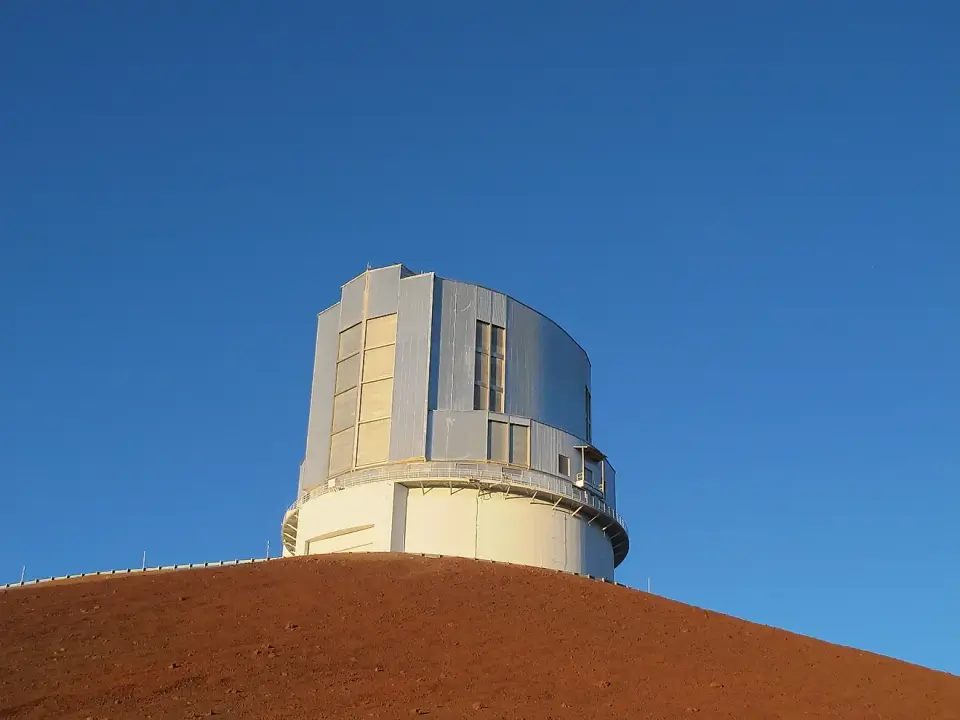
The W.M. Keck Observatory on Mauna Kea, Hawaii, remains the largest working observatory in the United States, featuring twin 10-meter telescopes that often outperform Hubble in near-infrared imaging. Located at 13,600 feet, the site benefits from stable atmospheric conditions and minimal light pollution. Recent achievements include mapping the Andromeda Galaxy, identifying the distant galaxy EGSY8p7, and observing the forming planet Elias 2-24 b. The facility utilizes advanced adaptive optics and multiple spectroscopic instruments to study dark matter, quasars, and the early universe.
Key points
- The W.M. Keck Observatory is situated on the summit of Mauna Kea, Hawaii, at an elevation of 13,600 feet (4,145 meters).
- It features two telescopes, Keck I and Keck II, each with a 10-meter diameter mirror composed of 36 hexagonal segments.
- Adaptive optics systems correct atmospheric turbulence 2,000 times per second, allowing for sharper near-infrared images than the Hubble Space Telescope.
- Key discoveries include mapping stellar motions in the Andromeda Galaxy and identifying the galaxy EGSY8p7, which dates to 600 million years after the Big Bang.
- The observatory currently studies the forming planet Elias 2-24 b, which is actively accreting material from its host star's disk.
- The site uses specialized instruments like MOSFIRE, DEIMOS, and the new Keck Planet Finder to analyze cosmic phenomena.
Background
The W.M. Keck Observatory has long been a cornerstone of astronomical research, leveraging the unique atmospheric stability of Mauna Kea. Previous coverage in our archive has not addressed this specific facility, but the observatory's role in defining the limits of ground-based astronomy is well-established. Its location in Hawaii, surrounded by thermally stable seas, provides a consistent observing environment that complements space-based telescopes. The facility's commitment to Native Hawaiian cultural sites is also a noted aspect of its operations.
Why it matters
The Keck Observatory's ability to outperform space telescopes in certain wavelengths underscores the continued importance of ground-based astronomy. Its discoveries, such as the mapping of Andromeda and the detection of early-universe galaxies, provide critical data for understanding cosmic evolution. The ongoing study of forming planets like Elias 2-24 b offers insights into planetary formation processes, which are essential for understanding our own solar system's origins. As technology advances, the Keck Observatory remains a vital tool for pushing the boundaries of astronomical knowledge.
What to watch
The Keck Observatory will continue to utilize its advanced instruments, including the newly installed Keck Planet Finder, to study exoplanets and other celestial objects. Ongoing research into the early universe and dark matter will likely yield new insights as the observatory maintains its position as a leader in astronomical discovery. The facility may also expand its public engagement efforts through its visitors gallery and educational programs.
Want the full story? Read the original reporting
Read on WorldAtlas