
Mars Gullies Formed by Dry Ice Avalanches, Not Water or Geysers
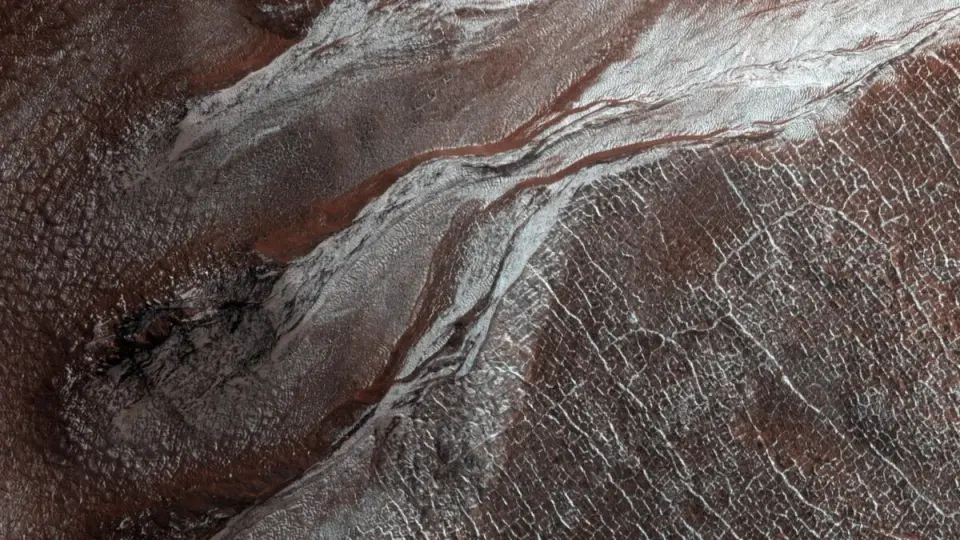
A new study using data from Mars Express and the Mars Reconnaissance Orbiter concludes that Martian gullies are not carved by liquid water or CO2 geysers, but by dry ice avalanches during seasonal sublimation.
Key points
- A French team led by Apolline Leclef analyzed decades of data from Mars Express and the Mars Reconnaissance Orbiter to determine the origin of Martian gullies.
- The study focuses on Sisyphi Cavi, a region near Mars' south pole, and finds no spectral evidence of liquid water during the spring season when gullies form.
- The timing of CO2 geysers, which peak around the spring equinox, does not align with the mid-to-late spring activity of gullies, ruling them out as the primary cause.
- The researchers propose that CO2 ice-driven fluidization or avalanches, where gas acts as a lubricant for dry ice and dust, are responsible for carving these channels.
- The findings are based on a preprint posted to arXiv on September 3, 2026, and have not yet undergone peer review.
Background
The debate over Martian gullies has persisted since their discovery, with early theories suggesting they were evidence of liquid water. In 2014, NASA suggested that seasonal freezing of carbon dioxide was responsible. This new study builds on that, providing a more specific mechanism for how dry ice shapes the landscape.
How outlets are covering it
Gizmodo, The Daily Galaxy, and Srpske Novine all report on the same study, emphasizing the shift away from water and geysers as the cause of Martian gullies. Gizmodo and The Daily Galaxy highlight the 'air hockey puck' analogy for CO2 fluidization, while Srpske Novine provides more detail on the specific instruments used (OMEGA and CRISM) and the location of the study site. All sources agree that the findings are preliminary and based on a preprint.
Why it matters
This study refines our understanding of Mars' surface processes and the role of carbon dioxide in shaping its landscape. It also impacts the search for signs of past or present life, as it further diminishes the likelihood of liquid water being a current factor in gully formation.
What to watch
The study awaits peer review, and further research will be needed to determine if the findings apply to gullies at other latitudes on Mars. The team also noted that the data do not rule out water playing a role in earlier geological epochs.
- Scientists Thought Ancient Water Carved Martian Gullies. New Analysis Says Otherwise Gizmodo
- What's carving active gullies on Mars? It's not water Phys.org
- Mars: Gullies Carved by Dry Ice, Not Water srpske.rs
- Scientists Discover Why Mars Has Earth-Like Gullies Without a Single Drop of Liquid Water The Daily Galaxy
Want the full story? Read the original reporting
Read on Gizmodo