
New Software Reveals Hidden Giant Planet in Existing James Webb Data
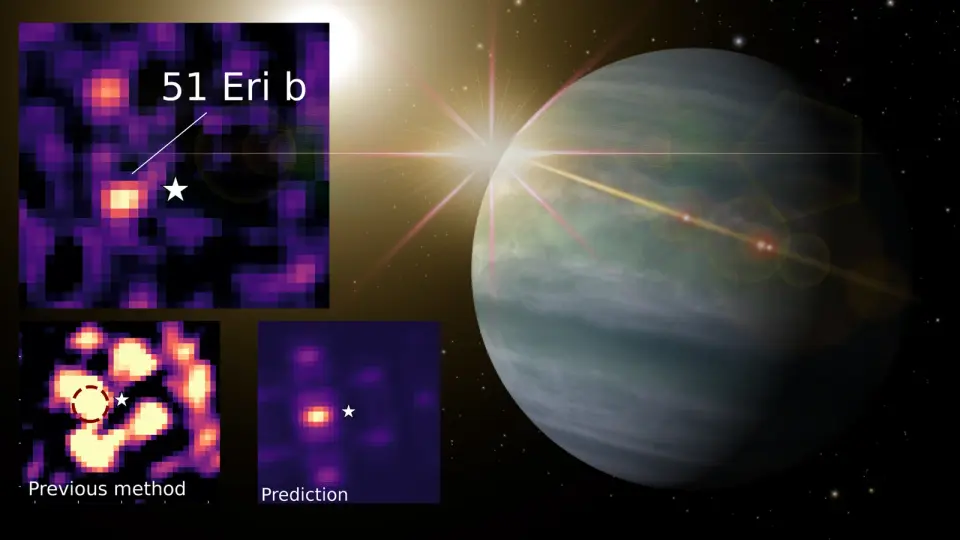
A Northwestern University team developed a new software technique called FLIP that improves the James Webb Space Telescope’s ability to detect exoplanets by up to 15 times. By creating a digital twin of the telescope to account for minor instabilities, the method successfully revealed the giant planet 51 Eridani b in data previously obscured by starlight. This advance could help future observatories detect Earth-like worlds without requiring extreme hardware stability.
Key points
- Researchers at Northwestern University created FLIP, a physics-based algorithm that models how starlight travels through the James Webb Space Telescope (JWST).
- The technique addresses telescope instability, such as mirror vibrations from cryocoolers, which previously left residual glare that hid faint planets.
- FLIP improved detection sensitivity by 2 to 15 times compared to standard image-processing methods like KLIP.
- The method successfully revealed 51 Eridani b, a gas giant with 11 Jupiter masses located 97 light-years away, in JWST data collected two years ago.
- The discovery was made at a 4.3-micron wavelength, where carbon dioxide absorption makes the planet particularly faint and difficult to observe.
Background
Direct imaging of exoplanets has long been hindered by the overwhelming brightness of host stars, which are roughly 100,000 times brighter than their planets. While previous methods relied on subtracting reference images of other stars, this approach was limited by the inability to perfectly replicate the unique optical imperfections and instabilities of the telescope at the moment of observation. Recent archive coverage noted that FLIP was already recognized for boosting sensitivity, but this new study confirms its efficacy on real, on-sky data, moving the technique from theoretical potential to practical application.
How outlets are covering it
All sources agree on the core finding: FLIP significantly enhances JWST’s capabilities. However, they emphasize different aspects. Space.com and Scientific American focus on the practical outcome, highlighting that the planet was 'hidden' in existing data and that the method could ease the engineering requirements for NASA’s future Habitable Worlds Observatory. The Nature abstract provides the technical depth, detailing the use of automatic differentiation and multistage optimization to tune millions of parameters. Northwestern Now emphasizes the human element, noting that while the tools resemble AI, the method relies on known physics rather than machine learning to identify planets. Dimitri Mawet, a senior research scientist at NASA’s Jet Propulsion Laboratory, noted in Scientific American that while model-based subtraction has been discussed for a decade, this is the first time it has successfully outperformed empirical reference methods on real data.
Why it matters
This advancement allows astronomers to extract more data from existing telescope observations without upgrading hardware. By correcting for minor instabilities in software, FLIP could make the construction of future observatories like the Habitable Worlds Observatory more feasible, as it may reduce the need for picometer-level mechanical stability. Ultimately, this could lead to the detection of Earth-like planets, helping scientists understand how common our solar system is in the universe.
What to watch
The research team plans to apply FLIP to other existing JWST datasets to uncover additional hidden exoplanets. They also intend to use the 4.3-micron detection of 51 Eridani b to analyze the planet’s atmospheric composition, specifically looking for carbon dioxide. The technique is expected to be adopted by the broader astronomical community to improve sensitivity for current and future space-based observatories, including the Nancy Grace Roman Space Telescope.
- Giant exoplanet emerges from the dark when the James Webb Space Telescope turns out the starlight Space
- Imaging exoplanets below the telescope stability limit Nature
- Hidden planet emerges from the glare Northwestern Now News
- NASA’s James Webb Space Telescope is wobbly—scientists have a fix that could reveal new alien worlds Scientific American
- Software squeezes more data out of Webb Telescope for imaging exoplanets Ars Technica
Want the full story? Read the original reporting
Read on Space