
Pseudomonas aeruginosa Uses Mechanical Collisions to Adaptively Regulate Collective Movement
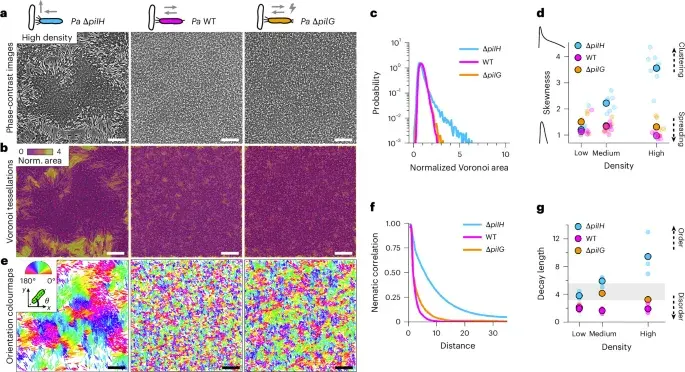
Researchers demonstrate that Pseudomonas aeruginosa bacteria actively regulate their collective order by sensing physical collisions with neighboring cells. This mechanosensory feedback allows bacteria to switch between disordered exploration in crowded areas and coordinated movement at the colony front, enhancing navigation through complex environments.
Key points
- Pseudomonas aeruginosa uses the Pil-Chp mechanosensory system to detect cell-cell collisions, triggering contact-induced reversals (CR) that disrupt collective alignment in dense populations.
- Wild-type bacteria adapt their motility based on local density: they move isotropically in crowded cores to avoid trapping but align directionally at the colony edge to explore new space.
- Non-reversing mutants (ΔpilH) form highly ordered clusters that move fast individually but fail to spread collectively, while wild-type strains outcompete them by balancing dispersal and coordination.
- In micromaze experiments, wild-type bacteria explored 92% of the area and escaped 20% of the time, compared to 65% exploration and 1% escape for non-reversing mutants, proving the navigational advantage of mechanosensing.
- This feedback mechanism operates independently of chemical gradients like quorum sensing, allowing bacteria to navigate heterogeneous environments where physical obstacles replace chemical cues.
Background
Previous research, such as the 2026 study on T cells sensing tissue rigidity, established that mechanical cues can influence biological behavior beyond biochemical signals. Similarly, this study challenges the classical view that bacterial collective order is merely an emergent property of physical interactions, showing instead that it is actively regulated by sensory feedback.
Why it matters
Understanding how bacteria use mechanical feedback to navigate complex environments offers insights into infection dynamics and biofilm formation. This knowledge could inform the development of new antimicrobial strategies that disrupt bacterial coordination or improve the design of active matter systems and robotic swarms that rely on adaptive collective behavior.
What to watch
Future research may explore how this mechanosensory feedback applies to other bacterial species and eukaryotic cells, potentially revealing convergent evolutionary strategies for controlling collective organization in diverse biological and synthetic systems.
Want the full story? Read the original reporting
Read on Nature