
Hawaii Telescope Captures First Direct Evidence of Solar Vortices Driving Magnetic Activity
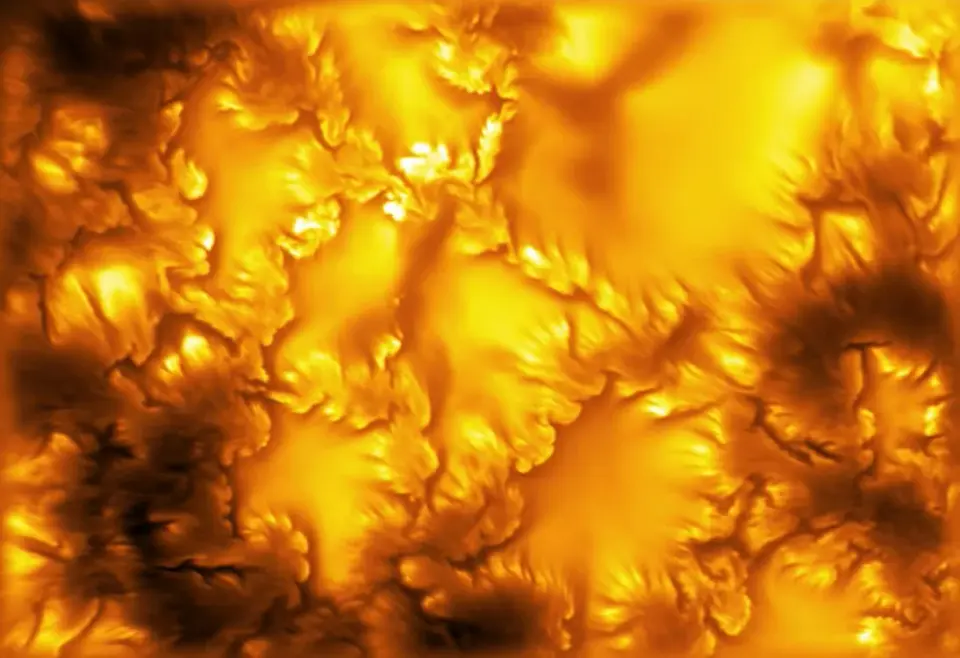
A team of international scientists has confirmed the presence of Kelvin-Helmholtz instabilities on the Sun's surface for the first time. Using the Daniel K. Inouye Solar Telescope in Hawaii, researchers captured the highest-resolution images of the solar photosphere, revealing tiny whirlpool-like vortices at the edges of magnetic fields. These findings, published in Nature, suggest these vortices are a primary mechanism for transporting energy and mixing plasma, potentially explaining why the Sun's outer atmosphere is hotter than its surface and how magnetic energy builds up to drive solar flares.
Key points
- The Daniel K. Inouye Solar Telescope (DKIST) on Maui captured the highest-resolution images of the Sun's surface, revealing vortex structures at a scale of approximately 19 km.
- The observed vortices are identified as Kelvin-Helmholtz instabilities (KHI), a phenomenon previously only theorized for the solar photosphere but now confirmed through observation and simulation.
- The study, led by Dr. David Kuridze of the National Solar Observatory, involved collaboration with the High Altitude Observatory and the Max Planck Institute for Solar System Research.
- KHI vortices are believed to drive 'flux braiding,' a process where magnetic field lines twist and reconnect, releasing energy that powers solar flares and coronal mass ejections.
- The discovery may help explain the 'coronal heating problem,' where the Sun's outer atmosphere is significantly hotter than its surface, by showing how energy is transported from the surface to the corona.
Background
This discovery builds on previous theoretical models that predicted the existence of Kelvin-Helmholtz instabilities in the Sun's photosphere but lacked observational proof due to insufficient resolution. Earlier archive coverage from August 2026 highlighted the initial announcement of these findings, emphasizing the unprecedented detail provided by the 4-meter mirror of the DKIST. The current report synthesizes the initial announcement with detailed analysis from the journal Nature and press releases from the National Solar Observatory, confirming the widespread nature of these vortices and their role in solar dynamics.
How outlets are covering it
CNN and the National Solar Observatory (NSO) emphasize the practical implications of the discovery for space weather forecasting, noting that understanding these micro-scale vortices could improve predictions of solar flares that disrupt satellites and power grids. The journal Nature focuses on the scientific validation, highlighting the close agreement between the DKIST observations and high-resolution numerical simulations using the MURaM code. Good News Network frames the discovery as a breakthrough in understanding fundamental physics, comparing the solar vortices to familiar phenomena like ocean waves and Jupiter's Great Red Spot. All sources agree on the significance of the finding but differ in emphasis: CNN and NSO focus on technological impacts, Nature on methodological validation, and GNN on the broader scientific curiosity.
Why it matters
Understanding the mechanism behind solar magnetic activity is crucial for predicting space weather events that can damage infrastructure on Earth. By identifying Kelvin-Helmholtz instabilities as a key driver of magnetic energy buildup and release, scientists can develop more accurate models of solar behavior. This could lead to better warnings for potential disruptions to satellites, power grids, and communication systems, enhancing global resilience against solar storms.
What to watch
Researchers plan to use automated software to analyze more DKIST data to quantify the energy transport and magnetic diffusion caused by these vortices. Future observations will aim to link these micro-scale events to larger solar phenomena, improving the accuracy of space weather forecasts. The team also intends to conduct longer observation sessions to fully map the magnetic field and understand the energy budgets involved in these processes.
- Highest Resolution View of the Sun Reveals Breaking Waves and Magnetic Mysteries Good News Network
- Ubiquitous Kelvin–Helmholtz instabilities driving plasma mixing on the Sun Nature
- Unprecedented images reveal hidden process driving solar activity cnn.com
- NSF Inouye Solar Telescope Enables Major Discovery of a Hidden Solar Process - NSO NSO - National Solar Observatory
- 2026 August 6 – New Sharpest Image of the Sun Uncovers Instability NASA (.gov)
Want the full story? Read the original reporting
Read on Good News Network