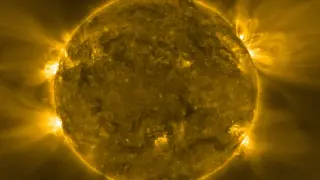
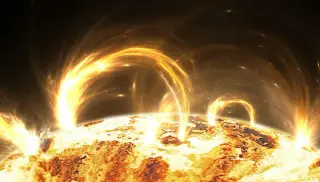
ESA’s Solar Orbiter has identified the origin of magnetic switchbacks, S-shaped kinks in the solar wind, by analyzing particle composition. A new study confirms these structures originate from hot, closed magnetic loops on the Sun’s surface via interchange reconnection, resolving a long-standing debate about their formation.
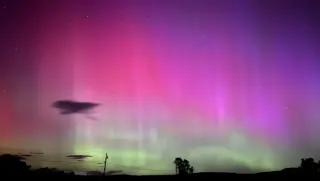
Three coronal mass ejections (CMEs) from the sun are expected to trigger geomagnetic storms that could make the northern lights visible in New Hampshire skies this weekend. The first CME is anticipated to impact Earth’s atmosphere on Friday afternoon, with additional chances for aurora visibility on Saturday and Sunday nights. Visibility depends on clear skies, the strength of the solar wind, and local light pollution. Experts recommend viewing from dark, rural locations and using camera equipment to capture colors invisible to the naked eye.
A G2-class geomagnetic storm, triggered by recent solar flares, is expected to produce visible aurora australis displays across southern Australia on October 11 and 12. The event coincides with a new moon, providing optimal dark-sky conditions for observation in Tasmania, Victoria, and parts of New South Wales, South Australia, and Western Australia.
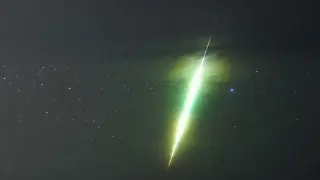
The Draconid meteor shower peaks on October 8, 2026, offering a rare evening viewing window from 7 p.m. to 9 p.m. depending on time zone. Unlike most showers, it is visible shortly after sunset rather than pre-dawn. While activity is typically low at 5-10 meteors per hour, the proximity of Comet 21P/Giacobini-Zinner to Earth creates a possibility for a meteor storm. Clear skies and a waning crescent moon provide ideal conditions for observers in the Northern Hemisphere.
A fourth coronal mass ejection (CME) from the sun on October 8 has intensified forecasts for aurora visibility across the northern United States. NOAA predicts G1 to G2 geomagnetic storms for October 8-9, potentially allowing northern lights to be seen as far south as New York and Idaho. The activity stems from solar flares in active region AR4549, with the latest CME potentially catching up to earlier ejections to enhance geomagnetic conditions.
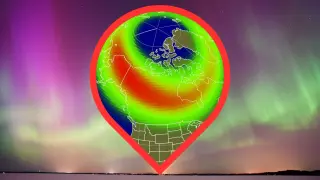
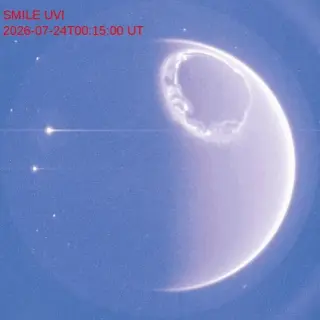
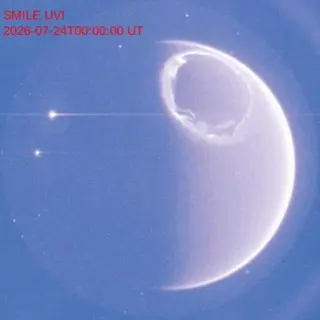
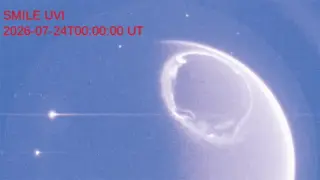
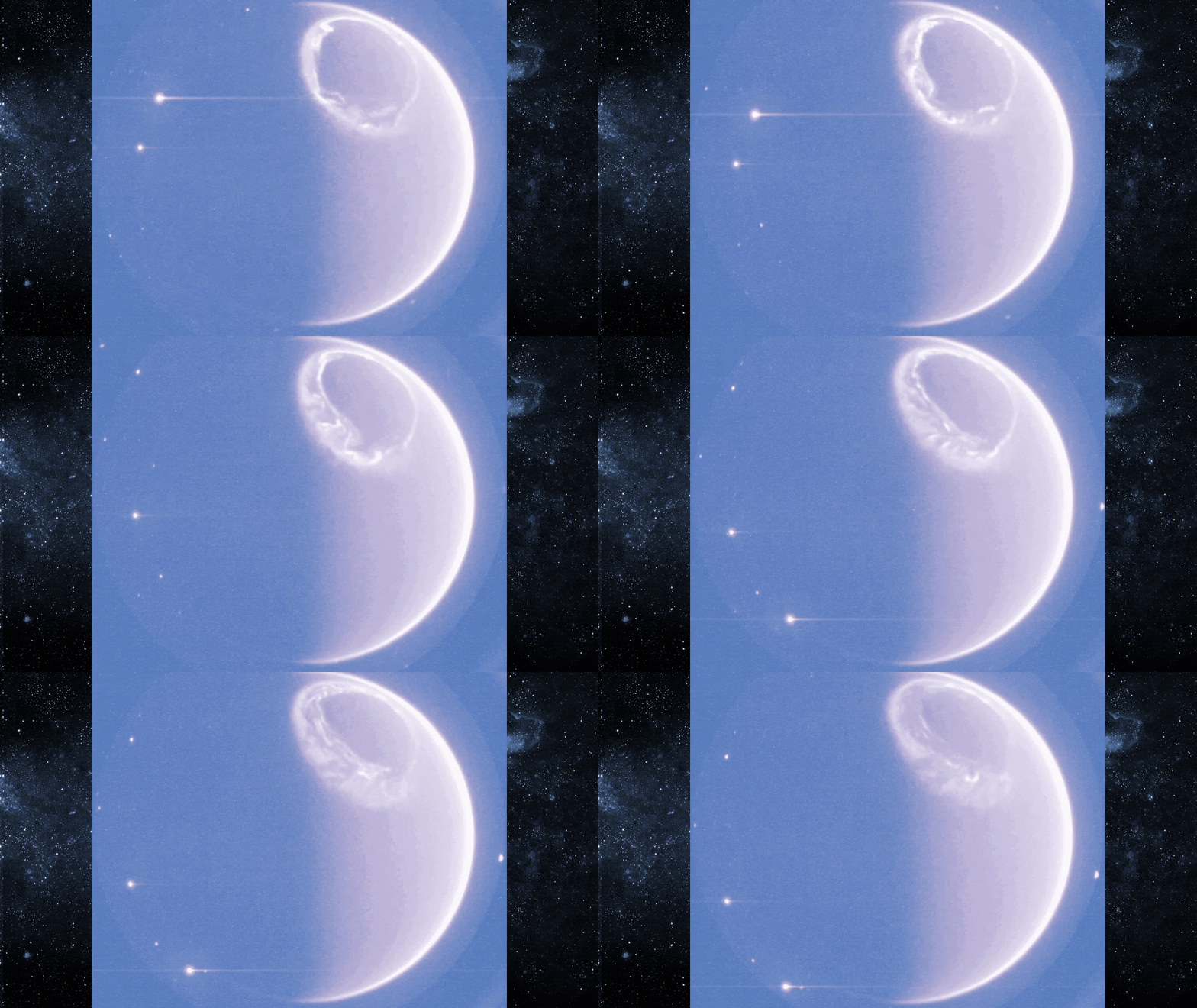
The joint European-Chinese SMILE spacecraft has successfully captured the first complete ultraviolet images of Earth's auroral oval since 2008. These images, taken during a daytime substorm, reveal the full ring of northern lights around the North Pole, a view previously impossible from the ground. The mission, which launched in May 2026, aims to study how solar wind interacts with Earth's magnetosphere to improve space weather forecasting and protect infrastructure.
The joint ESA and Chinese Academy of Sciences SMILE spacecraft has released its first ultraviolet images of a complete auroral oval, revealing daytime auroras above Earth's magnetic poles. Captured in late July, the footage shows the turbulent nature of solar wind interactions with the magnetosphere, aiding future space weather protection efforts.
On October 6, 2026, the waning crescent Moon passed in front of Jupiter and its four Galilean moons, creating a quintuple occultation visible across North America. The event occurred in the pre-dawn hours, with Jupiter disappearing behind the Moon's bright limb and reappearing from the dark limb. Observers in the eastern United States and Canada had the best views, while those in the western states saw only the reappearance. The event was highlighted for its rarity, occurring roughly once every 13 years for a given location, and was visible to the naked eye or with binoculars and telescopes.
The joint European-Chinese SMILE satellite officially began science operations on September 23, 2026, after a successful commissioning phase. Its first ultraviolet images, captured on July 24, reveal auroras visible in broad daylight over the North Pole. The mission aims to study solar wind interactions with Earth's magnetic field, with its X-ray imager currently undergoing calibration to reduce stray light before targeting the magnetopause in mid-October.
The Solar Wind Magnetosphere Ionosphere Link Explorer (SMILE) has released its first ultraviolet images, revealing the full ring of northern lights encircling Earth’s North Pole. Captured on July 24, 2026, the footage shows auroral activity on both the day and night sides of the planet, a capability not seen since 2008. This marks the start of science operations for the joint European-Chinese mission, which aims to improve understanding of solar storms and space weather.
An astronomer is utilizing the orbital decay of Starlink satellites to create a 'planetary barometer' that measures Earth's upper atmospheric density. By tracking how quickly satellites sink due to atmospheric drag, researchers can generate real-time data on space weather conditions. This method addresses significant inaccuracies in current orbit prediction models and enhances collision avoidance capabilities in increasingly crowded low Earth orbit.
SpaceWeather.com has developed a daily 'Satellite Drag' index that uses public tracking data from over 11,000 Starlink satellites to measure Earth's upper atmospheric density. By analyzing the B-star drag terms in orbital elements, the index quantifies how much air density has changed relative to quiet days, providing a real-time barometer for space weather. The method is validated against independent constellations, including Planet Labs Doves and Amazon Kuiper, showing a 94% correlation with Starlink data. In 2026, the sink rate at 480 km ranged from 19.7 meters per day in August to 127.6 meters per day during a January geomagnetic storm. This daily metric helps calibrate orbit prediction models, which currently suffer from 20-30% errors in density estimates, and offers a new tool for collision avoidance as low Earth orbit becomes increasingly crowded.
A new study corrects a 19th-century record, moving the first known space weather disruption of technology from 1841 to 1848. Researchers found that the railway line mentioned did not exist in 1841, but a magnetic storm on October 18, 1848, aligns with the reported 16-minute train delay in Exeter, UK.
Researchers have converted data from Earth's magnetic field reversal 41,000 years ago into an audio simulation, revealing a period of severe weakening that exposed the planet to cosmic radiation. The event, known as the Laschamps excursion, saw the field drop to 5% of its normal strength for centuries, potentially impacting climate and human behavior. While current anomalies like the South Atlantic Anomaly suggest ongoing instability, experts note these do not necessarily indicate an imminent full reversal.
A new study corrects a long-standing historical error, revealing that a solar storm delayed a train in Exeter in 1848, not 1841. Researchers used archival records to match the event with a known geomagnetic storm, confirming it as one of the earliest documented cases of space weather disrupting technology.