
Hiroshima Blast Forged a Novel Silicon-Rich Alloy in Microscopic Debris
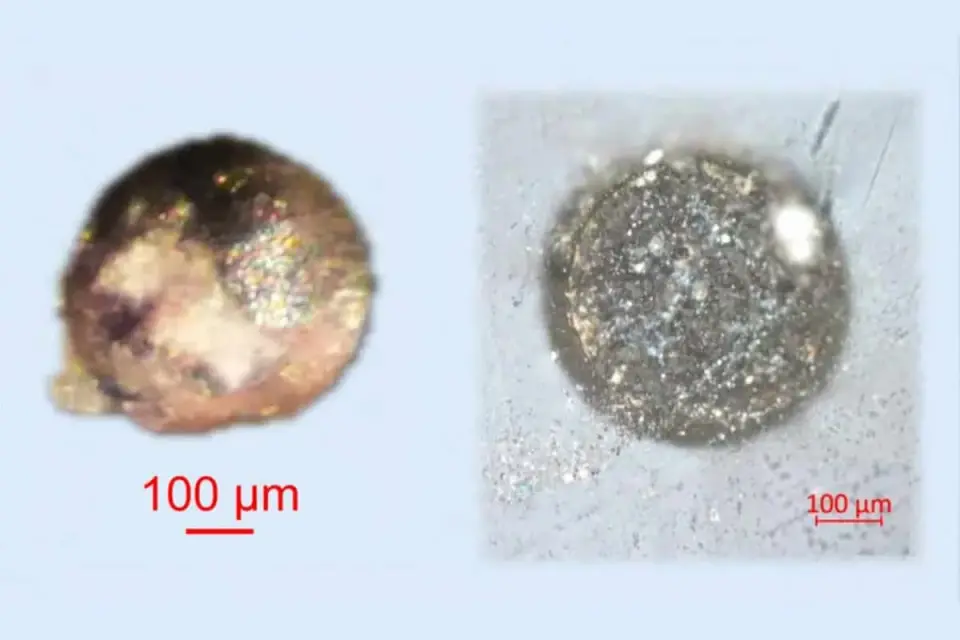
Scientists identified a previously unknown, silicon-rich metallic alloy within microscopic debris from the 1945 Hiroshima atomic bombing. The alloy, composed of iron, chromium, nickel, manganese, molybdenum, silicon, and aluminum, features a complex cubic lattice structure never before observed in nature or laboratories. Formed when the blast vaporized urban materials and rapidly cooled them, these particles serve as physical archives of the explosion's extreme conditions.
Key points
- The discovery was reported in the journal Science Advances by Luca Bindi and colleagues at the University of Florence.
- The alloy was found inside 'hiroshimaites,' glassy droplets recovered from beach sands in Hiroshima Bay.
- The specific grain measured approximately 10 micrometers in diameter, comparable to a red blood cell.
- The atomic structure is described as an ordered AlAu4 type, distinct from typical disordered high-entropy alloys.
- The rapid cooling of the fireball prevented atoms from settling into simpler, more common crystal structures.
Background
This finding extends a series of discoveries regarding materials formed by nuclear explosions. In 2021, researchers identified a quasicrystal in 'trinitite' from the 1945 Trinity test in New Mexico. A 2026 study also found a novel calcium-copper-silicon clathrate in the same Trinity debris. The 2019 study in Anthropocene first described hiroshimaites, noting their formation above 1,800 degrees Celsius. The current discovery adds to the understanding of how extreme, rapid quenching events can create exotic materials, similar to processes seen in meteorite impacts or lightning strikes.
How outlets are covering it
ZME Science emphasizes the novelty of the atomic arrangement, noting that while the elements are common, their specific cubic lattice is unprecedented. Scientific American highlights the concept of the explosion as an 'uncontrolled microexperiment,' where rapid cooling traps complex structures that would not form under stable conditions. Gizmodo focuses on the implications for nuclear forensics, suggesting these particles encode diagnostic information about the device and local environment. All three sources agree that the discovery broadens the understanding of materials formation under extreme violence, though ZME Science and Scientific American place greater weight on the materials science implications, while Gizmodo stresses the forensic potential.
Why it matters
The discovery demonstrates that nuclear detonations can create complex, ordered crystalline alloys that are difficult to replicate in laboratories. This has implications for materials science, potentially offering insights into developing new alloys with enhanced hardness or heat resistance. Additionally, the chemical and structural signatures of such debris could aid in identifying undisclosed nuclear testing sites through forensic analysis.
What to watch
Researchers will continue to analyze hiroshimaites to determine if this alloy is an isolated curiosity or part of a broader class of materials formed by extreme events. Further studies may explore whether similar structures can be synthesized through rapid solidification or additive manufacturing techniques without the need for nuclear detonations.
- The Hiroshima Bomb Created a Strange Alloy Never Seen on Earth From Vaporized Buildings and Metal ZME Science
- Bizarre new material discovered in Hiroshima bombing debris scientificamerican.com
- Hiroshima blast debris reveals a previously unknown alloy Phys.org
- Never-Before-Seen Material Was Forged In "Gigantic Accidental Laboratory" Created By Hiroshima Atomic Bomb Explosion IFLScience
- Physicists Discover Previously Unknown Substance Born From Hiroshima Atomic Bombing Gizmodo
Want the full story? Read the original reporting
Read on ZME Science