
Uranus’s Serene Blue Mask Hides a Toxic Stench of Hydrogen Sulfide
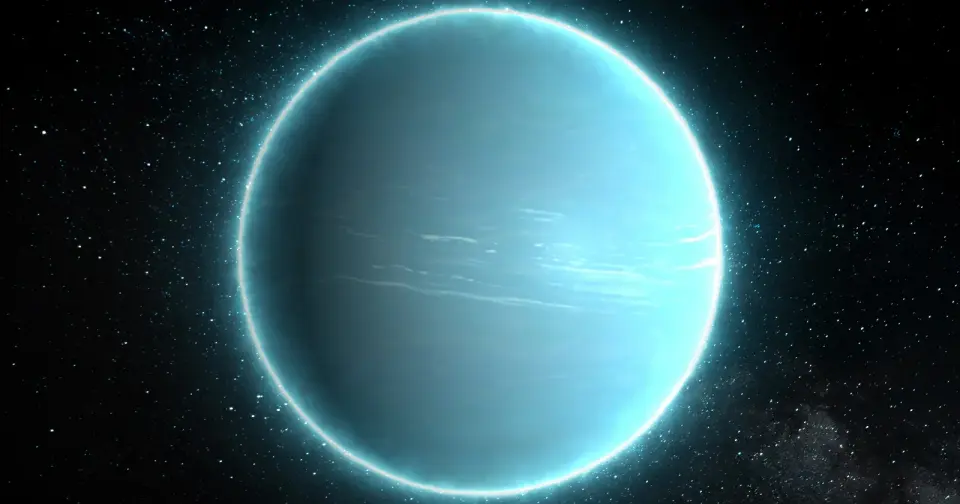
Uranus appears as a smooth, pale blue-green sphere due to methane absorbing red light, but its cloud tops contain hydrogen sulfide, the gas responsible for the smell of rotten eggs. Detected in 2018 using the Gemini North telescope, this gas exists in trace amounts of 0.4 to 0.8 parts per million. While the concentration is low, it is sufficient for human detection and indicates the planet’s chemical makeup differs significantly from Jupiter and Saturn. The atmosphere is lethal, with temperatures around minus 200 Celsius, making the odor a minor detail compared to the immediate risks of suffocation and extreme cold.
Key points
- Uranus’s blue color is caused by methane absorbing red wavelengths of sunlight, creating a serene but misleading appearance.
- Hydrogen sulfide was detected above Uranus’s cloud deck in 2018 by a team led by Patrick Irwin, published in Nature Astronomy.
- The gas concentration is 0.4 to 0.8 parts per million, which is within the range humans can detect.
- The presence of hydrogen sulfide suggests Uranus formed differently than the inner gas giants, which rely on ammonia.
- The atmosphere is composed mostly of hydrogen, helium, and methane, with temperatures reaching minus 200 Celsius.
Background
This finding resolves a long-standing debate about whether Uranus’s clouds are primarily ammonia or hydrogen sulfide. Previous studies, such as the 2026 UCLA research, suggested the planet might have magma oceans rather than icy mantles, challenging traditional 'ice giant' classifications. The detection of hydrogen sulfide provides critical data for understanding the formation and chemical evolution of ice giants, distinct from the ammonia-rich atmospheres of Jupiter and Saturn.
Why it matters
Identifying hydrogen sulfide on Uranus clarifies the planet’s atmospheric composition and formation history, distinguishing it from other gas giants. This knowledge is crucial for modeling the chemistry of similar exoplanets and understanding the conditions that allow specific gases to persist in upper atmospheres, despite the extreme cold and pressure.
What to watch
Future missions, such as the proposed Uranus Orbiter and Probe, may provide more detailed data on the planet’s atmospheric layers and chemical processes. Continued analysis of spectral data from large telescopes will help refine models of how hydrogen sulfide behaves in such extreme environments.
Want the full story? Read the original reporting
Read on Space Daily