Tag

Uranus

All articles tagged with #uranus

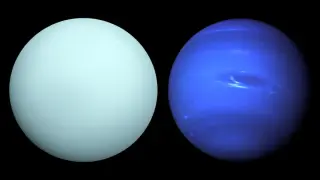
Rocks in the Ice Giants? Uranus and Neptune May Be More Rocky Than Thought
space17 days ago

Rocks in the Ice Giants? Uranus and Neptune May Be More Rocky Than Thought

A new Astronomy & Astrophysics study models Uranus and Neptune and finds their outer shells may be composed largely of rocks rather than being purely icy, implying their atmospheres could be littered with rocky material and suggesting a possible reclassification from “ice giants” to a term like “minor giants,” though the authors caution this isn’t definitive.

Contrasting Hues on Uranus’ Rings Suggest Distinct Origins
space1 month ago

Contrasting Hues on Uranus’ Rings Suggest Distinct Origins

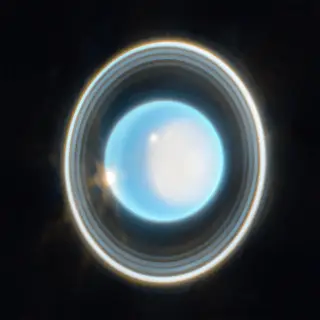
Using Hubble, JWST, and Keck, scientists show Uranus’ faint μ and ν rings have distinct colors and compositions: μ appears blue and icy, likely sourced from the moon Mab; ν appears red and dust-rich with 10–15% carbon-bearing organics, probably from micrometeorite impacts on rocky parent bodies. These differences raise questions about their origins and materials, and the rings—likely young and continually refreshed—will be monitored to track brightness changes and refine the system’s dynamics.

JWST data links Uranus rings to hidden moons, hinting at more to discover
space1 month ago

JWST data links Uranus rings to hidden moons, hinting at more to discover

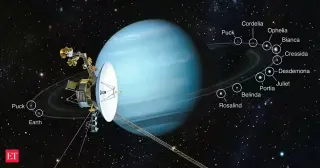
New infrared observations from the James Webb Space Telescope show Uranus’s outer mu- and nu-rings have distinct origins: the blue mu-ring is ice-rich and linked to Mab (a 12‑km inner moon), while the red nu-ring contains organics, likely produced by dust from undiscovered inner moons, suggesting additional moons exist beyond the 29 already known and that a future Uranus mission may be needed to unravel the system.

Uranus’s Distant Rings Reveal Two Separate Origins
space-and-spaceflight1 month ago

Uranus’s Distant Rings Reveal Two Separate Origins

Astronomers using Keck, Webb, and Hubble analyzed Uranus’ faint outer rings and found two distinct compositions: the blue μ ring consists of tiny icy grains likely sourced from Mab, while the red ν ring is rocky with about 10–15% carbon-rich organics, suggesting different formation histories for the planet’s second ring system. The study, published in the Journal of Geophysical Research: Planets, highlights how ring material traces back to source bodies and collisions, with implications for Uranus’s formation and a need for future close-up observations.

Predicted Quasi-1D Carbon-Hydrogen State Inside Uranus and Neptune
science1 month ago

Predicted Quasi-1D Carbon-Hydrogen State Inside Uranus and Neptune

Scientists predict a quasi-one-dimensional superionic carbon–hydrogen phase under the extreme pressures and temperatures inside Uranus and Neptune, with hydrogen moving along helical pathways within an ordered carbon lattice. This could affect heat and electricity transport, influence magnetic field interpretation, and expand understanding of matter at high pressures relevant to planetary interiors and materials science.

Starship Could Fast-Track NASA’s Uranus Mission
space2 months ago

Starship Could Fast-Track NASA’s Uranus Mission

A MIT/IEEE Aerospace Conference paper proposes using SpaceX’s Starship as the launcher and propulsion enabler for a Uranus Orbiter and Probe (UOP). By refueling in orbit and potentially employing Starship as an aerobraking shield, the mission could reach Uranus in about 6.5 years—roughly half the previously projected time and without needing planetary gravity assists—while cutting operational costs. However, a UOP funding decision remains uncertain, Starship’s aerobraking concept is unproven for ice giants, and launch windows in the 2030s (or the next feasible window in the mid‑2040s) will heavily influence feasibility.

Webb Maps Uranus in 3D, Unveiling Its Tilted Magnetosphere
science2 months ago

Webb Maps Uranus in 3D, Unveiling Its Tilted Magnetosphere

NASA’s James Webb Space Telescope captured Uranus’ upper atmosphere for nearly a full rotation, delivering the most detailed 3D view of its ionosphere and how energy moves through the atmosphere, where auroras form under the planet’s unusually tilted magnetic field, and it reinforces ideas about ongoing atmospheric cooling—while highlighting the uncertain outlook for a future Uranus mission.

JWST maps Uranus’s auroras and tilted magnetosphere in unprecedented detail
space3 months ago

JWST maps Uranus’s auroras and tilted magnetosphere in unprecedented detail

JWST mapped Uranus's upper atmosphere during a ~15-hour rotation, revealing two bright auroral belts around the planet's magnetic poles and a mid-latitude depletion region, along with a three-dimensional view of ion temperature and density up to about 5,000 km above the cloud tops. The data show Uranus’s highly tilted magnetosphere drives distinctive auroral patterns and that the atmosphere has cooled since the 1990s, offering clues about ice giants and exoplanet atmospheres.

space3 months ago

Webb Telescope Maps Uranus’ Ionosphere in 3D

The European Space Agency reports that the James Webb Space Telescope used the Near-Infrared Spectrograph (NIRSpec) to study Uranus’ upper atmosphere, focusing on its ionosphere up to about 5,000 km above the clouds and creating a full-rotation 3D map to probe the planet’s magnetic field and auroras. The measurements show the hottest regions at roughly 3,000–4,000 km altitude with ion densities around 1,000 km, offering new insights into Uranus’ enigmatic magnetosphere and ice-giant atmospheres more broadly.

Webb’s 17-hour stare at Uranus uncovers baffling auroras
space-and-spaceflight3 months ago

Webb’s 17-hour stare at Uranus uncovers baffling auroras

The James Webb Space Telescope spent 17 hours peering at Uranus to map its upper atmosphere in three dimensions, revealing two bright auroral bands near the planet’s unusual magnetic poles and a depletion of ions between them. The observations show how Uranus’s tilted, offset magnetosphere shapes energy flow and auroral activity, with the upper atmosphere still cooling since the 1986 Voyager flyby, providing new insights into the dynamics of ice-giant atmospheres.

Miranda's Hidden Ocean Reframes the Search for Life on Uranus' Moon
space3 months ago

Miranda's Hidden Ocean Reframes the Search for Life on Uranus' Moon

A Planetary Science Journal study reexamining Voyager 2 data suggests Miranda, a moon of Uranus, could have hosted a deep subsurface ocean (potentially ≥100 km) in the last 100–500 million years, with tidal heating possibly keeping liquid water inside. While conclusive evidence of life isn’t found, this makes Miranda a notable candidate in the broader search for extraterrestrial life and informs the Drake Equation’s life-fraction term.