
Webb Telescope Reveals Two Types of Cosmic Debris from Planetary Collisions
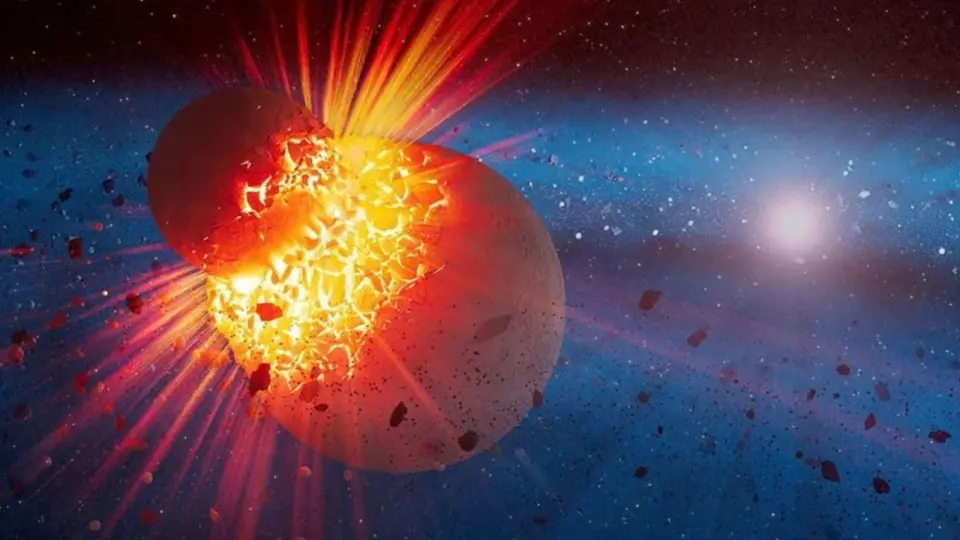
Astronomers used the James Webb Space Telescope to analyze 21 'extreme debris disks' around young stars, revealing that these systems are the aftermath of violent planetary collisions. The study, published in The Astrophysical Journal, categorizes these disks into silica-rich and silica-poor types, linking them to impacts between Mars-sized and Moon-sized bodies, respectively. These findings offer new insights into the formation of the Moon and the evolution of rocky planets in our own solar system.
Key points
- A team led by Kate Su of the Space Science Institute analyzed 21 extreme debris disks using data from the James Webb Space Telescope (JWST) and the retired Spitzer Space Telescope.
- The study found that these rare systems, which occur in only about 1% of young stars, are characterized by unusually large amounts of warm dust close to the central star.
- The disks are divided into two categories: silica-rich systems, likely caused by high-energy collisions between Mars-sized bodies, and silica-poor systems, resulting from less energetic, grazing impacts between Moon-sized objects.
- Silica-rich disks are only found around stars younger than 300 million years, aligning with simulations of terrestrial planet formation, while silica-poor disks persist across a wider range of ages.
- The findings suggest that our own solar system may have experienced similar extreme debris disk phases, potentially linked to the formation of the Moon via the Theia impact and later dynamical instabilities.
Background
This research builds on earlier JWST and Hubble surveys that have examined the Kuiper Belt and protoplanetary disks, providing a broader context for understanding planetary formation and collision history in the solar system. The Nancy Grace Roman Space Telescope, set to launch in August 2026, will further complement these efforts by mapping the cosmos on a larger scale.
How outlets are covering it
While all sources agree on the core findings, they emphasize different aspects. Space.com and NASA Science focus on the connection to the Moon's formation and the Theia impact. Sci.News highlights the mineralogical analysis and the rarity of these systems. Mashable India provides a more accessible explanation, comparing the silica-rich debris to volcanic glass and the silica-poor debris to green sand, and emphasizes the potential for spotting planetary systems in the midst of formation. The primary source (Space.com) and NASA Science are more detailed in their technical descriptions, while Mashable India and Sci.News offer more concise summaries.
Why it matters
Understanding extreme debris disks helps scientists piece together the violent history of planetary formation, including the events that led to the creation of the Moon. This knowledge can inform models of how rocky planets evolve and how dynamical instabilities in planetary systems can trigger catastrophic collisions, providing a clearer picture of the solar system's past and the potential for similar events in other star systems.
What to watch
Researchers plan to observe more extreme debris disks to confirm their hypotheses, particularly regarding the absence of silica-rich systems in older stars. The Nancy Grace Roman Space Telescope, launching in August 2026, will provide a wider field of view to potentially identify more such systems and further refine our understanding of planetary formation and evolution.
- Worlds collide! James Webb Space Telescope investigates what happens when planets crash together Space
- NASA’s Webb Provides Crash Course on Planet-Shattering Collisions NASA Science (.gov)
- Strange Dusty Disks around Young Stars May Be Wreckage of Moon- and Mars-Sized Collisions Sci.News
- JWST Spots ‘Extreme Debris Disk’ – Young Planetary Systems Where Mars-Sized Or Moon-Sized Worlds Collide IFLScience
- How Violent Was That Planet Crash? Astronomers Check The Dust Mashable India
Want the full story? Read the original reporting
Read on Space