Tag

Planet Formation

All articles tagged with #planet formation

WISPIT 2: A Young Solar System Taking Shape
space14 days ago

WISPIT 2: A Young Solar System Taking Shape

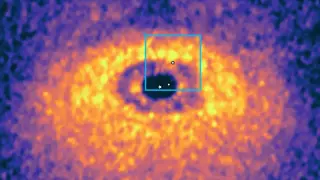
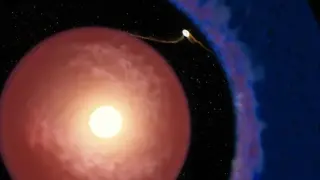
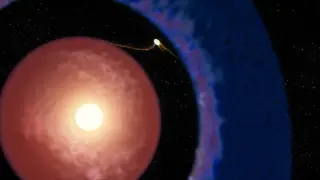
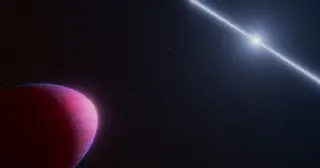
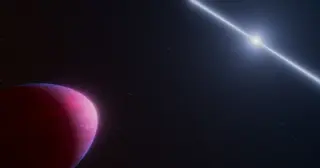
Astronomers directly observed two planets forming around the very young star WISPIT 2, about 437 light-years away. A distant giant, WISPIT 2b, sits at 57 AU with ~5 Jupiter masses, while a closer planet, WISPIT 2c, lies at 14 AU with 8–12 Jupiter masses. The system’s disk shows multiple rings and gaps, hinting at a possible third planet and offering a rare glimpse into how our Solar System may have formed; future imaging with the Extremely Large Telescope could reveal more.

Twin Jovian Planets Take Shape Around Young Star WISPIT 2
space16 days ago

Twin Jovian Planets Take Shape Around Young Star WISPIT 2

Astronomers using ESO's VLT instruments SPHERE and GRAVITY+ directly observe two Jupiter-like planets forming within a structured protoplanetary disc around the young star WISPIT 2: WISPIT 2b about five Jupiter masses at ~60 AU, and WISPIT 2c ~two Jupiter masses at ~15 AU, with hints of a possible third planet in a distant gap, marking only the second confirmed case of ongoing giant-planet formation.

Budding planets around a newborn star reveal early solar-system formation
space17 days ago

Budding planets around a newborn star reveal early solar-system formation

Astronomers studying the young star WISPIT 2, located about 437 light-years away and ~5.4 million years old, have directly detected two forming planets—WISPIT 2b and WISPIT 2c—in the star’s surrounding protoplanetary disk, carving gaps as they grow. Hints of a third planet farther out have researchers hopeful, and the system offers a rare look at how solar systems like our own form; observations via the VLT (with SPHERE and GRAVITY+ upgrades) suggest future clues may be revealed by the ELT.

Sulfur-Scented Exoplanet Redefines Planet Types
space24 days ago

Sulfur-Scented Exoplanet Redefines Planet Types

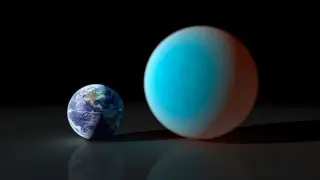
Scientists using JWST have identified L 98-59 d, a 1.6× Earth-radius exoplanet 35 light-years away with a global magma ocean that stores sulfur, producing a sulfur-rich atmosphere including hydrogen sulfide; its low density and molten interior challenge existing small-planet categories. Computer models trace its five-billion-year evolution from a volatile-rich world that cooled and shrank while preserving sulfur, implying more exotic planet types exist—though the planet is unlikely to host life.

JWST Uncovers Sulfur Clues That Redefine How Giant Exoplanets Form
science1 month ago

JWST Uncovers Sulfur Clues That Redefine How Giant Exoplanets Form

A JWST study of HR 8799’s three inner gas giants detects hydrogen sulfide in their atmospheres, revealing heavy-element enrichment consistent with solid-material accretion during formation. The finding suggests these 5–10 Jupiter-mass planets may have formed in a Jupiter-like way despite their wide, distant orbits, challenging simple core-accretion models and hinting at a more complex, potentially mixed formation path; the results were published in Nature Astronomy.

Snowman-Shaped Kuiper Belt Object Reveals a Quiet Route to Planet Formation
space1 month ago

Snowman-Shaped Kuiper Belt Object Reveals a Quiet Route to Planet Formation

A new study shows Arrokoth-like bilobed objects can form directly from the gravitational collapse of small pebbles in the early solar system, producing the snowman shape without violent mergers and suggesting such binaries may be more common in the Kuiper Belt; simulations found several instances of this outcome, supporting a calmer path to planet formation.

JWST Discovers Hydrogen Sulfide on Distant Super-Jupiters, Illuminating Planet-Formation Paths
science1 month ago

JWST Discovers Hydrogen Sulfide on Distant Super-Jupiters, Illuminating Planet-Formation Paths

Using the James Webb Space Telescope, astronomers detected hydrogen sulfide in the atmospheres of HR 8799’s inner gas giants (c, d, e), suggesting sulfur came from solid material in their birth disks and signaling a universal pattern of heavy-element enrichment during planet formation. The study also showcases a direct-imaging technique that could, in time, help study Earth-like worlds for biosignatures.

Hubble Spots Giant, Turbulent Planet-Forming Disk 40 Times Wider Than Our Solar System
astronomy2 months ago

Hubble Spots Giant, Turbulent Planet-Forming Disk 40 Times Wider Than Our Solar System

NASA’s Hubble Space Telescope has captured the largest known protoplanetary disk around the young star IRAS 23077+6707 (nicknamed Dracula’s Chivito), extending about 400 billion miles—roughly 40 times the Solar System’s diameter. Seen nearly edge-on in visible light, the disk is unusually turbulent and asymmetric, with filament-like features on one side and a sharp edge on the other, hinting at dynamic infall of material and environmental interactions. With an estimated mass 10–30 times Jupiter’s, the system may host a large planetary system and provides a valuable laboratory for understanding planet formation in extreme conditions.

ALMA reveals the chaotic teenage years of growing planets
space2 months ago

ALMA reveals the chaotic teenage years of growing planets

Astronomers using the Atacama Large Millimeter/submillimeter Array (ALMA) as part of the Resolve exoKuiper belt Substructures (ARKS) survey captured 24 disks around young stars, showing complex rings, halos and asymmetries that indicate a turbulent, collision‑driven “teenage” phase of planet formation and offering new clues to how planetary systems evolve—including hints about our Solar System’s early history.

Webb Discovers Crystalline Silicates Forged in Inner Disk of Young Star, Flung to Disk Edges
space2 months ago

Webb Discovers Crystalline Silicates Forged in Inner Disk of Young Star, Flung to Disk Edges

NASA’s James Webb Space Telescope observed protostar EC 53 in the Serpens Nebula and confirmed that crystalline silicates form in the hot inner disk, with MIRI spectra identifying minerals like forsterite and enstatite. The star’s strong disk winds and periodic outbursts appear to launch these crystals outward toward the disk’s edges, offering a mechanism for crystalline silicates found in comets and potentially seeding planet formation during the system’s ongoing evolution.

Cosmic Hamburger Disk Reveals Birthplace of Distant Giant Planets
space2 months ago

Cosmic Hamburger Disk Reveals Birthplace of Distant Giant Planets

Astronomers using ALMA have imaged Gomez’s Hamburger (GoHam), one of the largest edge-on protoplanetary disks, finding a stratified arrangement of gas and dust and signs of ongoing planet formation, including a potential giant-planet core or clump dubbed GoHam b in the outer disk. The disk’s sheer size and uneven features—such as a bright, lopsided region and a northern wind—make it an ideal laboratory to study how giant planets can form far from their star and how such planets shape their surroundings.

Hubble Unveils the Largest and Most Chaotic Planet Nurseries
science3 months ago

Hubble Unveils the Largest and Most Chaotic Planet Nurseries

Astronomers have captured the first visible-light image of 'Dracula’s Chivito,' the largest and most chaotic planet-forming disk ever observed, located about 1,000 light-years away. This massive, asymmetric disk exhibits unusual features like extended filaments on one side, challenging previous assumptions about the serenity of planet nurseries. It serves as a scaled-up model of early solar system conditions, offering new insights into the complex processes of planet formation.

The Enigma of Mercury's Existence
science3 months ago

The Enigma of Mercury's Existence

Mercury's unusual characteristics and orbit challenge current understanding of planet formation, with theories including giant impacts and migration. The upcoming BepiColombo mission aims to uncover its origins by studying its surface and internal structure, potentially solving one of the Solar System's biggest mysteries.