
New Zealand’s heaviest insect recovers after 11,000 releases
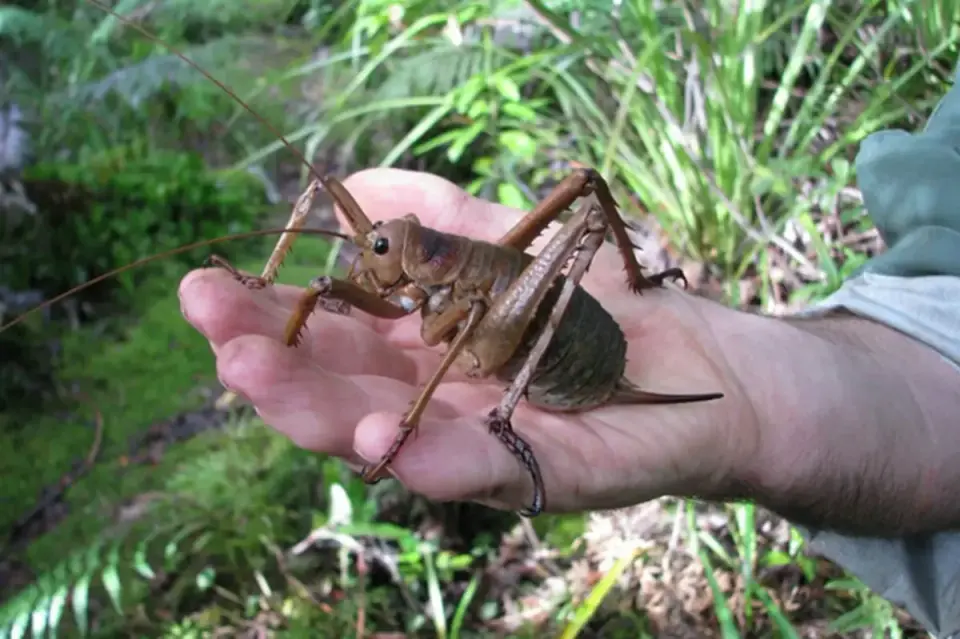
The wētāpunga, the world’s heaviest insect, has recovered from near-extinction in New Zealand following a 15-year breeding program that released over 11,000 individuals into the wild. Conservationists at Butterfly Creek and Auckland Zoo developed specialized feeding techniques to raise nymphs, leading to self-sustaining populations on predator-free islands. The species’ status has improved from 'Endangered' to 'Nationally Increasing,' with researchers now applying these methods to other threatened invertebrates.
Key points
- Over 11,000 wētāpunga have been released into wild habitats since 2010, primarily on predator-free islands in Auckland’s Hauraki Gulf.
- The species’ conservation status was downgraded from 'Endangered' to 'Threatened — Nationally Increasing' in 2022 due to successful multi-generational breeding in the wild.
- Conservationists developed a specific diet of fresh foliage, fish flake protein, and leaf litter to successfully raise nymphs in communal mesh cages.
- The wētāpunga, which can weigh up to 71 grams and reach 10 cm in length, was previously extinct on New Zealand’s mainland by the 1990s.
- Researchers are now using the successful husbandry techniques to aid the conservation of other species, including the Canterbury knobbled weevil and native stag beetles.
Background
The wētāpunga, also known as the Little Barrier Island giant wētā, is a flightless insect belonging to the cricket family. It was once widespread across New Zealand’s North Island but declined sharply due to habitat loss from deforestation and predation by introduced species like rats and cats. By the 1990s, the species was restricted to a single island, Hauturu/Little Barrier Island. This recovery effort follows broader trends in invertebrate conservation, where captive breeding and translocation are increasingly used to mitigate the impacts of invasive predators on native species.
How outlets are covering it
The New York Post emphasizes the sheer size and 'horrifying' nature of the insect, highlighting the record weight of a pregnant female at 71 grams. The Guardian focuses on the scientific methodology, noting that the breeding program is a rare success story for invertebrate conservation and that the techniques are being scaled up. The Times of India provides a detailed timeline, specifying that the first releases occurred in 2010 on Motuora Island and 2011 on Tiritiri Matangi Island, and highlights the role of local Māori iwi, Ngāti Manuhiri, in supporting the program. All sources agree on the success of the program but differ in their emphasis: the Post focuses on the spectacle, the Guardian on the scientific precedent, and the Times of India on the historical and cultural context.
Why it matters
The recovery of the wētāpunga demonstrates that large-scale captive breeding and translocation can effectively reverse the decline of invertebrate species threatened by invasive predators. The success of this program provides a replicable model for conserving other critically endangered species in New Zealand and potentially elsewhere. It also highlights the importance of predator-free sanctuaries in the recovery of flightless native species. The program’s success has led to a reclassification of the species’ status, offering hope for other threatened invertebrates that lack the visibility of charismatic vertebrates.
What to watch
Conservationists will continue to monitor the established populations on Motuora and Tiritiri Matangi to ensure long-term sustainability. Researchers are applying the husbandry techniques developed for the wētāpunga to other species, such as the Māhoenui giant wētā and the Canterbury knobbled weevil. Further studies will assess the genetic diversity of the released populations and the impact of climate change on their habitats. The success of this program may also encourage other institutions to develop similar breeding programs for threatened invertebrates.
- ‘Entirety of your hand’: World’s heftiest and most horrifying insect brought back from extinction — it’s heavier than a mouse New York Post
- 11,000 of the World’s Heaviest Insects, Growing Up to 4 Inches Long, Intentionally Released into the Wild People.com
- ‘The future is bright’: breeding programme brings world’s heaviest insect back from the brink The Guardian
- In 2010, conservationists began releasing captive-bred wētāpunga after the species survived naturally on one island; 15 years and 11,000 releases later, four generations are established on two islands The Times of India
- A conservation success story for New Zealand's heaviest insect Phys.org
Want the full story? Read the original reporting
Read on New York Post