
Webb Reveals 70 Infant Stars in Carina Nebula’s Treasure Chest
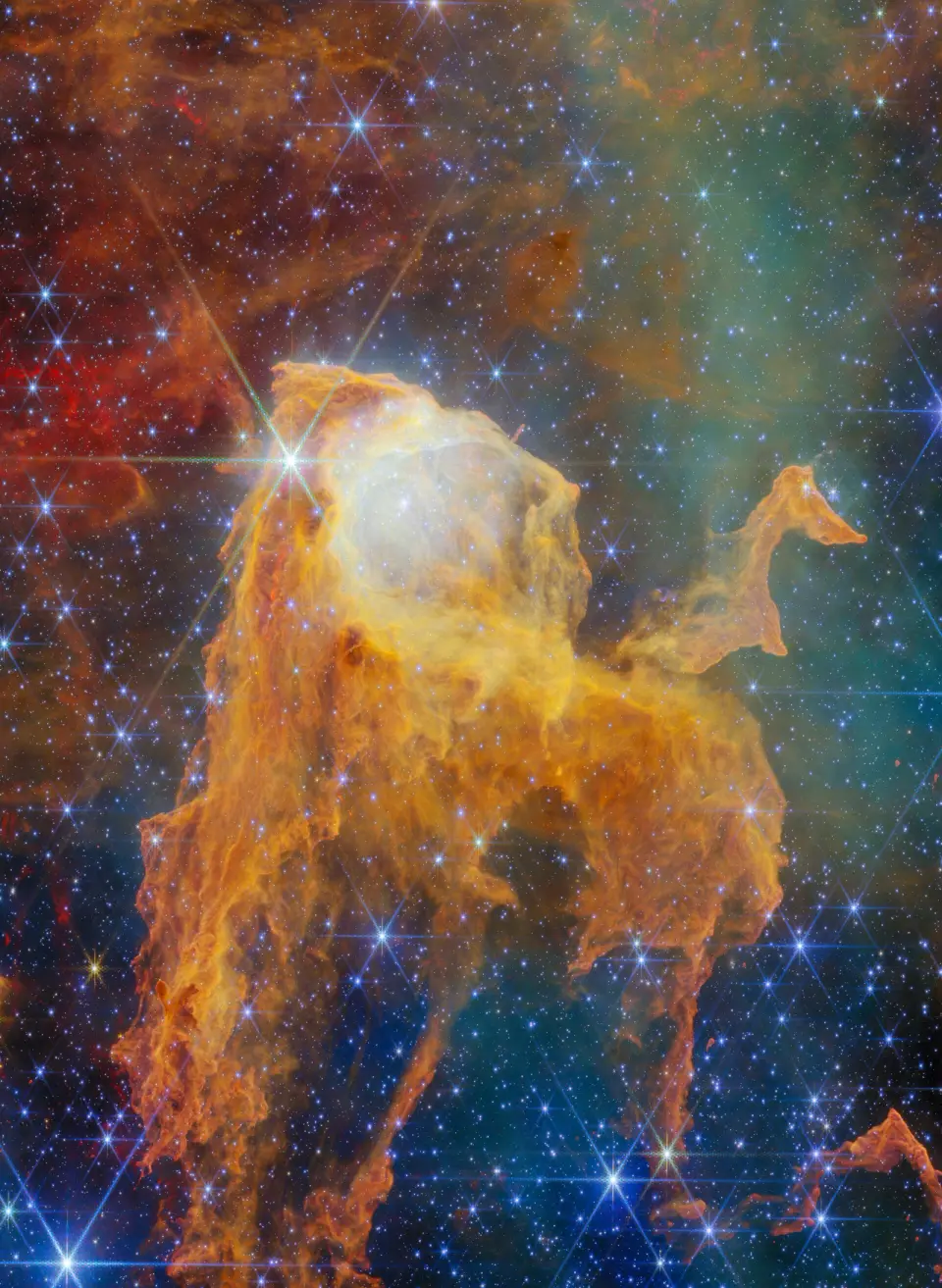
The James Webb Space Telescope has released its August 2026 Picture of the Month, revealing the interior of the 'Treasure Chest' cometary globule in the Carina Nebula. Located 7,500 light-years away, this region contains a cluster of approximately 70 young stars, including a rare O-type star 19 times the mass of the Sun. Webb’s Near-Infrared Camera penetrated the dense dust to show that these stars are surrounded by circumstellar disks, the raw material for planet formation. The image highlights a scientific race between star formation and the intense ultraviolet radiation from nearby Eta Carinae, which threatens to erase these disks before planets can form.
Key points
- Webb’s NIRCam imaged the Treasure Chest, a cometary globule in the Carina Nebula, revealing a cluster of about 70 young stars embedded in dust.
- The cluster is estimated to be 1.3 million years old, though some earlier estimates suggest it could be as young as 100,000 years, making it one of the youngest known star clusters.
- The most massive star in the cluster is an O-type star roughly 19 times the mass of the Sun, designated CPD -59°2661.
- The distinctive shape of the globule was sculpted by ultraviolet radiation and stellar winds from Eta Carinae, a binary system located 39 light-years away, which is 5 million times as luminous as the Sun.
- Webb’s observations confirm the presence of circumstellar disks around the infant stars, but intense UV radiation from Eta Carinae and nearby Trumpler 16 may destroy these disks before planets can form.
Background
This release follows Webb’s 2022 debut image of the 'Cosmic Cliffs' in the same Carina Nebula, which revealed dozens of protostellar jets. The current image is part of observing Program 5408, a Cycle 3 survey led by Megan Reiter of Rice University, which aims to map how young stars collect gas and expel outflows across the nebula. Earlier archive coverage noted Webb’s discovery of 'Little Red Dots' in the early universe, suggesting links between early star formation and globular clusters, but the current focus is on high-mass star formation in our own galaxy.
How outlets are covering it
The European Space Agency emphasizes the visual beauty and the structural details of the Treasure Chest, highlighting the 70-star cluster and the sculpting effect of Eta Carinae. Tech Times focuses on the scientific urgency, framing the image as a critical observation for understanding whether planet-forming disks can survive the intense ultraviolet environment of the Carina Nebula. While both sources agree on the cluster’s age and composition, Tech Times provides more detail on the specific infrared filters used by NIRCam and the potential for external photoevaporation to erase disks before giant planets can form via core accretion.
Why it matters
This observation provides a unique opportunity to study star and planet formation in one of the most extreme ultraviolet environments in our galaxy. The Carina Nebula is the nearest high-mass star-forming region that hosts the full range of stellar masses, making it an ideal laboratory for testing models of disk survival and planetary formation under intense radiation. Understanding whether planets can form in such hostile conditions helps answer fundamental questions about the origin of our own solar system, which likely formed in a similar dense cluster with nearby massive stars.
What to watch
Astronomers will continue analyzing data from Program 5408 to measure accretion rates and outflows from the young stars in the Treasure Chest. This data will help determine if the circumstellar disks can survive long enough to form planets despite the intense ultraviolet radiation from Eta Carinae and other massive stars in the Carina Nebula. Future observations may reveal whether this cluster produces long-lived planetary systems or remains planet-poor due to the hostile environment.
Want the full story? Read the original reporting
Read on European Space Agency