
XRISM Telescope Reveals Why a Pulsar Flares as It Feeds on a Hypergiant’s Wind
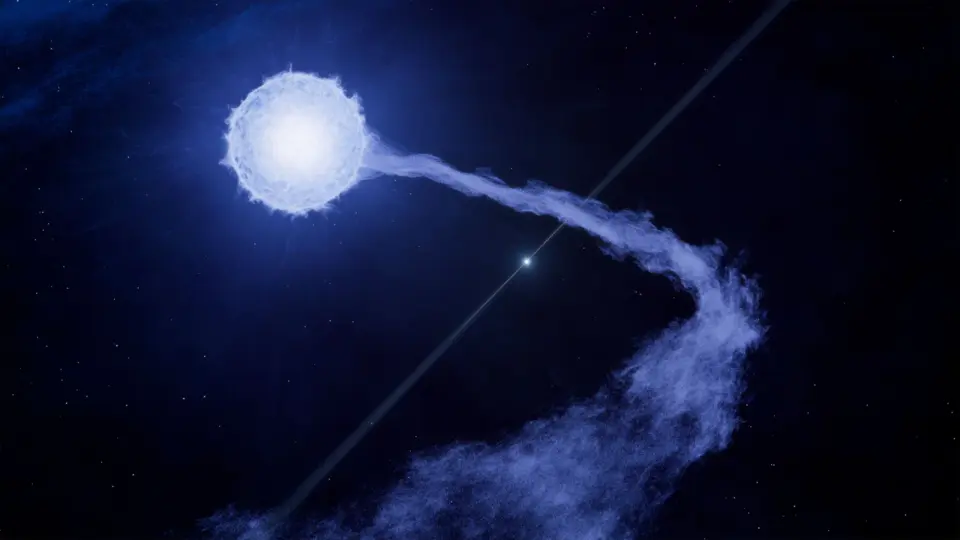
A new study published in Science Advances explains the recurring X-ray flares of the pulsar GX 301-2 in the BP Crucis system. Observations by the NASA-JAXA XRISM mission show that the neutron star flares when it passes through a dense plasma plume ejected by its hypergiant companion, Wray 977. This is the first clear detection of stellar wind material falling onto a compact object, offering a new way to study accretion processes in binary star systems.
Key points
- The BP Crucis system, located 13,000 light-years from Earth, consists of the pulsar GX 301-2 and the blue hypergiant Wray 977, which is roughly 60 times larger than the Sun.
- GX 301-2, a neutron star with the Sun’s mass compressed into a 20-kilometer diameter, emits regular X-ray pulses every 11 minutes but also produces brighter, irregular flares.
- The XRISM space telescope, jointly operated by NASA and JAXA, observed the system for 16 hours during a flare event, capturing high-resolution X-ray spectra.
- Data revealed that Wray 977 ejects a stellar wind plasma plume at approximately 540,000 kilometers per hour (335,000 mph).
- The flares occur when GX 301-2 passes through this plume, causing gas to accumulate on its surface and heat up, resulting in intense X-ray emission.
- The most powerful flares happen near the closest and farthest points of the pulsar’s 41.5-day orbit around its companion.
Background
This discovery builds on earlier astronomical findings, such as the James Webb Space Telescope’s identification of 'black hole stars' in the early universe, which highlighted the importance of gas accretion in cosmic evolution. While previous studies focused on isolated black holes or supernova remnants, this research specifically addresses the dynamics of matter transfer in a binary system involving a hypergiant and a neutron star.
How outlets are covering it
Live Science and Space.com emphasize the novelty of observing wind plasma falling onto a compact object, highlighting the 'groundbreaking' nature of the XRISM observations. UA.NEWS focuses on the technical details of the 16-hour observation and the rapid changes in emission lines that confirmed the plasma interaction. Starlust.org provides a more detailed mechanical explanation, noting that the accretion disk around the pulsar can break down and even reverse its spin direction as the neutron star moves through the stellar wind, a nuance less emphasized in the other outlets. All sources agree on the core finding but differ in their emphasis on the physical mechanics of the accretion disk versus the broader significance of the detection.
Why it matters
Understanding how neutron stars accrete material from stellar winds helps refine models of binary star evolution and the behavior of matter under extreme gravitational and magnetic conditions. This specific observation provides a direct test for theoretical models of wind-fed accretion, which were previously difficult to verify due to the lack of clear observational evidence. It also opens the door for studying similar systems in the future, potentially revealing new insights into the life cycles of massive stars and the formation of compact objects.
What to watch
The research team plans to continue observing the next flares of the BP Crucis system to further validate their models. The success of the XRISM mission in capturing these high-resolution spectra suggests that future observations of similar binary systems could yield more detailed insights into the dynamics of accretion disks and the interaction between stellar winds and compact objects.
- A giant cosmic 'fart' is making a wobbling zombie star repeatedly flash us, 'groundbreaking' observations reveal Live Science
- Astronomers explain X-ray flares of pulsar in BP Crucis system — Live Science UA.NEWS
- X-ray spacecraft watches extreme dead star feeding on the wind of a hypergiant (video) Space
- For The First Time Ever We've Seen A Neutron Star Gobbling The Solar Wind From Its Companion IFLScience
- A dead star siphoning gas at 335,000 mph: NASA-JAXA mission makes 'groundbreaking' observation starlust.org
Want the full story? Read the original reporting
Read on Live Science