Tag

Xrism

All articles tagged with #xrism

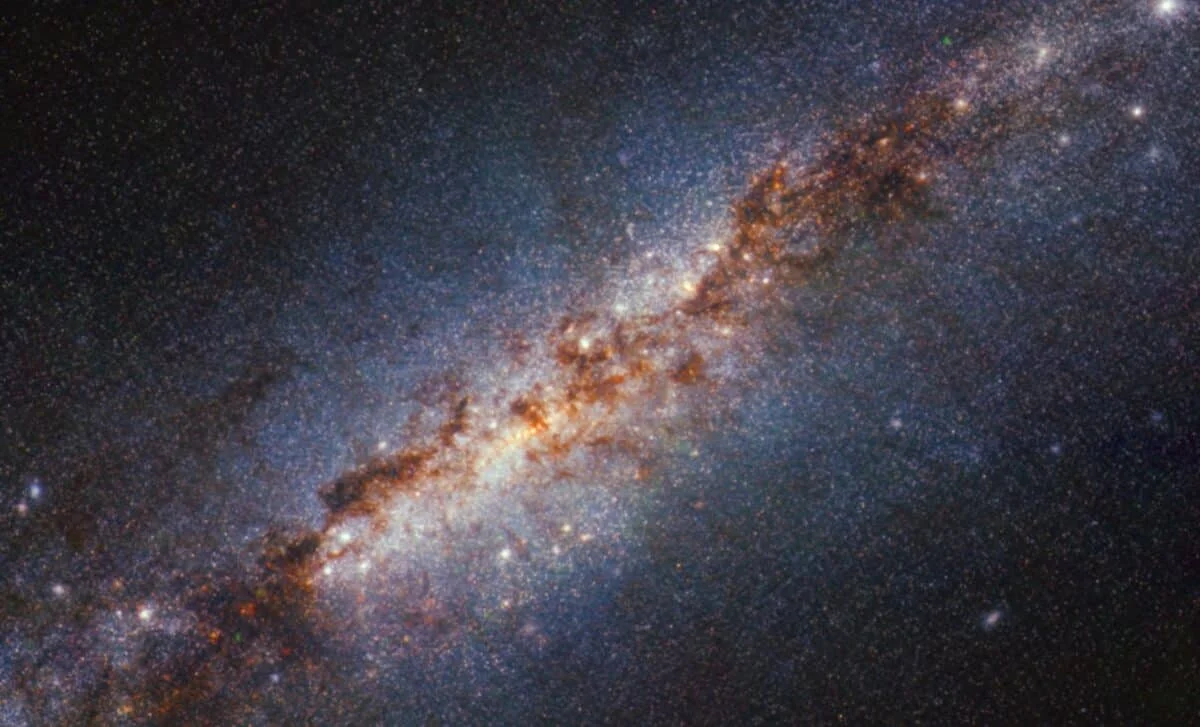
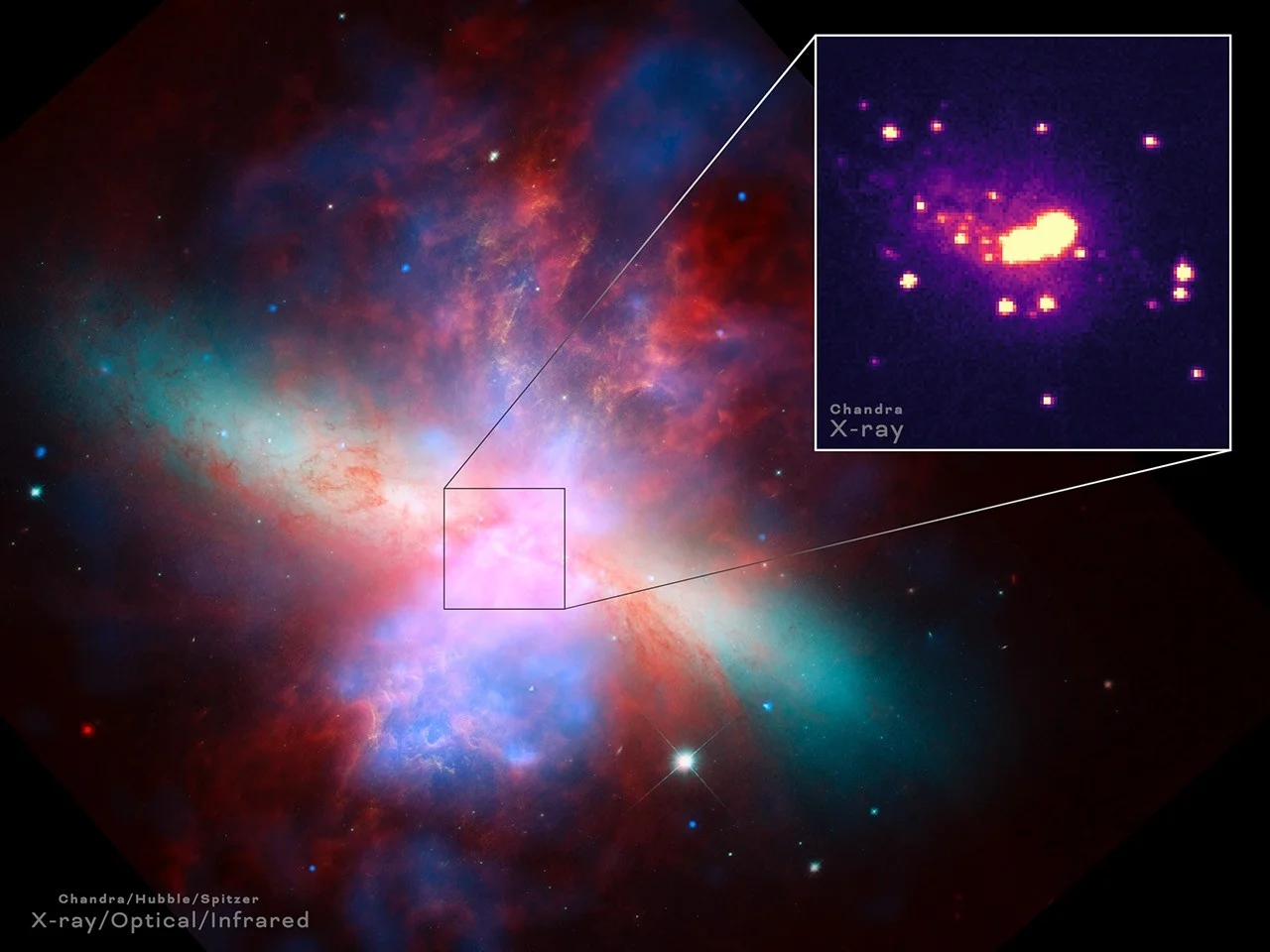
Astronomers Directly Measure M82's Extreme Galactic Wind
space13 days ago

Astronomers Directly Measure M82's Extreme Galactic Wind

Scientists using the XRISM X-ray telescope directly measured the hot wind from the starburst galaxy M82, finding speeds over 3 million km/h and temperatures near 25 million °C. The hot wind can drive about four solar masses of gas per year outward, contributing to a 40,000‑light‑year plume, while a total of seven solar masses per year are moving outward—with about three solar masses unaccounted for—raising questions about where that gas goes and how galactic winds affect galaxy evolution. Cosmic rays may contribute but aren’t the primary engine according to current data.

XRISM Confirms Fast Hot Wind Driving M82’s Outflow
space16 days ago

XRISM Confirms Fast Hot Wind Driving M82’s Outflow

For the first time, XRISM’s Resolve instrument directly measured the velocity of hot gas at the center of the starburst galaxy M82, finding speeds around 2 million mph (≈3 million km/h). The hot wind’s pressure from high temperatures appears capable of powering the cooler, galaxy-wide outflow, a result that challenges and refines models of starburst galaxies and the role of cosmic rays in driving galactic winds.

XRISM captures a monster black hole’s awakening blasting a starburst galaxy with fast winds
astronomy24 days ago

XRISM captures a monster black hole’s awakening blasting a starburst galaxy with fast winds

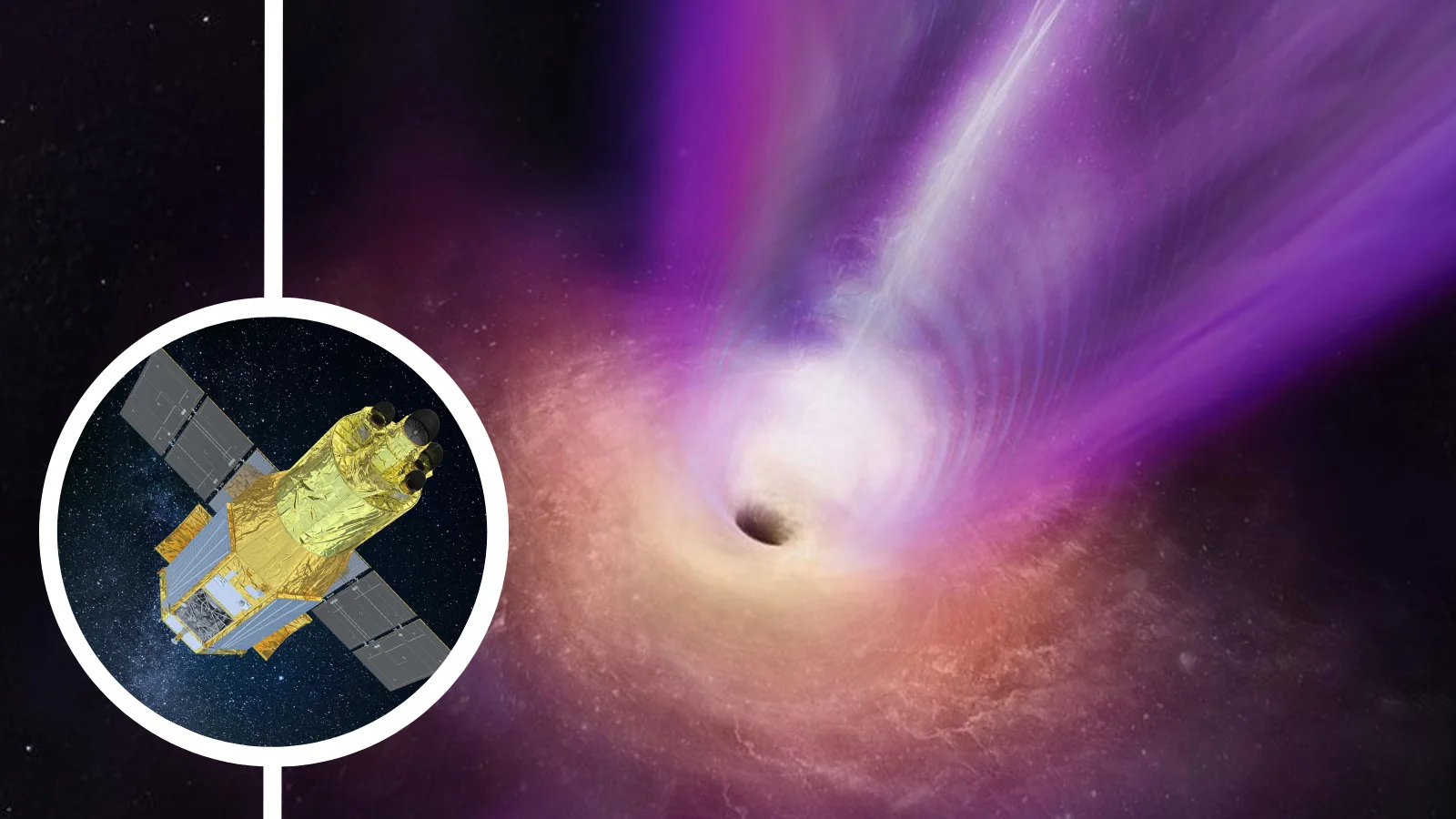
XRISM observed the waking of the supermassive black hole IRAS 05189-2524 in a merging, star-forming galaxy, detecting high-velocity, bullet-like outflows up to about 0.14c that carry far more energy than slower winds. The finding shows how black-hole winds can shape the host galaxy and regulate star formation, shedding light on the co-evolution of galaxies and their central engines.

XRISM reveals the turbulent winds around supermassive black holes
astronomy1 month ago

XRISM reveals the turbulent winds around supermassive black holes

NASA/JAXA’s XRISM X‑ray mission uses high‑resolution spectroscopy to measure gas motions around supermassive black holes, notably M87* and the Perseus cluster, unveiling the strongest turbulence seen near a black hole and the kinetic energy of surrounding gas. This helps explain how black holes heat their environments and influence galactic evolution; findings published late Jan 2026 in Nature and built on XRISM’s 2023 launch in collaboration with ESA.

Scientists Race to Uncover Dark Matter's Hidden Nature
science3 months ago

Scientists Race to Uncover Dark Matter's Hidden Nature

Scientists are exploring the nature of dark matter, which makes up about 85% of the universe's matter, by studying galaxy clusters with NASA's XRISM telescope. They are particularly interested in detecting signals from hypothetical particles called sterile neutrinos, which could decay and produce observable X-ray emissions, potentially revealing the particles that constitute dark matter.

Massive Black Hole Reveals Its Hidden Secrets
science3 months ago

Massive Black Hole Reveals Its Hidden Secrets

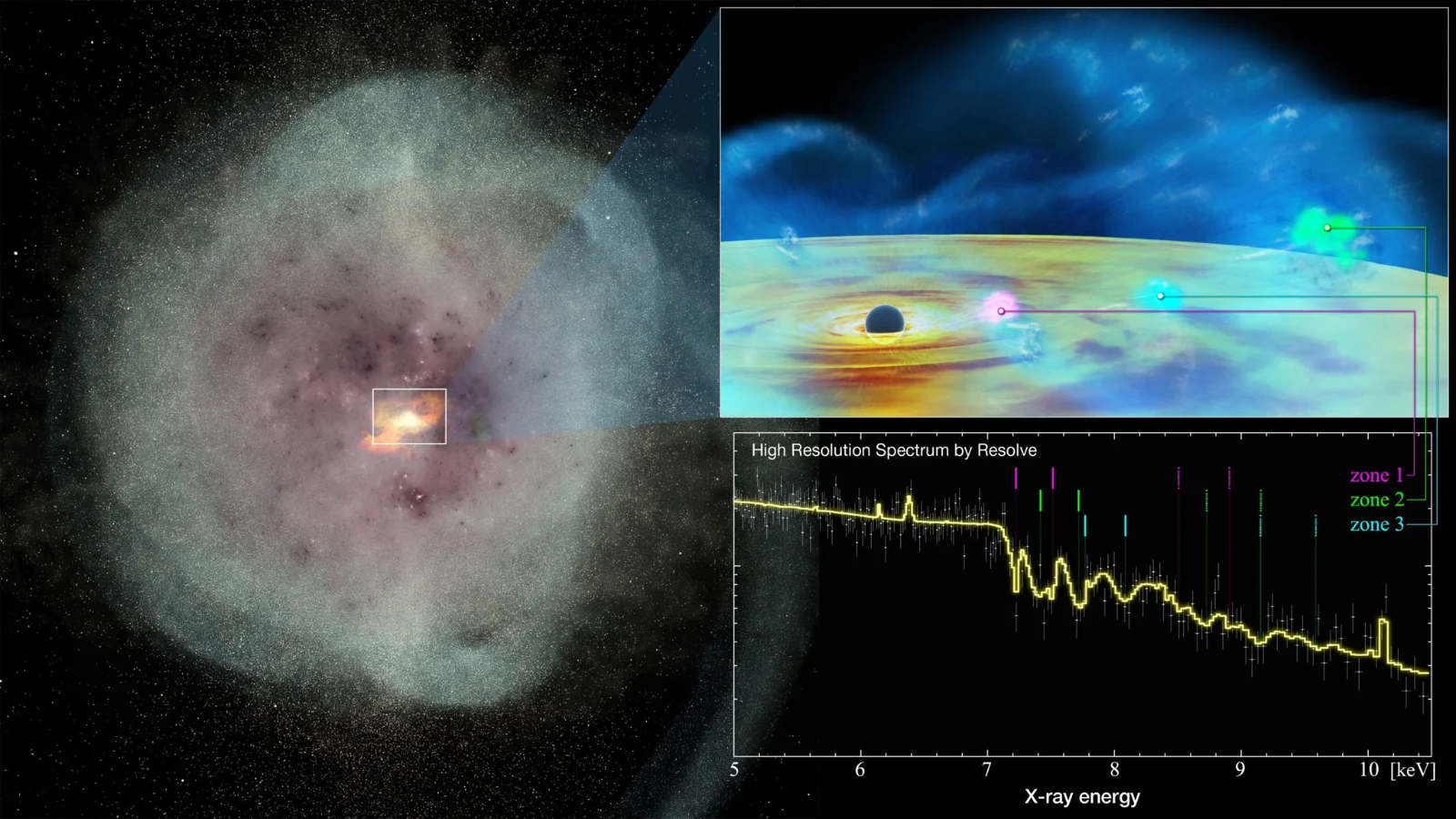
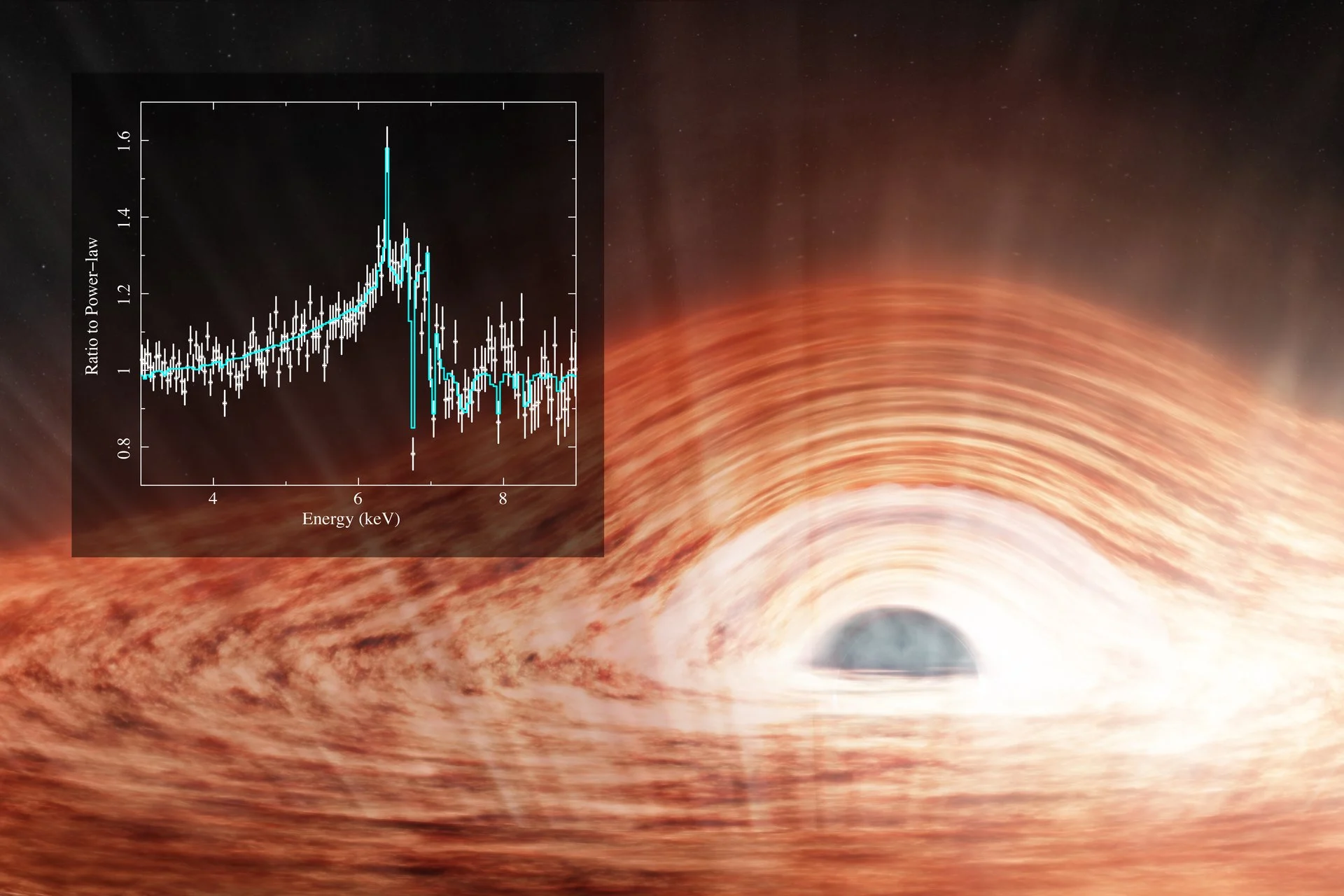
Using XRISM's high-resolution instruments alongside ESA's XMM-Newton and NASA's NuSTAR, scientists captured unprecedented details of a supermassive black hole in galaxy MCG–6-30-15, confirming relativistic effects near the event horizon, identifying multiple wind zones, and challenging previous models of distant reflection, thus advancing our understanding of black hole physics and galaxy growth.

XRISM Captures Sharpest Image Yet of Fast-Spinning Black Hole
science3 months ago

XRISM Captures Sharpest Image Yet of Fast-Spinning Black Hole

XRISM, a joint JAXA-NASA mission, has captured the sharpest X-ray image to date of a rapidly spinning supermassive black hole in galaxy MCG–6-30-15, providing new insights into black hole spin and the environment near the event horizon by combining high-resolution data with other telescopes, and confirming the presence of material orbiting close to the speed of light.

XRISM reveals unexpected speeds in cosmic wind from X-ray binary
science-and-exploration6 months ago

XRISM reveals unexpected speeds in cosmic wind from X-ray binary

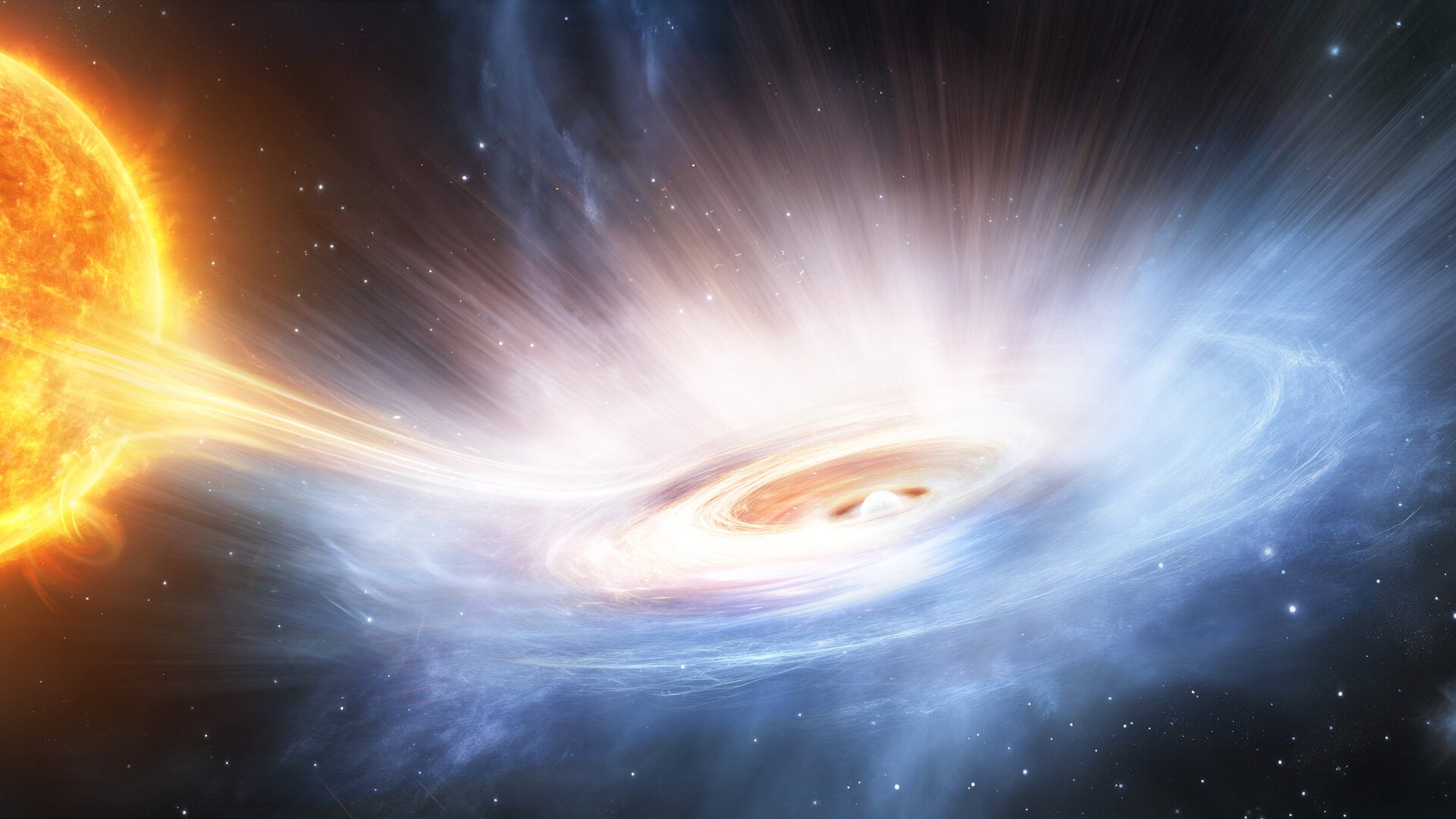
The XRISM mission has discovered that the winds from a neutron star system are unexpectedly dense and slower than those from supermassive black holes, challenging current understanding of how such winds form and influence their environments. The findings suggest that differences in accretion disc temperature and size may explain the variations, providing new insights into cosmic feedback mechanisms and galaxy evolution.

Supermassive Black Holes Eject Light-Speed Winds
science10 months ago

Supermassive Black Holes Eject Light-Speed Winds

Scientists have discovered that supermassive black holes emit high-velocity, bullet-like winds that are highly inhomogeneous and chaotic, challenging previous models of steady outflows. These clumpy winds can significantly influence galaxy evolution by regulating star formation, with implications for understanding black hole feedback and galaxy growth. Observations from XRISM are helping to unravel the complex structure and impact of these winds.

NASA and JAXA's XRISM Mission Unveils Hidden Stellar Secrets
science1 year ago

NASA and JAXA's XRISM Mission Unveils Hidden Stellar Secrets

The XRISM observatory, a collaboration between JAXA and NASA, has provided the most detailed X-ray portrait of Cygnus X-3, a binary system featuring a Wolf-Rayet star and a likely black hole. The mission's high-resolution spectrum reveals complex gas dynamics, including the effects of the Doppler shift due to rapid gas motion. This study aims to enhance understanding of the system's structure and confirm the nature of its compact object. The findings will be published in The Astrophysical Journal.

"NASA and JAXA Collaborate to Resolve X-ray Astronomy Satellite Glitch"
space2 years ago

"NASA and JAXA Collaborate to Resolve X-ray Astronomy Satellite Glitch"

The Japanese X-ray astronomy satellite XRISM, developed with contributions from NASA and ESA, is performing well in orbit, except for an issue with one of its instruments' aperture door. Despite the door not opening as intended, the spacecraft's two main instruments, Resolve and Xtend, are meeting or exceeding most requirements. NASA and JAXA are working to troubleshoot the aperture door issue, with hopes that it will eventually open, allowing the instrument to operate at full capacity.