
ESA's Hera Captures First Separate View of Dimorphos Ahead of November Arrival
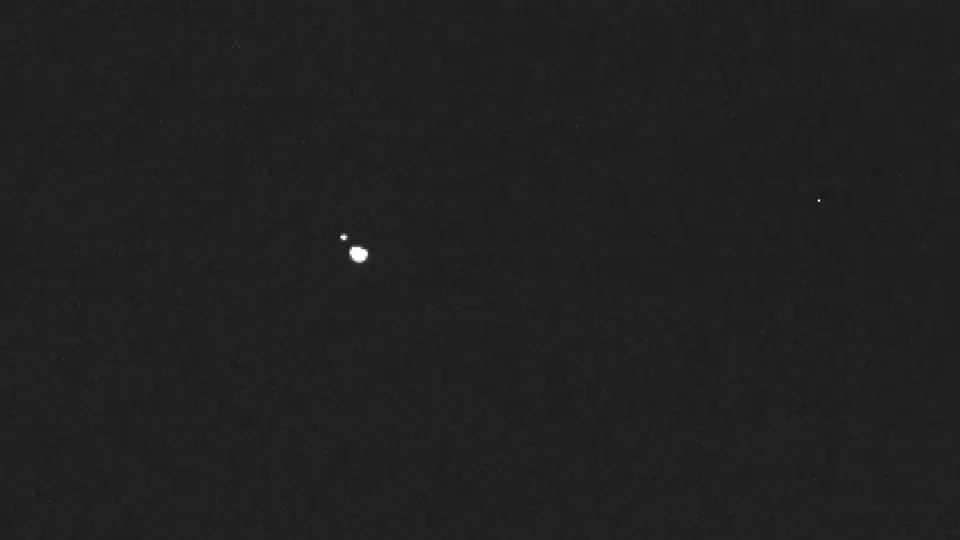
The European Space Agency's Hera spacecraft has achieved a key milestone by capturing the first image where the binary asteroid system Didymos and Dimorphos appear as two distinct objects. Taken on October 18 from a distance of 1,280 kilometers, the photo shows Dimorphos as a single pixel but clearly separated from its larger parent body. This success follows braking maneuvers that slowed the probe to 20 meters per second relative to the asteroids. Hera is now on a trajectory to reach the system in November, with detailed images of the impact site scheduled for release on November 25. The mission aims to analyze the aftermath of NASA's 2022 DART collision, which altered Dimorphos's orbit by 33 minutes, to refine planetary defense strategies.
Key points
- Hera captured its first image distinguishing Didymos and Dimorphos on October 18 from 1,280 km away.
- The probe slowed to 20 m/s relative to the asteroids after two braking maneuvers in October.
- Detailed images of Dimorphos are scheduled for release on November 25.
- Hera will conduct a series of close approaches, starting with ECP-1 on November 4.
- The mission aims to determine if DART's 2022 impact created a crater or altered the asteroid's shape.
Background
This development follows earlier coverage of Hera's successful braking maneuvers in October 2026, which aligned the spacecraft for its arrival at the Didymos system. The mission is a follow-up to NASA's Double Asteroid Redirection Test (DART), which impacted Dimorphos in September 2022 to demonstrate kinetic deflection capabilities. Previous reports noted that the impact's effect on the asteroid's orbit exceeded simulations, prompting the need for detailed forensic analysis by Hera.
How outlets are covering it
All sources agree on the October 18 imaging milestone and the November 25 release date for detailed images. Space.com and Science Daily emphasize the scientific significance of resolving the two bodies separately for the first time. Srpske.rs provides specific operational details, noting that the first close-approach maneuver (ECP-1) is scheduled for November 4 at 01:00 UT, and that Hera will not enter a permanent orbit but will pass by in hyperbolic arcs. It also details the planned release of CubeSats Juventas and Milani in early 2027. UA.News offers a concise summary consistent with the other outlets, focusing on the mission's goal to study the DART impact consequences. There are no significant disagreements among the sources, but Srpske.rs adds the most granular schedule and instrument details.
Why it matters
The successful separation of Didymos and Dimorphos in Hera's imagery confirms the spacecraft's precision in approaching the target, a critical step for the upcoming detailed survey. This mission is the first to investigate the physical effects of a kinetic impact on an asteroid, providing data essential for validating planetary defense strategies. Understanding whether DART created a crater or altered the asteroid's mass and structure will help scientists predict the effectiveness of future deflection missions against potentially hazardous asteroids.
What to watch
Hera is scheduled to perform its first close-approach maneuver (ECP-1) on November 4, 2026. Detailed images of Dimorphos are to be released on November 25. The spacecraft will conduct a series of flybys at distances ranging from 25-30 km down to 1 km. In early 2027, Hera is expected to release two CubeSats, Juventas and Milani, which will conduct radar and mineralogical studies, with one potentially landing on Dimorphos.
- Dimorphos in sight: Europe's Hera probe gets its 1st look at battered space rock (photo) Space
- NASA smashed into an asteroid. Now Hera is closing in to see what happened Science Daily
- Hera Reaches Didymos: First Approach Maneuver Nov. 4 srpske.rs
- Hera spacecraft sees asteroid Dimorphos separately for the first time — Space.com UA.NEWS
- 10 asteroid mysteries that Hera will explore European Space Agency
Want the full story? Read the original reporting
Read on Space