
Japan Unveils MMX Spacecraft Ahead of October 19 Mars Moon Launch
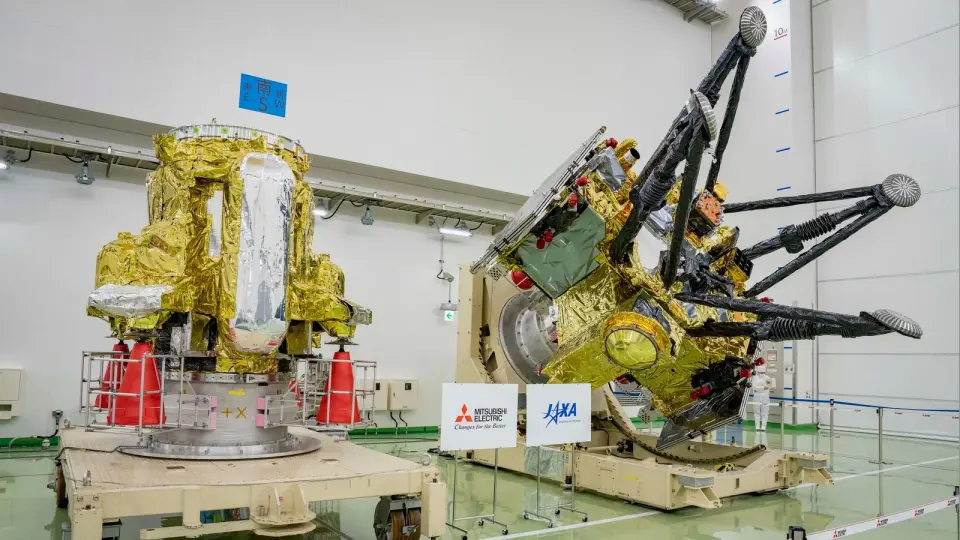
Japan’s JAXA unveiled the Martian Moons eXploration (MMX) spacecraft at Tanegashima Space Center on August 13, 2026, ahead of its scheduled launch on October 19. The mission aims to collect at least 10 grams of material from Mars’ moon Phobos and return it to Earth by 2031. This will be the first deliberate sample return from the Martian system, helping scientists determine whether Phobos formed from a giant impact or is a captured asteroid.
Key points
- JAXA confirmed the MMX launch date as October 19, 2026, at 3:41 p.m. EDT, with a window extending through November 7.
- The spacecraft consists of a Propulsion Module and Exploration/Return Modules, unveiled at Tanegashima Space Center on August 13.
- MMX will orbit Mars for approximately three years before landing on Phobos to collect samples.
- A 25-kg IDEFIX rover, developed with CNES and DLR, will assist in surface observations.
- The sample capsule is planned to land in Australia around 2031.
- The mission was delayed from 2024 due to issues with the H3 rocket, missing the previous 26-month launch window.
Background
Previous coverage noted that MMX is part of a broader international effort, involving NASA and ESA, to understand the origin of Mars’ moons and the transport of water and organics in the solar system. Japan’s prior success with Hayabusa-2, which returned 5.4 grams of asteroid material in 2020, provides a precedent for this complex sample-return operation. China’s Tianwen-3 mission, targeting Mars directly around 2028, adds a competitive dimension to planetary sample returns.
How outlets are covering it
Space.com emphasized the historical significance of the first sample return from the Martian system and the specific launch timing. Inspenet detailed the scientific goals, including the debate over Phobos’s origin (impact vs. captured asteroid) and the role of the IDEFIX rover. SpaceWatch.Global focused on the international collaboration, listing ESA, CNES, and DLR as key partners. Japan Today’s content was inaccessible due to a bot challenge, so no perspective could be extracted. All sources agree on the 2031 return timeline and the 10-gram sample target.
Why it matters
MMX represents a critical step in understanding the early solar system, potentially revealing how water and organic compounds reached rocky planets. The mission’s success would validate Japan’s sample-return capabilities and provide physical evidence to resolve long-standing debates about the formation of Mars’ moons. It also positions Japan as a leader in interplanetary exploration, competing with China’s Tianwen-3 and building on the legacy of Hayabusa-2.
What to watch
JAXA will monitor the launch window from October 19 to November 7, 2026. If launched, MMX will begin its journey to Mars, arriving in orbit around 2029. The mission will then conduct three years of observations before attempting a landing on Phobos. The sample capsule is expected to return to Earth, landing in Australia, around 2031 for laboratory analysis.
- Japan unveils Mars moon sample-return spacecraft ahead of Oct. 19 launch (photos) Space
- Japan to launch probe for Mars moons in October: space agency Japan Today
- Mission MMX will bring samples of Phobos to Earth Inspenet
- JAXA Sets October Launch for MMX Mars-Region Sample-Return Mission SpaceWatch.GLOBAL
- Japan mulls world’s 1st probe to collect samples from Mars moon Anadolu Ajansı
Want the full story? Read the original reporting
Read on Space