
NASA backs SPARK aerobots to probe Titan's subterranean caves
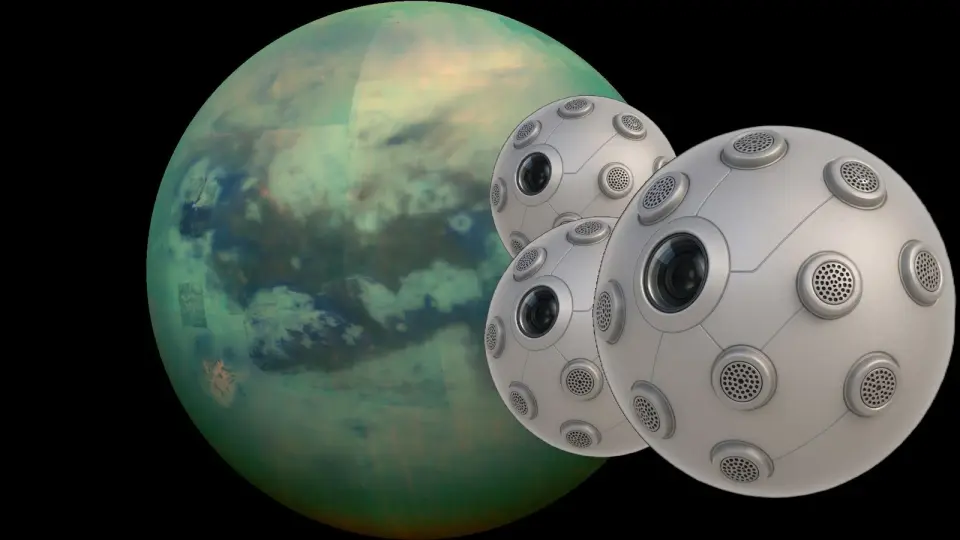
NASA has awarded a Phase 1 grant to Daniel Drew of the University of Hawaii to develop SPARK, a spherical flying robot designed to explore the cave systems of Saturn's moon Titan. The vehicle uses ion thrusters to navigate Titan's dense atmosphere and karst terrain, though it is unlikely to join the 2028 Dragonfly mission.
Key points
- NASA's Innovative Advanced Concepts program funded a nine-month Phase 1 grant for the SPARK project.
- SPARK stands for Solid-state Propulsion for Autonomous Reconnaissance of Karst.
- The aerobots are spherical and use electric ion thrusters for flight in Titan's atmosphere.
- Titan features hydrocarbon lakes and underground sinkholes that are difficult for rovers to traverse.
- Project lead Daniel Drew notes the technology is not yet ready for the 2028 Dragonfly launch.
Background
Previous coverage highlighted Titan's potential as a resource-rich outpost due to its hydrocarbons and dense atmosphere. Earlier reports noted that while Titan's surface pressure allows for standing without a pressure suit, the extreme cold and lack of oxygen prevent human habitation. The Dragonfly mission, targeted for a 2028 launch and 2034 arrival, aims to study Titan's chemistry and assess its habitability potential.
Why it matters
Exploring Titan's caves could reveal subsurface geological and chemical processes inaccessible to surface rovers. Successful development of SPARK could provide a new method for autonomous reconnaissance in dense atmospheres, potentially supporting future missions if Dragonfly is delayed or if additional payloads are added.
What to watch
The SPARK project will undergo a nine-month Phase 1 grant, followed by a potential up-to-two-year Phase 2. Success in these phases is required before the technology becomes realistic for integration into future Titan missions, possibly if the Dragonfly timeline shifts.
Want the full story? Read the original reporting
Read on Space