Tag

Titan

All articles tagged with #titan

Atmosphere-specific heat shield behavior revealed for Venus and Titan entries
space18 days ago

Atmosphere-specific heat shield behavior revealed for Venus and Titan entries

UIUC researchers using a Plasmatron X wind tunnel found that heat-shield ablation depends on atmospheric composition: in oxygen-rich environments ablation erodes the surface steadily, but when oxygen is absent the process becomes unsteady with intermittent, sometimes violent particle bursts. This “breathing” behavior affects shield performance and has implications for future missions like Dragonfly to Titan, whose nitrogen–methane atmosphere differs from Earth’s.

Earth as Titan's classroom: how terrestrial analogs prep Dragonfly's mission
space-exploration23 days ago

Earth as Titan's classroom: how terrestrial analogs prep Dragonfly's mission

Earth hosts Titan-like processes—methane rain, hydrocarbon rivers, seas and Titan-inspired geomorphology—that scientists are using as terrestrial analogs to test instruments and hypotheses. A new arXiv paper argues that field analog research on Earth can ground-truth Titan studies and refine data interpretation ahead of NASA’s Dragonfly mission to Titan (targeting Selk Crater) in 2036, linking Earth geophysics to the exploration of Saturn’s moon.

Blizzard's Titan Disaster: How an Overambitious MMO Shaped Overwatch
technology25 days ago

Blizzard's Titan Disaster: How an Overambitious MMO Shaped Overwatch

Blizzard's Titan was an overly ambitious, one-server MMO that blended sim-like daily-life elements with action gameplay, but hubris and leadership clashes doomed the project. With an estimated $83 million spent, Titan was cancelled in 2013 after years of scope creep and internal push-pull; Jeff Kaplan says the failure was a multifaceted leadership mistake, and its remnants helped birth Overwatch and steer Blizzard's post‑Titan strategy.

NASA's Nuclear Dragonfly Set to Scout Titan
space25 days ago

NASA's Nuclear Dragonfly Set to Scout Titan

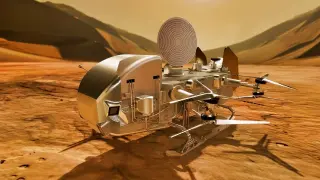
NASA is building Dragonfly, a nuclear-powered rotorcraft drone, to explore Saturn's moon Titan (launching on a SpaceX Falcon Heavy in 2028 with a 2034 arrival). Powered by a multi-mission RTG, it will fly through Titan's dense atmosphere to gather atmospheric, spectrometric, and seismic data, analyze chemical samples, and search for indicators of life, leveraging Titan's dunes and subsurface ocean in a mission costing about $3 billion.

NASA advances Dragonfly, a nuclear-powered Titan drone aimed for 2028
space-exploration29 days ago

NASA advances Dragonfly, a nuclear-powered Titan drone aimed for 2028

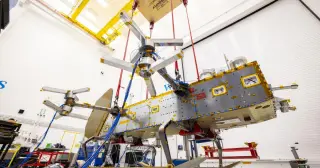
NASA has begun building and testing Dragonfly, a nuclear-powered rotorcraft that will explore Titan’s atmosphere and surface. After months of integration and power/instrument testing at the Johns Hopkins Applied Physics Laboratory, Dragonfly is on track for a 2028 launch aboard a SpaceX Falcon Heavy, with further system testing at Lockheed Martin and Kennedy Space Center to study Titan’s chemistry, geology and potential clues to life.

Detour: Titan-bound sci‑fi that prizes believability over flawless accuracy
entertainment1 month ago

Detour: Titan-bound sci‑fi that prizes believability over flawless accuracy

Space.com chats with Detour co-authors Jeff Rake and Rob Hart about crafting a mind‑bending sci‑fi tale: a Titan mission turns into a homecoming where Earth isn’t what the crew left behind, and the writers emphasize making big ideas feel believable rather than 100% technically correct. They discuss collaborating across TV and novels, near‑future tech with plausible physics, designing the ship with artificial gravity, and leaning into grounded family drama to humanize ambitious concepts. Detour is available now.

Ancient Moon Collision Reframes Titan and Saturn’s Rings
science1 month ago

Ancient Moon Collision Reframes Titan and Saturn’s Rings

A new study combining Cassini observations, arXiv simulations and planetary modeling suggests Titan formed after an ancient collision with a lost moon (proto-Hyperion, possibly Chrysalis) about 0.5 billion years ago. The merger could explain Titan’s drifting orbit, Saturn’s axial tilt, and the creation of Hyperion and Saturn’s rings, with Dragonfly’s upcoming Titan exploration offering a potential test of the theory.

A Cosmic Collision: Titan and a Lost Moon May Have Forged Saturn's Rings
science1 month ago

A Cosmic Collision: Titan and a Lost Moon May Have Forged Saturn's Rings

Scientists combining Titan formation ideas, Cassini data, and simulations propose that Titan collided with a lost proto-moon about 500 million years ago; the wreckage may have become Hyperion and also helped forge Saturn’s rings, while Titan’s altered mass could have nudged Saturn’s tilt and resonance with Neptune. Titan’s orbit is expanding, and NASA’s Dragonfly mission to Titan (launch 2028, arrival 2034) could test this scenario.

Dragonfly Mission Takes Flight to Titan
entertainment1 month ago

Dragonfly Mission Takes Flight to Titan

Space.com’s This Week In Space Episode 198 features Rod Pyle and Tariq Malik discussing NASA’s Dragonfly mission to Saturn’s moon Titan with principal investigator Dr. Elizabeth “Zibi” Turtle. The car-sized rotorcraft, slated for a 2028 launch and a 2034 arrival, will descend into Titan’s atmosphere and then fly across its hydrocarbon dunes and methane seas, stepping through its surface and atmospheric exploration plans.

Titan Collision May Have Scuplted Saturn’s Rings and Tilt
astronomy1 month ago

Titan Collision May Have Scuplted Saturn’s Rings and Tilt

Space.com reports Matija Ćuk and colleagues propose Saturn’s Titan may have formed from a collision/merger with a now-missing moon called Chrysalis about 100–200 million years ago. This upheaval could have widened Titan’s orbit, triggered further moon collisions, redistributed Saturn’s mass to alter its precession, and helped form Saturn’s rings. Hyperion might be a debris remnant from the event. Cassini data revised Saturn’s internal mass distribution, moving it slightly out of Neptune’s orbital resonance. There’s no direct evidence yet, but the scenario is being explored in Planetary Science Journal with an arXiv preprint, and future Dragonfly observations could test it.

Frozen HCN Crystals Could Have Fueled Life’s Origins
science2 months ago

Frozen HCN Crystals Could Have Fueled Life’s Origins

A study in ACS Central Science shows that frozen hydrogen cyanide forms needle-like crystal surfaces that generate strong electric fields and catalyze reactions, including HCN→HNC isomerization, at cryogenic temperatures. This surface catalysis could drive early prebiotic chemistry and help explain HNC’s abundance in cold space environments like Titan and comets, suggesting solid HCN crystals may have acted as tiny reaction engines in the origins of life.