
JPL Durability Tests Confirm SkyFall Helicopters' Flexible Radar Antennas Can Withstand 200 Mars Landings
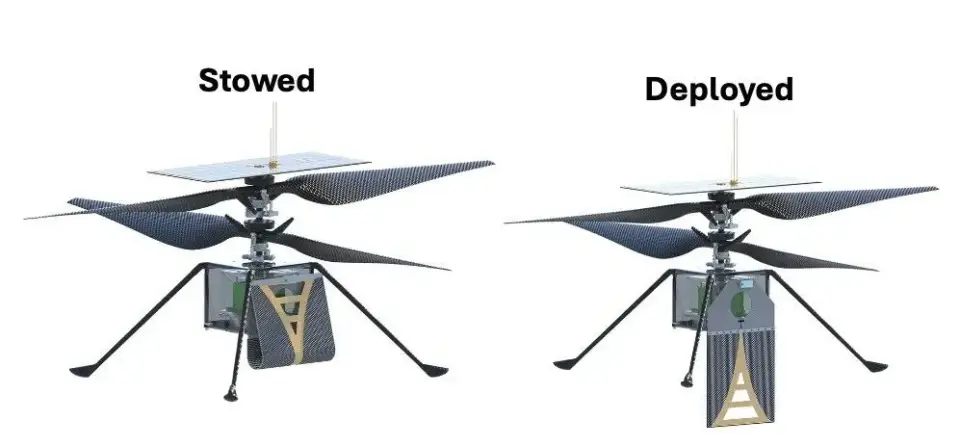
NASA’s Jet Propulsion Laboratory has successfully tested a flexible, fabric-based radar antenna for the SkyFall Mars mission. Designed to fold during landings and unfold for subsurface ice detection, the antenna survived 200 simulated impacts and thermal cycles, exceeding mission requirements. The three autonomous helicopters are scheduled for launch in late 2028 aboard the nuclear-powered Space Reactor-1 spacecraft.
Key points
- JPL engineers tested a downscaled Vivaldi antenna design made from polyester and Vectran, materials also used in Mars rover landing airbags.
- The antenna is designed to fold flat during landing to avoid ground impact, then return to its operational shape for radar scans.
- Testing confirmed the antenna can withstand 200 landings, double the number required for the primary mission, without signal degradation.
- The SkyFall mission involves three autonomous helicopters (one large, two small) capable of independent data transmission to orbiters, unlike Ingenuity which required a rover relay.
- The mission is scheduled for launch in late 2028 aboard the Space Reactor-1 Freedom spacecraft, with Mars arrival expected in fall 2030.
Background
SkyFall builds on the legacy of Ingenuity, which completed 72 flights before ending in 2024. Previous coverage noted that NASA awarded Firefly Aerospace a $13 million contract for the mission's aeroshell and estimated the total Space Reactor-1 cost at $2.1 billion. The mission aims to locate shallow subsurface ice, which is critical for future human exploration.
How outlets are covering it
While all sources agree on the antenna's success, they emphasize different aspects. Hackaday focuses on the engineering challenge of folding the antenna to fit within the helicopter's 15-centimeter ground clearance. Popular Science highlights the visual concept of the helicopters scanning the surface and the independent data transmission capability. Aviation Week notes the specific launch window of December 2028 and the use of a fission reactor. Universe Space Tech provides technical details on the radar frequency range (500-2,500 MHz) and the specific materials used, noting that dry Martian regolith allows for smaller antenna sizes compared to Earth soil.
Why it matters
The success of the flexible antenna is a critical milestone for SkyFall, enabling the detection of shallow ice deposits that orbital satellites cannot see. This capability is essential for identifying potential landing sites and resources for future crewed missions to Mars.
What to watch
JPL is now building an engineering model for vibration testing and simulated Martian environment tests, including at the Mars Yard. Full flight certification is pending, with the mission launch targeted for late 2028.
- NASA Tests Featherweight Radar Antenna For SkyFall Mars Helicopters Hackaday
- We just got a glimpse at what NASA’s Skyfall helicopters will look like in action Popular Science
- NASA's SkyFall Mars helicopters will feature a revolutionary antenna design Phys.org
- NASA Zeros In On Flexible Radar Antennas For Mars SkyFall Mission Aviation Week
- SkyFall will search for ice beneath the surface of Mars Universe Space Tech
Want the full story? Read the original reporting
Read on Hackaday