
UAE Unveils Autonomous Lander for 2028 Asteroid Belt Mission
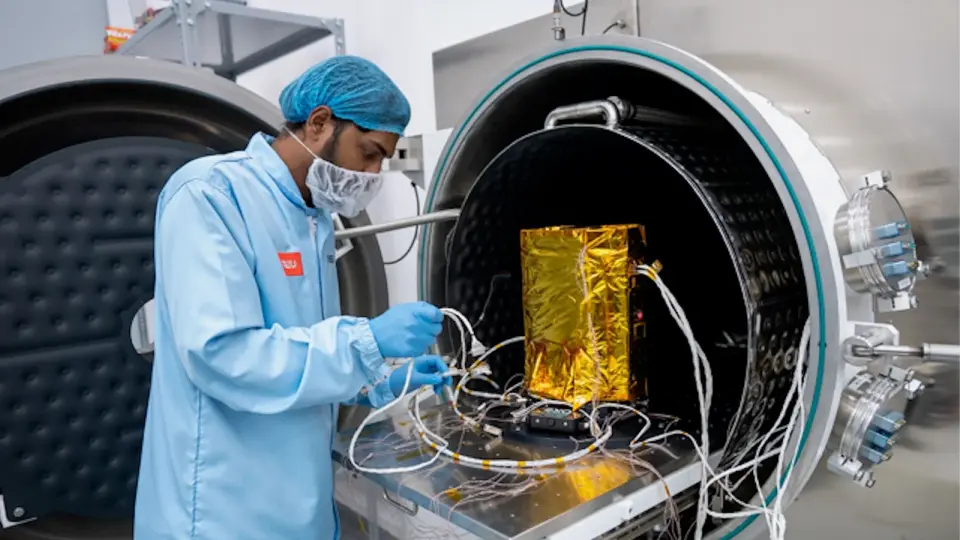
The UAE has completed development of a 10-kilogram autonomous lander for its second interplanetary mission, the Emirates Mission to the Asteroid Belt (EMA). Scheduled to launch from Japan in March 2028, the mission will travel 5 billion kilometers over eight years to study seven asteroids, culminating in a surface landing on 269 Justitia in 2036. The probe, built entirely in Abu Dhabi, will operate without ground commands to analyze the red asteroid's composition, offering insights into the early Solar System.
Key points
- The Technology Innovation Institute (TII) unveiled a half-scale model of the lander in Abu Dhabi on October 1, 2026, with the flight-ready unit now in a vacuum chamber.
- The lander will be transported to Colorado, USA, to integrate with the MBR Explorer spacecraft, which is named after Sheikh Mohammed bin Rashid al-Maktoum.
- The mission involves high-speed flybys of six asteroids, including 10253 Westerwald and 623 Chimaera, before orbiting 269 Justitia.
- The probe will separate from the main spacecraft in early 2036 to land on 269 Justitia, making it the seventh asteroid ever reached by a probe.
- The lander features two cameras and an autonomous digital processing unit to select images and manage power without Earth commands.
Background
This mission follows the UAE's Hope Mars orbiter, which has been studying Mars since 2021. Unlike the Hope mission, which relied on international partners for components, the EMA lander was designed, built, and tested entirely within the UAE by TII, the UAE Space Agency, and local universities. This marks a significant step in the country's push for sovereign space technology, supported by a recent AED1 billion International Space Cooperation Program approved in May 2026.
How outlets are covering it
Space.com emphasizes the ambitious nature of the 7-asteroid journey and the 'exploration' aspect of the unknown. The Abu Dhabi Media Office highlights the technical achievement of building the probe domestically and the autonomous capabilities of the lander. UA.NEWS focuses on the scientific implications of 269 Justitia's red color, suggesting it may have originated in the Kuiper Belt, and notes the educational impact of the UAE's space program on STEM enrollment. All sources agree on the March 2028 launch date and the 2036 landing target, but differ in emphasis: Space.com on the journey's scale, Abu Dhabi on engineering sovereignty, and UA.NEWS on the scientific value of the asteroid's origin.
Why it matters
The EMA mission represents a major milestone for the UAE, demonstrating its ability to develop complex, autonomous space technology independently. The landing on 269 Justitia could provide crucial data on the distribution of water and volatiles in the early Solar System, as the asteroid's composition resembles objects from the outer Solar System. This mission also underscores the growing role of non-traditional spacefaring nations in deep-space exploration and the increasing importance of autonomous systems in long-duration missions.
What to watch
The lander will be shipped to Colorado for integration with the MBR Explorer spacecraft. The mission is scheduled to launch from Japan in March 2028 within a narrow three-week window. The spacecraft will use gravity assists from Venus, Earth, and Mars to reach its targets, with the lander deploying in early 2036 to make contact with 269 Justitia's surface.
Want the full story? Read the original reporting
Read on Space