
"Unveiling the Mysteries of Space: LISA Mission to Explore Gravitational Waves and Venus"
TL;DR
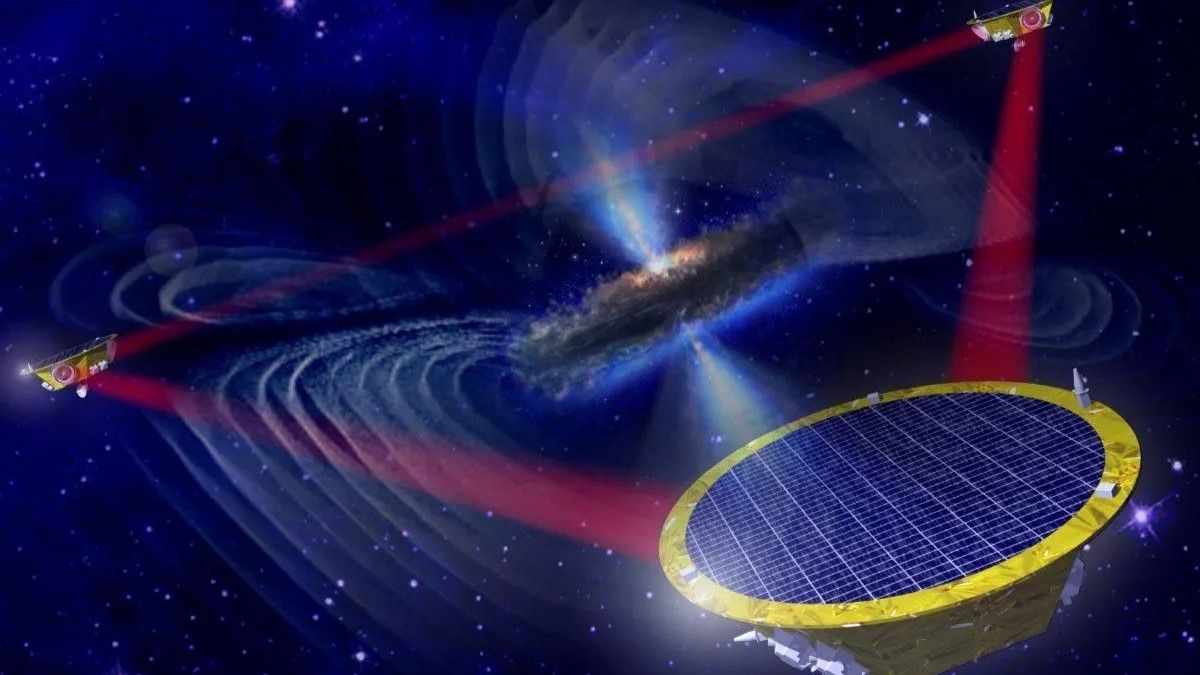
The European Space Agency and NASA have approved the LISA project, a space-based gravitational wave detector that will consist of three spacecraft forming a triangle of laser light to detect distortions in space caused by cosmic collisions. LISA's million-fold increase in scale will enable it to detect lower-frequency gravitational waves, providing advanced warning of collisions and probing events from the epoch of cosmic dawn. The detector, set to be launched in 2035, will open a new window to some of cosmology's biggest questions.
Topics:sciencespace-exploration#european-space-agency#gravitational-waves#lisa#nasa#space-exploration#space-time-ripples
- Europe approves LISA, a next-generation space mission that will discover the faintest ripples in space-time Livescience.com
- 'Sci-fi instrument' will hunt for giant gravitational waves in space Nature.com
- Why isn’t Venus like Earth? New space mission aims to find out CNN
- Capturing the ripples of spacetime: LISA gets go-ahead European Space Agency
- LIGO goes to space: ESA to proceed with LISA gravitational wave detector Ars Technica
Want the full story? Read the original reporting
Read on Livescience.com